Apple (NASDAQ: AAPL) and OpenAI, the ChatGPT developer, filed competing briefs in the same trade-secret case on Monday. On the fact that matters most they converge: Apple alleges a departed engineer kept reaching its cloud storage months after leaving, and OpenAI's reply explains the access rather than denying it.
Apple calls it theft, and says evidence is being destroyed. OpenAI calls it a courtesy to former colleagues, made possible by Apple's own exit procedures. The wire coverage led on the accusation. The gap between the two briefs is the more useful thing.
What Monday's filings actually said
The case is Apple Inc. v. Liu, docket 5:26-cv-07078, in the U.S. District Court for the Northern District of California, San Jose Division, according to the court docket. Apple brought it under the Defend Trade Secrets Act, the federal statute that lets companies sue in federal court over stolen confidential information.
Defendants include OpenAI, its hardware unit io Products — the group built around former Apple design chief Jony Ive — and two ex-Apple staff. They are Chang Liu, a former senior electrical engineer who joined OpenAI in January, and Tang Yew Tan, a former vice president of product design. The complaint landed on July 10. Monday's Apple brief supports a motion for expedited discovery. That is an order letting a party gather evidence faster than the normal pretrial calendar allows.
Apple told the court that OpenAI produced a MacBook Liu had kept, and did so only after weeks of delay. "The MacBook represents the very limited information Defendants provided so far (and only after weeks of delay), and shows Apple is not conducting 'fishing expeditions' but that its trade secrets are being used and evidence is being destroyed," Apple's lawyers wrote, per Bloomberg's account of the filing.
The specific claim about the device is narrow. Liu downloaded a confidential Apple circuit schematic, loaded it into LTspice — a widely used circuit-simulation program — and set an AI agent to run simulations on it, according to Gizmodo's review of the brief. Apple further alleges that in June, after Liu learned of the investigation, he discussed erasing forensic data with an OpenAI colleague, Yu-Ting Peng.
Why it matters: the argument in the brief that is genuinely new
One line in Apple's filing is doing more work than the headlines suggest. "Where trade secret information is fed into an AI agent or model that 'learns' from it, such 'learning' may create irreversible and continually propagating uses of the trade secret," Apple's lawyers wrote, as quoted by Gizmodo.
Read what that asks the court to accept. In an ordinary trade-secret case the remedy is containment. Return the files, delete the copies, wall off the people who saw them. Apple is arguing that containment may not exist here, because a model that absorbed the material has nothing clean to hand back.
That is a large ask, and it is also the clearest reason Apple wants speed rather than a normal schedule. On Apple's own account, every week of routine discovery is another week in which the contamination spreads and becomes harder to undo.
The reach of that argument goes past this docket. Confidential material now moves through AI tools at many large employers, often with no clean record of where it ends up. If a judge accepts that feeding a secret into a model is a permanent and spreading use, the usual cleanup stops being enough. Deleting a file is straightforward. Whether a model can be made to forget one is the harder question this brief puts in front of the court.
The 400 number, run in both directions
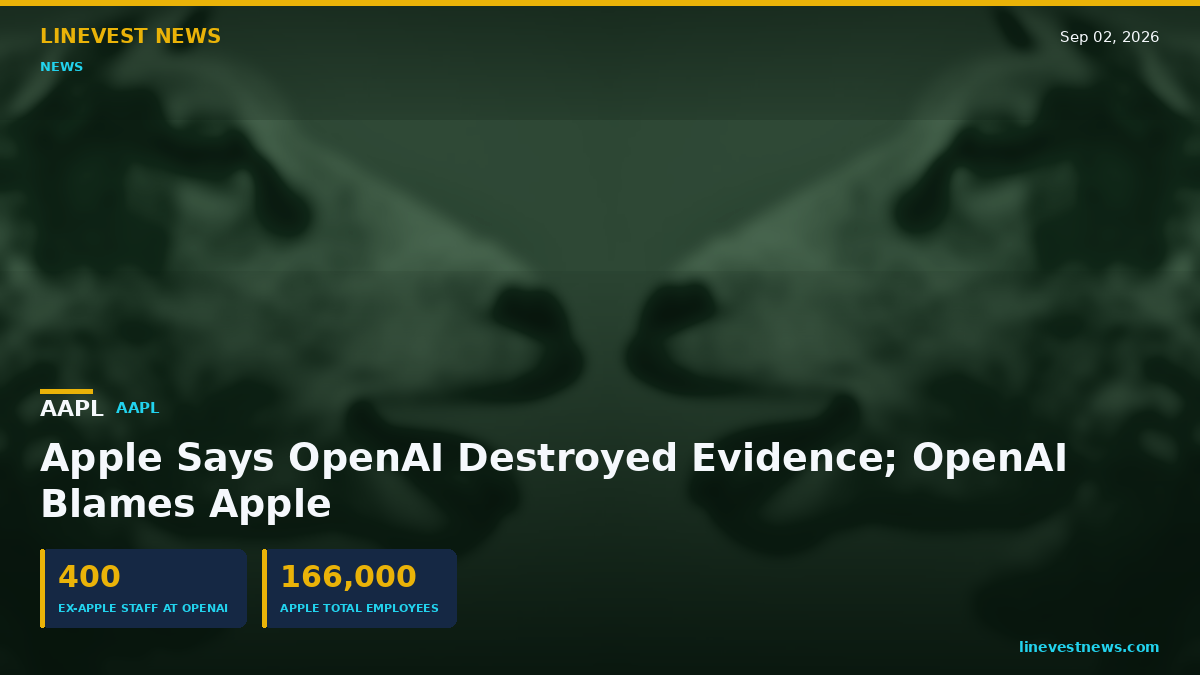
Both sides cite the same headcount figure and reach opposite conclusions. Apple's July complaint reads: "With over four hundred former Apple employees now working at OpenAI, it is not surprising that certain OpenAI personnel have knowledge of Apple's confidential and proprietary information." OpenAI's reply, per MacRumors: "Apple cannot stop the next 400 employees from leaving by filing baseless lawsuits."
Scale that figure against each employer and it reads two different ways. Apple reported roughly 164,000 full-time equivalent employees in its fiscal 2025 annual report on Form 10-K. At least four hundred people amounts to at least 0.24% of that payroll.
At OpenAI the same group looks entirely different. Revelio Labs, a workforce-data firm that estimates headcount from public professional records, put OpenAI at about 7,800 staff in March 2026. On that base, the ex-Apple cohort is at least one in twenty of the company.
That asymmetry explains the temperature of the filings better than any quote in them. The talent flow costs Apple little in staffing terms. It is close to load-bearing for the hardware program OpenAI is trying to stand up. Each company is arguing about a group that means something very different on its own books.
OpenAI is not really arguing about Liu
OpenAI's Monday brief calls the dispute "a mess of Apple's own making." Per MacRumors' account of the brief, OpenAI's position on Liu is that he kept access only to help former colleagues who asked. That is an explanation of the access, not a denial of it. The rest of the brief argues Apple made that access easy.
The brief offers two specifics, both about Apple's internal practice. OpenAI told the court that Apple "encourages staff to use personal iCloud accounts for work," which blurs the line between company and personal data once someone leaves. It also said Apple's habit of "immediately escorting departing employees off site leaves too little time" to return devices and files properly.
OpenAI adds that Tan returned prototypes before his exit. In an earlier motion to dismiss filed Aug. 7, OpenAI wrote that Apple's complaint is, "to borrow its own phrase — 'rotten to its core.'"
What has changed since our last piece on this case
LineVest reported on Aug. 5 that Apple was seeking a preliminary injunction and expedited discovery, and that OpenAI's public answer was a blog post calling the suit "careless, aggressive and oddly personal." Four weeks later the answer is a court brief attacking Apple's own data controls. The argument has moved from tone to procedure. That is a harder line for Apple to rebut, because the underlying facts about iCloud practice and offboarding are Apple's to explain.
One framing in that August piece also needs updating. We described OpenAI as both defendant and key AI supplier, on the basis that Apple Intelligence routed difficult Siri queries to ChatGPT. Since January, Google's Gemini has powered the rebuilt Siri, with ChatGPT pushed into a secondary role. Bloomberg reported the multi-year agreement at roughly $1 billion a year, a figure CNBC also covered on Jan. 12. Apple has more room to fight this than that description implied.
What these cases have historically cost
The precedent most often cited is Waymo v. Uber. Waymo, Alphabet's self-driving unit, sued in 2017 over an engineer who left with thousands of internal files. The case settled in February 2018, five days into trial.
Under terms reported at the time, Uber paid 0.34% of its equity, then valued at about $245 million, and accepted an outside monitor plus a ban on using Waymo material. What the settlement did not do was stop Uber's self-driving program. The remedy was money and a wall, not a shutdown. Anthony Levandowski, the engineer at the center of it, was later sentenced to 18 months in prison for stealing trade secrets.
That single case is not a statistical base rate, but it is the reference point both sides will work from. Trade-secret fights between well-funded rivals have tended to end in a payment and a compliance regime rather than a discontinued product line. Apple's model-learning theory is an attempt to argue that this case belongs in a different category. Whether it lands is what the October hearing starts to settle.
The market's answer so far
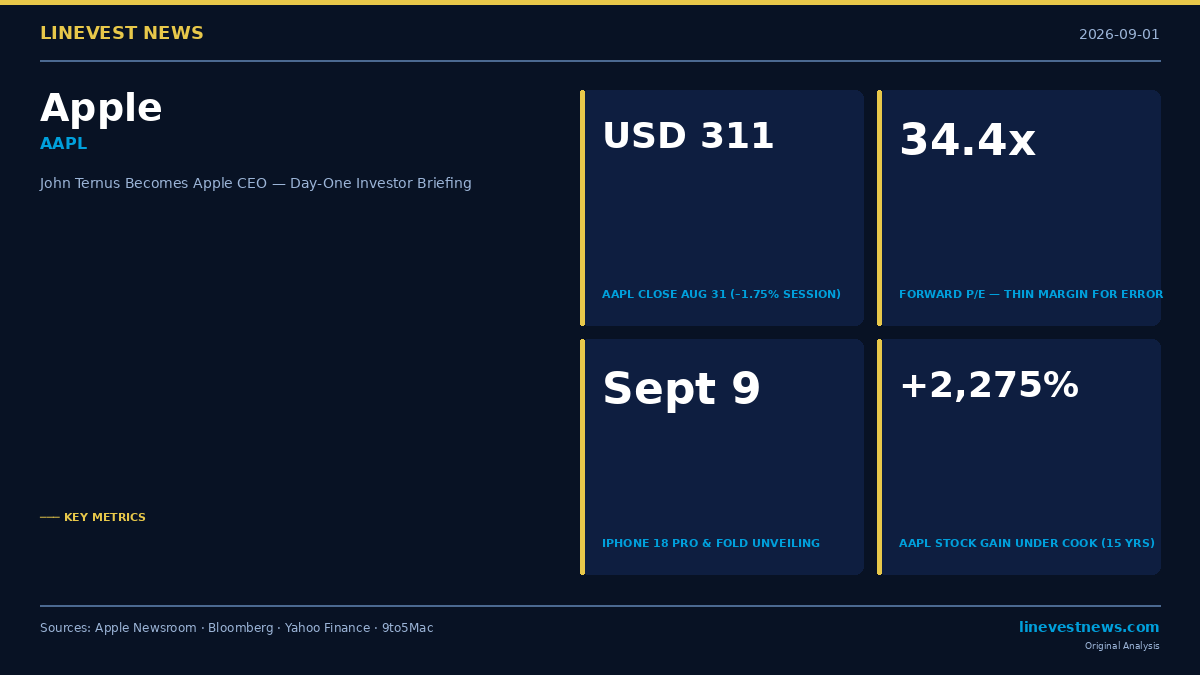
Apple shares closed at $325.13 on Tuesday, up 2.61%, with a market value near $4.75 trillion, according to Yahoo Finance. Tuesday was also John Ternus's first day as chief executive, a day after the competing briefs were filed. It fell eight days before Apple's Sept. 9 product event.
Attributing the day's move to a court filing would be guesswork, and this piece will not do it. A narrower statement holds. Nothing disclosed in either brief is sized to register against a company of this scale, and the shares showed no sign of stress.
The Waymo comparison makes the point arithmetically. That entire settlement, roughly $245 million, would equal about 0.0052% of Apple's current market value. A win on those terms would not change a line of Apple's income statement. The stakes here are strategic — who gets to build AI hardware, and with whose accumulated knowledge — not near-term earnings for either side.
The date that decides it, and what would make this reading wrong
Mark Oct. 1. A judge in San Jose hears argument that day on Apple's motions for expedited discovery and a preliminary injunction, per Bloomberg. Two questions get answered in practice. Whether Apple gets the accelerated discovery it says it needs, and whether the court is willing to treat a model's "learning" as an irreversible use.
Here is the case against the reading above. Apple's evidence-destruction claim — spoliation, in the court's vocabulary — rests on two things: one laptop the defense itself produced, and an alleged June conversation about erasing forensic data. Neither is a finding, and the laptop came from the other side. If the court denies expedited discovery on Oct. 1, this week's filings look less like a case building toward a remedy and more like pretrial positioning. OpenAI will make exactly that argument, and one produced MacBook is a thin foundation for an injunction that would reach an entire hardware program.