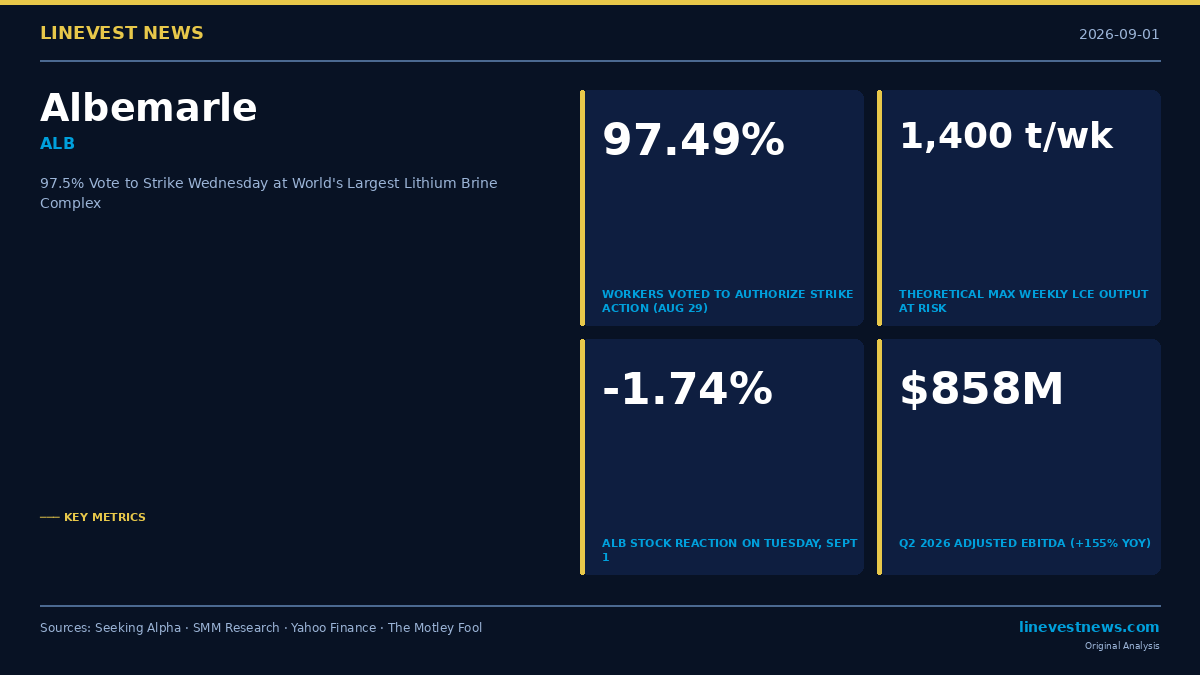
TL;DR - Albemarle Chile workers voted 97.49% in favor of strike action on August 29; walkout set for Wednesday, September 2, 2026 - At-risk output: up to 1,400 tons LCE/week (theoretical max) from the Salar de Atacama — equivalent to ~2% of Albemarle's full-year 2026 guidance of 70,700 tons LCE - ALB stock fell 1.74% to $134.97 on Tuesday; analyst average price target stands at $172.56 (+28% upside) - Albemarle Q2 2026 just posted its strongest recovery in years: revenue $1.74B (+31%), adjusted EBITDA $858M (+155%), EPS $3.75 vs $0.11 a year ago - 2021 precedent: A strike at the same Atacama facility lasted 35 days before a negotiated settlement — supply disruption risk is real but historically bounded - Lithium demand grew +45% through May 2026 YoY; SQM expects spot lithium carbonate to hold $15–$18/kg in 2026
Part A — What Happened
On Friday, August 29, workers at Albemarle Corporation's (NYSE: ALB) lithium operations in Chile's Salar de Atacama cast their ballots: 97.49% voted to authorize a strike, according to union disclosures cited by SMM Research. Under Chilean labor law, if no mandatory mediation is requested by either party, the walkout can begin as early as 8:00 a.m. local time on Wednesday, September 2, 2026.
The vote follows a breakdown in collective bargaining talks between the union and Albemarle's Chilean subsidiary, which operates the brine extraction fields at the Atacama Salt Flat and the downstream La Negra processing facility — the two pillars of what is widely regarded as the world's lowest-cost lithium-producing complex.
Production at Stake
Albemarle's Atacama operation carries a nominal capacity of 84,000 tons LCE/year, though the company guided FY2026 output at 70,700 tons LCE as of its Q2 earnings call on August 13. That translates to an implied daily run-rate of 190–230 tons LCE per day, or roughly 1,330–1,610 tons LCE per week.
SMM Research estimates a theoretical maximum loss of approximately 1,400 tons LCE per week if the strike proceeds unimpeded. Stretched to a full month, total foregone production could approach ~6,200 tons LCE — about 8.8% of the annual 2026 guidance and more than what many mid-tier lithium miners produce in a quarter.
| Scenario | Tons LCE Lost | Share of FY2026 Guidance |
|---|---|---|
| 1-week work stoppage | ~1,400 | ~2.0% |
| 2-week stoppage | ~2,900 | ~4.1% |
| 1-month stoppage | ~6,200 | ~8.8% |
Source: SMM Research analysis. Figures are theoretical maximums assuming full operational halt.
Part B — Investment Analysis
Why This Matters Now — Timing Is the Key Variable
A labor dispute at any point in Albemarle's recent history would have registered differently. Six months ago, ALB stock traded near three-year lows with lithium spot prices wallowing below $10/kg. Today the picture has changed dramatically: global lithium demand grew 45% through May 2026 compared to a year earlier (per industry data), Albemarle itself posted a 155% jump in adjusted EBITDA in Q2, and Chile's SQM — the only other comparable producer operating at Atacama — has guided its key lithium customers to expect prices of $15–$18/kg for 2026, occasionally spiking to $20/kg.
In other words, the company is emerging from a brutal two-year downcycle just as a supply disruption risk has materialized. The market timing amplifies the headline risk.
The 2021 Precedent: 35 Days and a Settlement
This is not Albemarle's first Atacama strike. In 2021, workers at the same facility walked off the job, and the dispute ran for 35 days before the company and union reached a negotiated agreement. That episode demonstrated two things investors should hold in mind:
- Disruption is real: A 35-day halt at today's run-rates would remove approximately 7,000–8,000 tons LCE from global supply — a non-trivial figure for a market where spot prices can move $2–$3/kg on tighter-than-expected data.
- Resolution is achievable: The 2021 precedent ended without permanent damage to the facility, the union relationship, or Albemarle's long-term Chile position.
The company has also been investing in technology to reduce labor intensity over time. In Q2 2026, Albemarle disclosed that it submitted an environmental permit in March 2026 for its Direct Lithium Extraction (DLE) pilot plant at Atacama, which in testing achieved recovery rates above 90% — compared to the 50–60% yields of conventional brine evaporation. DLE technology would eventually reduce dependence on labor-intensive pond operations, but that transition is measured in years, not quarters.
Stock and Analyst Picture
Albemarle shares fell 1.74% to $134.97 on Tuesday as news of the vote circulated. The stock's one-year return remains strong at +61%, driven by the lithium price recovery that pushed Q2 net income to $480 million (vs. $22.9 million in Q2 2025). However, the stock trades well below the average analyst price target of $172.56, with 12-month estimates ranging from $83 to $225.
JPMorgan, one of the more cautious voices, recently trimmed its price target from $160 to $140 — still above the current price — citing uncertainty about the medium-term lithium supply-demand balance. The Chile strike adds a new variable to that uncertainty calculus.
| Metric | Value |
|---|---|
| Current Price (Sept 1) | $134.97 |
| 1-Day Change | -1.74% |
| 52-Week Range | $71.25 – $221.00 |
| Market Cap | $15.93B |
| Avg Analyst PT | $172.56 |
| JPMorgan PT | $140 |
| Q2 2026 Revenue | $1.74B (+31% YoY) |
| Q2 2026 Adj. EBITDA | $858M (+155% YoY) |
| Q2 2026 Adj. EPS | $3.75 (vs $0.11) |
Two-Stage Market Reaction Framework
SMM Research frames the likely market response in two stages:
- Probability pricing (now through strike resolution): Lithium carbonate spot prices may rise modestly as traders price in the risk premium of a potential supply gap. This effect is relatively limited — it reflects expected value, not realized disruption.
- Volume pricing (if the strike extends): If the stoppage runs beyond 1–2 weeks, actual tons-out-of-market data will begin to re-shape the medium-term supply/demand balance more meaningfully.
The two-stage framework suggests that investors monitoring ALB or the broader lithium space (SQM, LTHM, LIVENT equivalents) should focus on how quickly Albemarle and the union signal progress toward mediation as the most actionable leading indicator.
What Investors Should Watch
- Mandatory mediation: Either party can request Chilean government mediation, which would delay or prevent the September 2 start date. No such request had been publicly disclosed as of Tuesday.
- Strike duration vs. 2021: If talks stall past the two-week mark, the volume-pricing stage becomes more likely to affect near-term lithium carbonate spot prices.
- SQM capacity slack: Chile's SQM operates adjacent Atacama brine fields with its own capacity. Some market participants may watch for opportunistic SQM volume increases, though these are typically constrained by processing bottlenecks.
- Albemarle's DLE timeline: Management has said the DLE environmental process could clear regulatory review in 2026–2027. A successful early agreement today would likely have no bearing on that timeline.
Sources: Seeking Alpha (August 31, 2026); SMM Research / Metal.com analysis; Yahoo Finance / ALB quote (September 1, 2026); Albemarle Q2 2026 earnings call transcript (August 13, 2026) via The Motley Fool; IndustriALL Global Union (2021 strike record); SQM lithium price guidance via Mining.com / TradingView.
This article is for informational purposes only and does not constitute investment advice. LineVest is not a registered investment advisor.