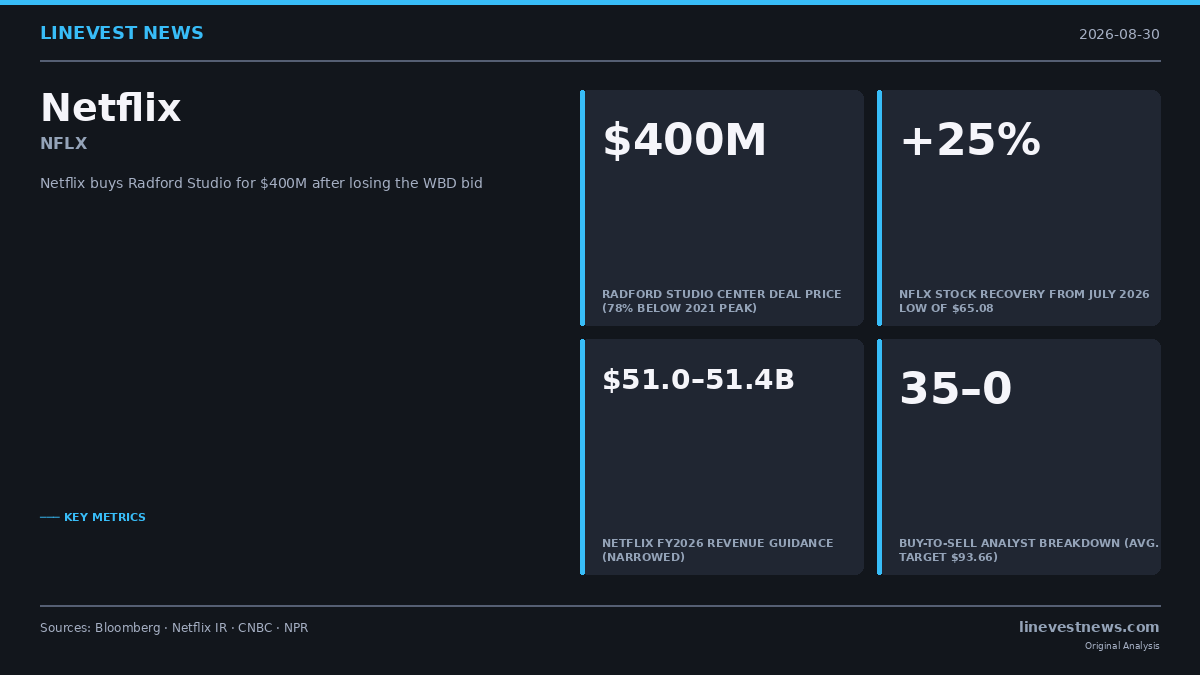
TL;DR - Netflix stock has recovered 25% from its July 2026 low of $65.08, trading around $81.72, though still down ~35% from its $126.71 peak - The $400M Radford Studio Center acquisition is expected to close in Q3 2026 — a bargain buy at 78% below the 2021 price of $1.85B - Netflix received an estimated $2.8 billion termination fee after WBD chose Paramount's superior bid over Netflix's $82.7B enterprise-value offer - Netflix is exploring streaming aggregation — hosting rivals like Peacock and Fox One — signaling a YouTube/Roku-style platform pivot - Analyst consensus: 35 Buy / 16 Hold / 0 Sell; average 12-month price target $93.66 (roughly 15% above current levels)
Part A: The Deals That Define Netflix's 2026
In December 2025, Netflix made headlines with a proposal to acquire Warner Bros. Discovery (WBD) at $27.75 per share, implying an equity value of roughly $72 billion and a total enterprise value of approximately $82.7 billion (net of the planned spin-off of WBD's legacy cable networks into a new entity called Discovery Global). The deal would have combined two of the world's largest content libraries under a single streaming platform.
In March 2026, WBD's board switched allegiances. Paramount Global, backed by Skydance Media, launched an all-cash bid of $31 per WBD share — valuing the total deal, including debt, at roughly $111 billion. Netflix declined to match Paramount's higher offer. The U.S. Department of Justice's antitrust scrutiny of the Netflix-WBD combination also weighed on the outcome: regulators warned that a merged Netflix-WBD would hold "monopsony power" over creative talent and dominate downstream subscription markets.
Netflix withdrew from the bidding. Under the original merger agreement, Netflix reportedly collected a termination fee in the range of $2.8 billion — exactly seven times the price of the Radford Studio acquisition it would announce three months later.
Paramount's acquisition of WBD won DOJ clearance in June 2026. But a coalition of 12 state attorneys general sued to block the deal in July 2026, obtaining a temporary restraining order. That litigation remains pending as of August 2026.
Radford Studio Center: Infrastructure Over IP
With the WBD chapter closed, Netflix pivoted quickly. In June 2026, Bloomberg reported that Netflix had signed a contract to purchase Radford Studio Center — a historic Hollywood lot in Studio City, Los Angeles — for approximately $400 million.
That price represents a 78% discount to the $1.85 billion Hackman Capital Partners paid just five years earlier in 2021. Hackman defaulted on $1.1 billion in bondholder debt; lenders led by Goldman Sachs repossessed the property. The Netflix deal is expected to close in Q3 2026.
| Metric | Detail |
|---|---|
| Acquisition price | ~$400 million |
| Prior sale price (2021) | $1.85 billion |
| Discount to prior sale | ~78% |
| Soundstages | 22 |
| Production office space | ~484,000 sq ft |
| Backlots | 3 |
| Current occupancy | ~71% leased |
| Location | Studio City, Los Angeles |
| Expected close | Q3 2026 |
The property has hosted legendary productions including Gunsmoke, Gilligan's Island, and Seinfeld. For Netflix, it would become the first wholly owned major studio campus in Los Angeles — the city where the bulk of its creative talent resides. Netflix's existing LA footprint largely consists of leases from Hudson Pacific Properties set to expire in 2031.
The Radford deal complements Netflix's $1 billion Fort Monmouth campus development in New Jersey, signaling a structural shift toward owned production infrastructure rather than third-party leases.
Part B: What This Means for NFLX Investors
The Strategic Logic
The debate over whether Netflix should be a pure-play streamer or a vertically integrated media giant has intensified in 2026. By acquiring Radford rather than WBD, Netflix chose scale-efficient infrastructure over expensive content libraries.
The math illustrates the contrast: Netflix's estimated $2.8 billion termination fee alone covers the Radford purchase exactly seven times over. The company did not dilute shareholders to fund a debt-laden mega-deal. Instead, it bought a production asset at a deep discount and retained balance-sheet flexibility.
In parallel, Netflix is exploring an even bolder strategic move: positioning itself as a streaming aggregator. Bloomberg and others have reported that Netflix is evaluating whether to host rival services — including Comcast's Peacock and Fox One — on its platform. This would mimic the model pioneered by Amazon's Prime Video Channels and challenge YouTube and Roku as the go-to destination for video content.
If successful, the aggregation play would transform Netflix from a subscription platform into a recurring-revenue distribution layer — potentially adding high-margin affiliate fees without requiring incremental content investment.
Q2 2026 Financials: Beat on EPS, Miss on Revenue
Netflix's Q2 2026 results (reported July 16) landed in a mixed but broadly in-line zone:
| Metric | Q2 2026 Actual | Estimate | YoY Growth |
|---|---|---|---|
| Revenue | $12.56B | $12.58B | +13% |
| Operating income | $4.19B | — | — |
| Operating margin | 33.4% | — | — |
| Diluted EPS | $0.80 | $0.79 | — |
On a reported basis, Latin America led regional growth at +21% year over year; Asia-Pacific was the strongest on an F/X-neutral basis at +18%, compared with LatAm's +16% F/X-neutral. The U.S. and Canada gained a more modest 10%. Netflix discontinued subscriber reporting after Q1 2026, focusing investors instead on revenue and margin as the key KPIs.
For the full year, management narrowed guidance to $51.0–$51.4 billion, from a prior range of $50.7–$51.7 billion. The ad-supported tier's revenue is expected to roughly double to ~$3 billion in 2026, adding a fast-growing, high-margin revenue stream.
The stock hit a 52-week low of $65.08 in mid-July — immediately after the Q2 report — on investor concern about the lower Q3 revenue outlook. Since then, shares have recovered approximately 25% to the $81–82 range.
Valuation and Analyst Consensus
At $81.72 per share:
| Valuation Metric | Current |
|---|---|
| 52-week range | $65.08 – $126.71 |
| Distance from 52-week high | –35.5% |
| YTD return | –34% |
| Forward P/E | ~22.6x |
| Avg. analyst 12-month target | $93.66 |
| Analyst breakdown | 35 Buy / 16 Hold / 0 Sell |
Wolfe Research raised its price target to $95 (Outperform) in late August 2026. The absence of any Sell ratings from the 51 analysts covering the stock is notable against a backdrop of macro uncertainty and a stock still materially below its 52-week high.
Key Risks
Investors weighing NFLX at current levels should monitor:
- Q3 revenue guidance: Management's lower Q3 outlook contributed to the July sell-off. A miss on Q3 revenue or margin would test the recovery.
- Radford integration: Studio real estate assets require capital investment to fully utilize — occupancy at 71% suggests meaningful upside but also execution risk.
- Aggregation deal execution: Hosting rival streamers brings revenue but introduces content conflict with Netflix's own shows and potential margin pressure.
- Paramount-WBD litigation: While Netflix is no longer a party, the ongoing 12-state AG lawsuit against Paramount's WBD acquisition creates industry uncertainty. If the deal collapses, WBD's assets could return to the market — though Netflix's appetite for another mega-deal appears limited.
- Subscriber opacity: Without quarterly subscriber figures, investors must rely on revenue as a growth proxy. Any deceleration could amplify market reaction.
Bottom Line
Netflix's 2026 playbook has evolved from "buy everything" to "buy smart." The Radford Studio deal is a textbook opportunistic acquisition — a distressed seller, a well-understood asset, and a price that reflects infrastructure value rather than hype. Combined with an ad tier on track for ~$3 billion annually and a potential aggregation business in development, the Netflix investment case at roughly 23x forward earnings looks more balanced than it did at the September 2025 peak.
The 35-to-0 Buy-to-Sell ratio among analysts, and an average target implying ~15% upside from current levels, suggests Wall Street is beginning to see the same.
This article is for informational purposes only and does not constitute investment advice. LineVest is not a registered investment advisor. Past performance does not guarantee future results.
Sources: - Netflix IR: Netflix Amends WBD Agreement to All-Cash (prior to Paramount's superior offer) - Bloomberg: Netflix Under Contract to Buy Radford Studio Center - Motley Fool: Netflix Finally Makes an Acquisition Wall Street Likes - CNBC: Netflix Q2 2026 Earnings - NPR: Paramount Outbids Netflix to Acquire Warner Bros. Discovery - Edgen: Netflix Buys Radford Studio Center for $400 Million, 78% Below Peak