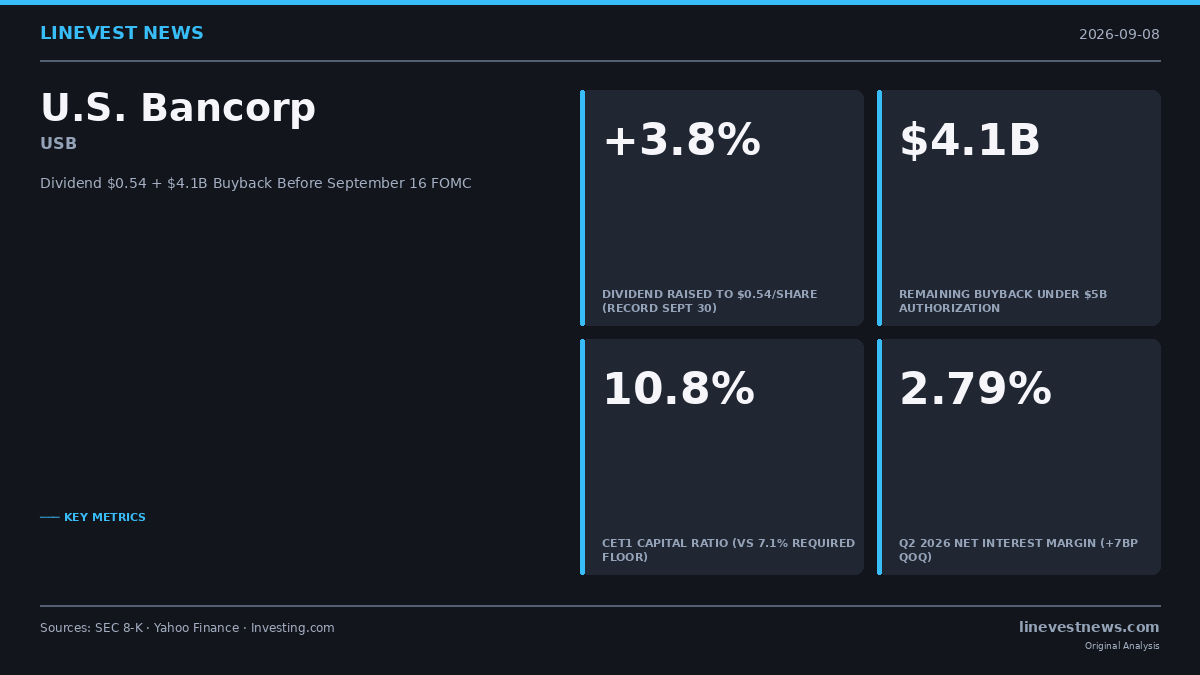
TL;DR - U.S. Bancorp (NYSE: USB) raised its quarterly dividend 3.8% to $0.54 per share; record date September 30, payable October 15, 2026 — the bank's 15th consecutive annual dividend increase. - $4.1 billion of remaining capacity under the existing $5 billion share-repurchase authorization (per Q1 2026 disclosures). - CET1 capital ratio: 10.8% (Q2 2026), versus the Fed-mandated floor of 7.1% (4.5% Basel III minimum + 2.6% Stress Capital Buffer, effective October 1, 2026 through September 30, 2027). - Q2 2026: Record net revenue $7.7B (+10.1% YoY), EPS $1.35 (+22% YoY), NIM 2.79%, ROTCE 18.7%. - The September 15–16 FOMC rate decision is the single biggest swing factor for USB's NIM trajectory in H2 2026.
What Happened (Part A)
U.S. Bancorp's board of directors declared a regular quarterly dividend of $0.54 per common share, payable October 15, 2026, to stockholders of record as of September 30, 2026 — a 3.8% increase from the prior $0.52 quarterly rate. The announcement followed the Federal Reserve's Dodd-Frank Act Stress Test (DFAST) results, in which USB received a Stress Capital Buffer (SCB) of 2.6%, effective October 1, 2026 through September 30, 2027. Combined with the 4.5% Basel III minimum, USB must maintain a CET1 ratio of at least 7.1%; the bank reported 10.8% CET1 in Q2 2026, providing a 370-basis-point buffer above the regulatory floor.
USB's existing $5 billion share-repurchase authorization had $4.1 billion of remaining capacity per Q1 2026 disclosures filed with the SEC. The Q2 2026 remaining balance was not separately disclosed in available filings.
Q2 2026 snapshot:
| Metric | Q2 2026 | Change |
|---|---|---|
| Net Revenue | $7.7 billion | +10.1% YoY |
| Diluted EPS | $1.35 | +22% YoY |
| Net Interest Income | $4.4 billion | +7.5% YoY |
| Net Interest Margin | 2.79% | +7 bp QoQ vs Q1 2026 |
| Average Loans | $405 billion | +7.1% YoY |
| CET1 Ratio | 10.8% | — |
| Efficiency Ratio | 57.1% | improving |
| ROTCE | 18.7% | — |
Management raised full-year 2026 revenue guidance to +5%–7%, with net interest income expected to grow more than 5% for the full year. Note: Q2 revenue grew 10.1% year over year; the full-year guidance implies H2 growth running meaningfully below H1 — reflecting management's own expectation of a more challenging rate environment in the second half.
Three Watch Points for USB Investors (Part B)
Watch Point 1: NIM in a Rate-Cut Environment
USB's net interest margin has been on an upward path — 2.72% in Q1 2026 to 2.79% in Q2 2026 (+7 bp sequentially) — and management's medium-term target is above 3.0%. That trajectory depends on the Fed's rate path.
A rate cut on September 16 would lower the Fed funds rate, pressing down on USB's asset yields as floating-rate loans reprice immediately. Deposit costs, by contrast, tend to be stickier and may not fall as fast — meaning asset yields compress faster than funding costs in the near term, squeezing NIM. The magnitude depends on USB's asset-liability duration mix.
| Scenario | NIM Direction | Full-Year NII |
|---|---|---|
| Fed holds (no cut) | Expansion continues toward 3%+ | Above 5% comfortably achievable |
| 25bp cut (market base case) | Modest compression, ~2.70%–2.75% range | 5% guidance at risk in H2 |
| 50bp cut (tail risk) | Sharper compression | Guidance revision possible |
The mitigating factor: lower rates historically stimulate loan demand, and USB's average loan book already grew 7.1% year over year to $405 billion. If volume accelerates, it can partially offset margin compression.
The first full quarter with the new rate environment fully reflected will be Q4 2026 (October–December), reported around mid-January 2027. The Q3 report (approximately mid-October 2026) will capture only the final ~14 days of September post-FOMC decision.
Watch Point 2: Buyback Deployment — What the $4.1 Billion Actually Means
USB has $4.1 billion remaining under its board-authorized $5 billion repurchase program (as of Q1 2026). The key distinction: the authorization is the binding ceiling, not capital. USB's 10.8% CET1 provides ample capital headroom, but the bank cannot repurchase more than the $4.1 billion authorized without the board approving an additional program.
Banks typically slow buyback deployment when: 1. Regulatory capital rules are in flux — Basel III "endgame" implementation remains uncertain for large U.S. banks. 2. Loan-loss provisioning needs are elevated — in a slowdown, more capital is held as credit reserves. 3. Acquisition opportunities exist — USB integrated MUFG Union Bank following its 2022 acquisition; another deal would require capital.
If management exhausts the $4.1 billion in the second half and seeks a fresh authorization, that would be a direct signal that the board views the share price as undervalued. Watch for any new-authorization language at the Q3 2026 earnings call (approximately mid-October 2026).
Watch Point 3: Fee Income as the Rate-Cut Hedge
USB guided for low-teens percentage fee income growth for the full year. Fee income — from payment processing, trust and investment management, and capital markets activity — does not depend on the spread between lending rates and deposit costs. In a rate-cut environment:
- Mortgage origination fees tend to rise as lower rates spur refinancing demand.
- Capital markets fees can accelerate as bond issuance increases with cheaper financing.
- Payment processing volume tracks economic activity, which tends to improve with looser monetary conditions.
USB's efficiency ratio of 57.1% — generating $1.00 of revenue for roughly $0.57 of costs — means if fee income grows at a low-teens pace while NIM compresses modestly, the net earnings impact may be more benign than the market's initial reaction to a rate cut would suggest. This makes USB a more nuanced play on the Fed pivot than banks with minimal fee income.
Measuring the actual offset: management said at the Q2 call that full-year revenue growth is guided to +5%–7%, accounting for some rate normalization already. If that guidance holds through a cut, fee income is doing the work.
Capital Return Context
| Bank | CET1 (Q2 2026) | Quarterly Dividend | Annual Yield (approx.) |
|---|---|---|---|
| U.S. Bancorp (USB) | 10.8% | $0.54 (raised from $0.52) | ~3.4% |
| JPMorgan Chase (JPM) | ~15.3% | $1.40 | ~2.1% |
Comparative figures are approximate and for directional context only. Verify current data from each company's most recent SEC filings before making investment decisions. USB dividend yield of ~3.4% is computed as $0.54 × 4 ÷ approximate current share price; exact yield depends on entry price.
USB's ~3.4% dividend yield is materially higher than JPMorgan's while the bank maintains a well-capitalized balance sheet above the regulatory floor.
Investor Takeaway
The dividend raise and buyback authorization are constructive signals — banks that have increased dividends for 15 consecutive years have built durable earnings streams, even if near-term NIM is under pressure.
The September 16 FOMC introduces the swing factor. A rate cut compresses NIM in the near term but historically benefits loan demand and fee activity — USB's diversified revenue mix means the earnings impact is likely less negative than a pure NIM-compression narrative implies. The first full quarter with the new rate regime fully captured will appear in Q4 2026 results (reported mid-January 2027).
Three things to monitor: 1. NIM trajectory at Q3 2026 (mid-October report): captures ~14 days post-FOMC; guides Q4 expectations. 2. Buyback pace and any new authorization: signals management's view of share price relative to intrinsic value. 3. Fee income actuals vs. low-teens guidance: the natural hedge within USB's own model if rates fall.
This article is for informational purposes only and does not constitute investment advice. LineVest News is not a registered investment adviser.