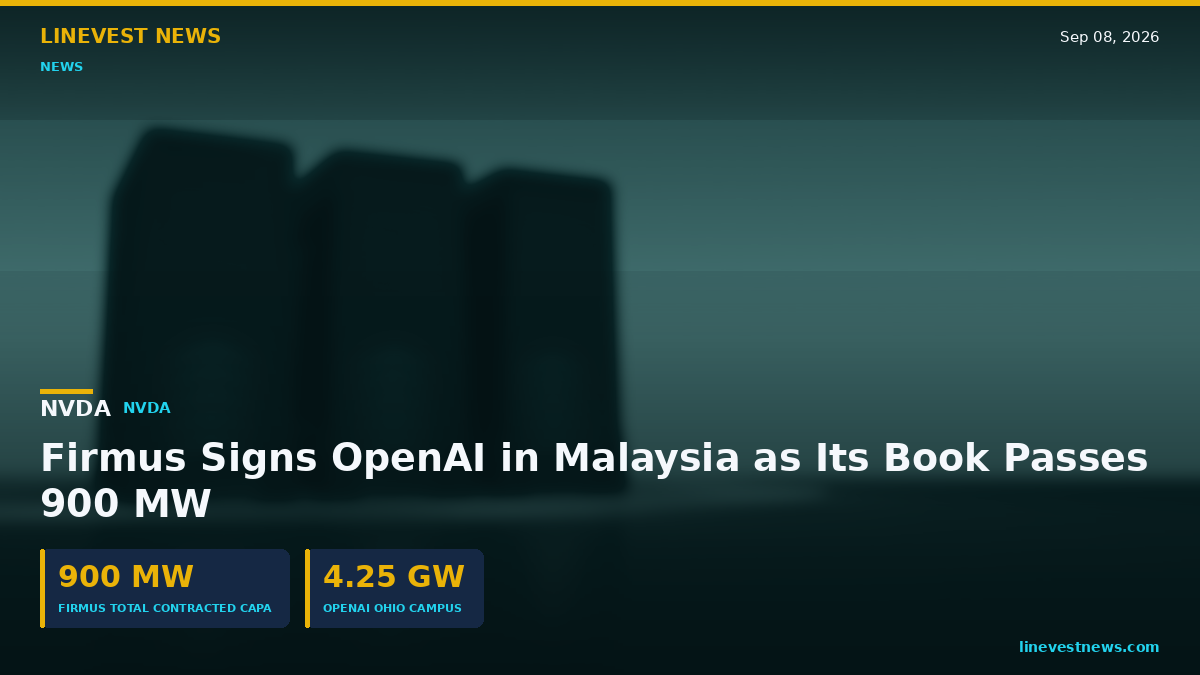
OpenAI will take dedicated computing capacity from two Malaysian sites run by Firmus, an Australian builder of AI data centres. The deal pushes everything Firmus has under contract — all customers, every country it operates in — past 900 megawatts. That is roughly a fifth of the capacity Nvidia agreed last month to backstop for the same customer at a single Ohio campus.
The gap is the story. The 900-megawatt figure has circulated without anything set beside it for scale.
Compute contracts have become the currency of this industry. A model developer that cannot secure electricity and floor space cannot ship product, however good its research is. So the announcements that matter are increasingly about buildings and power rather than about models. This is a building announcement.
What was signed
Firmus Technologies, a Sydney-headquartered company founded in 2021 that builds and operates AI data centres, announced the agreement on Tuesday. OpenAI, the developer of ChatGPT, becomes its anchor customer — the tenant whose commitment underwrites a site before other buyers sign. Neither side disclosed what OpenAI is paying. Neither disclosed how much of the capacity it takes.
The company now counts seven AI factories across four countries, per its announcement: Australia, Singapore, Indonesia and Malaysia. Two are running today. The rest are still under construction, and Firmus is targeting ready-for-service — the point at which a hall can accept live workloads — within 24 months.
Dedicated capacity is not the same thing as renting cloud servers by the hour. The customer commits ahead of construction, and that commitment is what lets the operator raise debt against the site. In effect the tenant underwrites the landlord. It is why an anchor name gets disclosed even when the money attached to it does not.
The Malaysian sites will run on Nvidia's Vera Rubin NVL144 rack-scale systems and the company's DSX AI Factory platform, Firmus said. The building itself is Firmus's own design: a modular unit called HyperCube that packages liquid cooling, mechanical systems and electrification into one shippable block, prefabricated in regional New South Wales. Nico Caprez, Nvidia's vice president of global AI infrastructure growth, said in the release that the approach "will help bring advanced capacity online faster."
Tim Rosenfield, Firmus co-founder and co-chief executive, called the partnership "the moment Asia-Pacific becomes a producer of intelligence, not just a consumer of it." That is the pitch. The arithmetic underneath it is more modest.
Why it matters: the number nobody divided
Nine hundred megawatts sounds large in isolation. Set it against what OpenAI has already contracted elsewhere and it shrinks. Nvidia said in August it would guarantee an initial 4.25 gigawatts at the PORTS-Pike Technology Campus in Pike County, Ohio. OpenAI is the customer there, under a 20-year lease.
That single commitment is about 4,250 megawatts. Firmus's entire contracted book is a little over 900. The ratio is about 4.7 to one. And OpenAI's Malaysian share is only part of that book, because Firmus was already selling capacity to other buyers before this week.
None of that makes the agreement trivial. It sets the scale. OpenAI is not moving its training workload to Southeast Asia. It is buying capacity near the users it wants to serve, which is a different purchase with different economics. Sachin Katti, OpenAI's vice president of compute strategy, framed it that way in the release, saying the sites would help meet growing demand for its products across the region.
Training and serving are different jobs with different geography. Training can happen wherever power is cheap and plentiful, because nobody is waiting on the answer. Serving has to happen near the person typing, because they are waiting. A regional footprint is bought for the serving job, and it should be measured against regional demand rather than against the training estate.
Firmus's own disclosures sharpen the point. Its largest announced project is a 360-megawatt campus in Batam, Indonesia, built with Nvidia and DayOne, a Singapore-headquartered digital infrastructure operator. That single campus is roughly 40% of everything the company has under contract.
Firmus said in June it expects $25 billion to $30 billion from committed offtake — capacity a customer has agreed in advance to pay for — across the first eight years of that Nvidia partnership. The agreement runs to 2034. Malaysia was not part of it.
Nvidia sits on three sides
Nvidia's position here is unusual, and worth stating plainly. It is an equity investor in Firmus. It is the vendor whose systems will fill the Malaysian halls. And in a separate deal, it is the party that agreed to backstop OpenAI's lease obligations in Ohio.
Put those roles side by side. The chip supplier funds the landlord, sells that landlord its equipment, and elsewhere guarantees the tenant's rent. Each leg is disclosed. None of it is hidden. Together they describe a market in which the same balance sheet turns up at several points along the same chain.
Vendor financing is not new, and it is not by itself a warning. It is a structure that concentrates outcomes. When the supplier of the equipment is also a funder of its buyers, demand and capital arrive from the same direction. The question a reader can usefully ask is which party carries the residual risk, because the press releases rarely say.
LineVest covered that Ohio guarantee last month. The shape there was one enormous American site, a single landlord, and up to $105 billion of Nvidia credit standing behind a 20-year lease, per the disclosures at the time. Now the same vendor's capital appears behind a Southeast Asian operator whose entire global book amounts to about a fifth of that campus. The strategy looks consistent. The unit size does not.
What the private market has paid
Firmus has repriced quickly, and the sequence is public:
| Date | Event | Valuation |
|---|---|---|
| April 2026 | $505 million raised, Coatue leading, Nvidia participating (SiliconANGLE) | $5.5 billion |
| Aug. 7, 2026 | $2 billion fully subscribed strategic equity round (Firmus release) | above $10.5 billion post-money |
| Past 12 months | more than $2.5 billion of new equity (Firmus release) | — |
| Sept. 8, 2026 | contracted capacity passes 900 MW (Firmus release) | — |
Post-money means the value placed on the company including the new cash. Backers of the August round included Nvidia and Coatue as returning investors, plus funds run by Blackstone, the US alternative-asset manager, and Jane Street, the New York proprietary trading firm.
The valuation roughly doubled in four months. Against a book that has now passed 900 megawatts, the $10.5 billion post-money figure prices each contracted megawatt at a maximum of about $11.7 million of equity value. Neither company published that figure; it is our arithmetic on the two disclosed numbers. It also moves every time a new customer signs, which is part of why an anchor tenant matters more than the headline capacity number.
That repricing has a destination. Firmus was expected to list on the Australian Securities Exchange this year, SiliconANGLE reported in April, seeking roughly $2 billion more in the offering. An anchor customer of OpenAI's standing is precisely the disclosure an infrastructure company wants in a prospectus. A listing would also force something the private rounds never did — a public breakdown of who has contracted what.
Malaysia is the variable
Malaysia is Southeast Asia's fastest-growing data centre market, Reuters noted in its report on the deal, and the buildout there has drawn scrutiny over electricity and water use. Those are the operating constraints. The regulatory ones are separate, and they sit at both ends of the chip supply chain.
Site selection in this business is mostly an electricity decision dressed as a real-estate decision. Operators go where grid connections can be secured on a predictable schedule, where land sits beside them, and where cooling is affordable. Malaysia has offered that combination, which is why so much of the region's buildout concentrated there. It is also why the scrutiny arrived.
In July 2025, Malaysia's Ministry of Investment, Trade and Industry imposed a Strategic Trade Permit requirement on the export, transshipment and transit of high-performance US-origin AI chips. MITI issued the directive under the catch-all provision of the Strategic Trade Act 2010, with a 30-day advance notification. The stated purpose was to close a regulatory gap around chips being rerouted.
That directive governs chips leaving Malaysia, not chips arriving to run in a Malaysian hall. It is not an obstacle to what Firmus is building. It is a signal about the environment the building happens in. The constraint that would actually bite comes from the other end — Washington's licensing of what may be shipped into the country at all.
The US has moved on that end too. The Commerce Department clarified in May 2025 that export licences are required for advanced computing chips destined for any entity whose ultimate parent sits in China or Macau, wherever that entity is registered. The Biden-era country tiers that had capped Malaysian GPU imports were scrapped, and no country-specific replacement has been published to date. Firmus is Australian-owned, so the China-parent test does not reach it.
For OpenAI the regional argument extends past speed. Governments and large enterprises across Asia increasingly want to know which jurisdiction their data is processed in, and a local hall answers that question in a way a distant one cannot. That is a commercial reason to hold capacity in several countries even when the absolute megawatts stay modest.
What would break this reading
The reading above rests on a single gap: nobody has said how much of the 900 megawatts belongs to OpenAI.