TL;DR
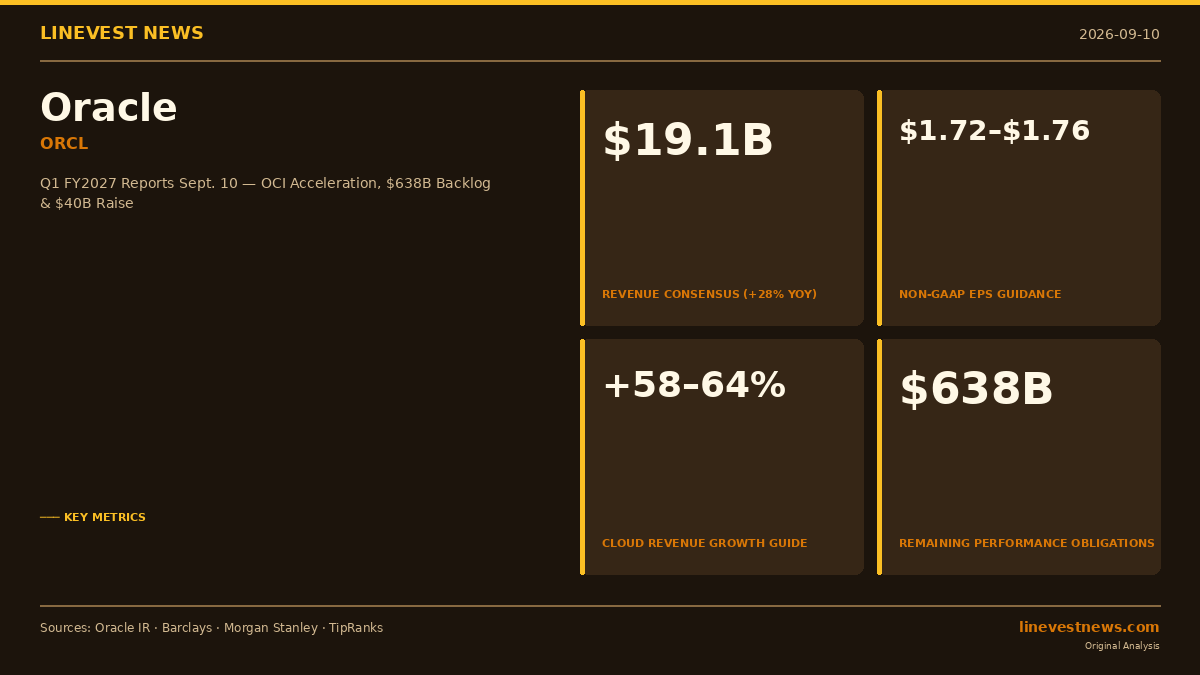
- Oracle reports Q1 FY2027 results on September 10, 2026 after market close; conference call at 4:00 PM Central Time
- Analyst consensus: revenue ~$19.1B (+28% YoY), aligned with Oracle's own 27–29% guidance range
- Company guided non-GAAP EPS of $1.72–$1.76 (+17–20% YoY) and cloud revenue growth of +58–64% — which, given SaaS's slower pace, implies OCI must grow well above 100% to pull the blended average into the guided range
- Remaining Performance Obligations hit $638 billion at Q4-end, up $85B in a single quarter; $75B in prepaid cash and customer-supplied hardware already earmarked for infrastructure
Part A — By the Numbers
Q4 FY2026 Actual Results (Comparison Baseline)
Oracle closed its fiscal year 2026 with a record fourth quarter on June 10. Cloud infrastructure (OCI) was the headline, posting 93% year-over-year revenue growth — its fastest pace on record.
| Metric | Q4 FY2026 | YoY Change |
|---|---|---|
| Total Revenue | $19.2B | +21% |
| Cloud Revenue (IaaS + SaaS) | $9.9B | +47% |
| — OCI / IaaS | $5.8B | +93% |
| — SaaS / Applications | $4.1B | +10% |
| Non-GAAP EPS | $2.11 | +24% |
| GAAP EPS | $1.45 | +21% |
| Remaining Performance Obligations (RPO) | $638B | grew $85B in Q4 |
For full-year FY2026, total revenue reached $67.4B (+17%), with cloud contributing $34.0B (+39%) — OCI alone hit $18.1B for the year, up 77%.
Q1 FY2027 Oracle Guidance vs. Consensus
At the Q4 earnings call, Oracle management provided explicit first-quarter guidance:
| Metric | Oracle Guidance (Q1 FY2027) | Analyst Consensus |
|---|---|---|
| Total Revenue Growth | +27–29% YoY | ~+28% (~$19.1B) |
| Cloud Revenue Growth | +58–64% YoY | — |
| Non-GAAP EPS | $1.72–$1.76 (+17–20% YoY) | ~$1.72 |
Note: The Q1 non-GAAP EPS guidance of $1.72–$1.76 is a step-down from Q4's $2.11 — standard seasonality for Oracle, whose fiscal fourth quarter (March–May) is historically its strongest. The comparable quarter a year earlier (Q1 FY2026) is the YoY baseline.
FY2027 Full-Year Targets
| Metric | FY2027 Target |
|---|---|
| Total Revenue | ~$90B |
| Non-GAAP EPS | $8.05 |
| Implied Revenue Growth | ~33.5% YoY |
Part B — Three Watch Points
Watch Point 1 — OCI Must Accelerate Past 93% to Hit the Cloud Guide
Oracle's 58–64% Q1 cloud guidance is a blended figure covering both OCI (infrastructure) and SaaS (applications). The math reveals a counterintuitive implication: to pull the blend into the 58–64% range while SaaS continues growing at its Q4 pace of +10%, OCI must grow faster than its Q4 record of +93%.
Using Q1 FY2026 as the year-ago baseline — OCI approximately $3.3B, SaaS approximately $3.8B, total cloud approximately $7.1B — the arithmetic works as follows:
- Q1 FY2027 total cloud target (58% blend): $7.1B × 1.58 = $11.2B
- Q1 FY2027 SaaS at +10%: $3.8B × 1.10 = $4.18B
- Required OCI to hit the low end: $11.2B − $4.18B = $7.0B → +112% YoY
- Required OCI to hit the high end: $7.1B × 1.64 − $4.18B = $7.5B → +127% YoY
By contrast, if OCI simply repeated Q4's 93% growth rate with SaaS at +10%, the blended cloud would land near +49% — approximately 10 percentage points short of the guidance floor.
The 1GW of new data center capacity Oracle plans to deliver in Q1 is the mechanism that makes this acceleration possible. At the close of Q4, global GPU utilization across Oracle's cloud regions stood at 97.5%, meaning virtually every GPU-hour in the current inventory is already consumed by active customer workloads. New demand is being queued and deferred, not lost. Q1's capacity additions are the unlock.
For the September 10 report, investors should watch the IaaS (OCI) line specifically:
- OCI above +110%: capacity additions landed on schedule; on track to meet or beat the blended cloud guidance
- OCI below +100%: builds ran behind schedule; blended cloud guide likely missed, and Q2 capacity ramp becomes the new focal point
Watch Point 2 — The $638B Backlog: Seven Years of Revenue, or a Recognition Bottleneck?
Oracle's Remaining Performance Obligations (RPO) — contracted future revenue not yet recognized — stood at $638 billion at the end of Q4 FY2026, up $85 billion in a single quarter from $553 billion at Q3-end. For context: Oracle's entire FY2027 revenue target is $90 billion. The backlog now represents roughly seven years of projected annual revenue.
The pre-funding structure matters. Oracle disclosed that $75 billion in prepaid cash and customer-supplied hardware is embedded within its large AI contracts. Under this arrangement, either customers pay upfront so Oracle can purchase GPUs, or customers supply their own hardware for Oracle to operate — in both cases, Oracle's net capital outlay is materially lower than the headline backlog implies.
| Backlog Metric | Q3 FY2026 | Q4 FY2026 | Change |
|---|---|---|---|
| Total RPO | $553B | $638B | +$85B |
| Prepaid + customer-supplied hardware (AI contracts) | — | $75B | disclosed at Q4 |
The practical question for Q1: Is Oracle recognizing backlog at an accelerating pace?
If Q1 shows RPO growth continuing above $50B sequentially and cloud revenue outperforms the guidance range, it validates the central thesis: the backlog represents real demand, and each gigawatt added converts directly into revenue. A flat or declining RPO would raise the concern that mega-deal signings have peaked, even as capacity ramps.
Watch Point 3 — The $40B Financing Plan: Timing, Structure, and Dilution Risk
The same Q4 call that delivered the revenue beat also disclosed the key overhang: Oracle plans to raise approximately $40 billion through a combination of debt and equity during FY2027 (June 2026–May 2027). Management specified that new debt issuance will not occur in calendar year 2026 — placing any equity component in the June–December 2026 window and debt issuance in calendar 2027 (January–May of FY2027's final months).
This disclosure — not the revenue beat — drove Oracle's stock down more than 7% after-hours on June 10.
Bear case: An equity raise dilutes per-share value near term. Even if the $75B in pre-funded customer commitments offsets a large portion of GPU purchases, the incremental $40B still requires new land, fiber, cooling, and power — costs not pre-covered by AI contract deposits.
Bull case: The $75B in pre-funded infrastructure covers the most capital-intensive portion of the buildout. The $40B raise addresses expansion beyond those commitments, against a backdrop of $638B in backlog that implies multi-year revenue certainty. At a projected $90B in FY2027 revenue, the raise is roughly 44 cents on the dollar of that revenue — and a fraction of the backlog.
For Q1, the key watch items: - Operating cash flow vs. capital expenditure: Does Oracle sustain positive free cash flow despite heavy investment? - Equity issuance announcement: Any equity raise flagged before December 2026 (per the no-debt-in-CY2026 commitment) would confirm the near-term dilution scenario - Management commentary on the financing timetable: Clarity on when and how the $40B will be deployed could significantly reduce the overhang
The DoD's $6.9 billion IDIQ enterprise software contract awarded to Oracle in August 2026 adds a government cloud revenue stream that further underpins the capital deployment case.
Analyst Positioning Before September 10
Multiple firms raised their Oracle price targets in the weeks ahead of Q1 results — treating the post-Q4 selloff as an overreaction to the capex disclosure:
| Firm | Rating | New Target | Prior Target |
|---|---|---|---|
| Barclays (Raimo Lenschow) | Overweight | $281 | $221 |
| Morgan Stanley (Keith Weiss) | Overweight | $246 | $175 |
Across the full coverage universe, Oracle carries approximately 36 Overweight or equivalent ratings out of 45 active analyst opinions. The consensus mean price target is approximately $253, underpinned by the FY2027 non-GAAP EPS guidance of $8.05 and the $90B revenue target.
The upgrade cycle heading into Q1 reflects a specific thesis: that the post-Q4 selloff priced in maximum dilution and minimum execution. If Q1 shows OCI accelerating above 110%, RPO growing sequentially, and operating cash flow holding up, that thesis would receive its first major confirmation.
Sources
- Oracle Q4 FY2026 Earnings Press Release — Oracle Investor Relations
- Oracle Q1 FY2027 Earnings Date — Oracle Investor Relations
- Oracle Q4 2026: $638B Backlog Turns AI Cloud Growth into Funding Test — ERP Today
- Top Analysts Raise Oracle Price Target Ahead of Q1 Earnings — TipRanks
- Oracle Earnings Preview: AI Backlog vs. Cloud Revenue — Investing.com
- Oracle Q4 Revenue Record High, Shares Fall on Capex — TradingKey
This article is for informational purposes only and does not constitute investment advice. LineVest News is an independent financial publication and is not a registered investment advisor. All financial data sourced from Oracle's official investor relations disclosures and publicly available analyst reports. Always conduct your own due diligence before making investment decisions.