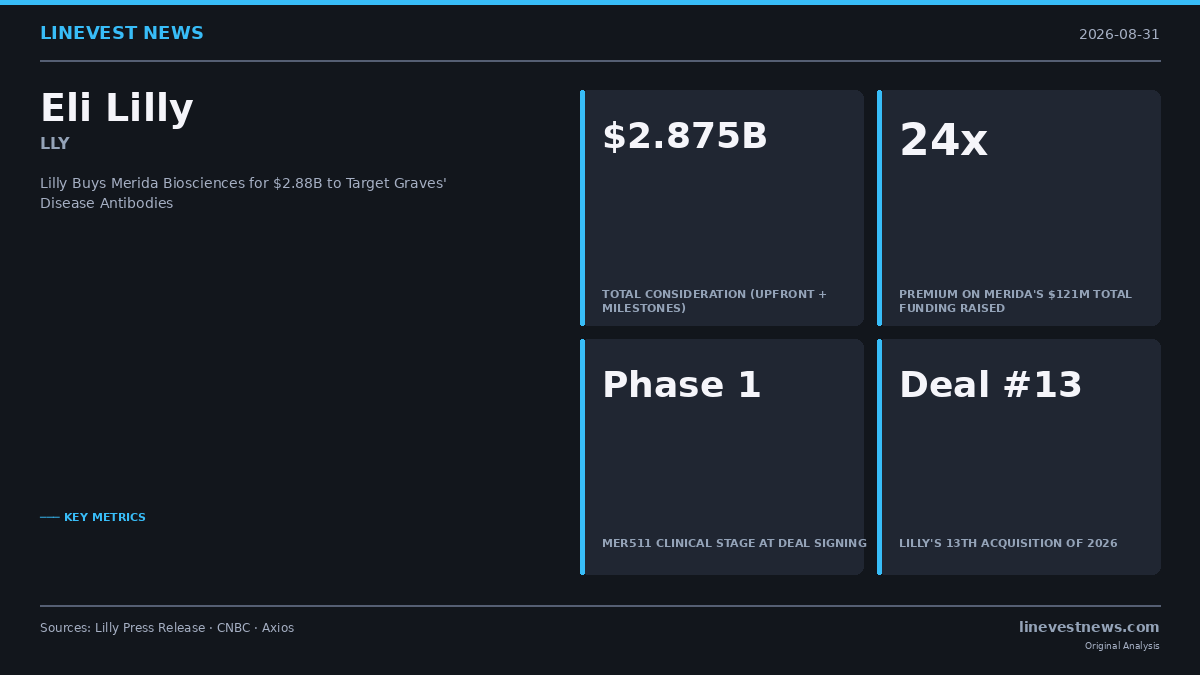
TL;DR - Eli Lilly agreed Aug. 31 to buy Merida Biosciences for up to $2.875 billion in cash (upfront + contingent milestones; split undisclosed), Q4 2026 close expected - Merida's lead drug MER511 is in Phase 1 for Graves' disease and thyroid eye disease — it targets the antibodies that overstimulate the thyroid, a mechanistically distinct approach from all current treatments - Phase 1 primary completion: July 2028; commercialization is years away and won't affect near-term LLY earnings - Merida raised approximately $121 million before the deal; $2.875B represents roughly a 24x premium on invested capital - This is Lilly's 13th acquisition of 2026 — the most of any large pharma company this year
Part A — The Deal
What Merida Biosciences Does
Merida Biosciences is a private biotech whose platform selectively degrades disease-causing autoantibodies — proteins the immune system mistakenly produces and which drive specific autoimmune conditions — without broadly suppressing immune function.
The lead program, MER511, targets thyroid-stimulating immunoglobulins (TSIs): the autoantibodies that activate the thyroid-stimulating hormone receptor in Graves' disease. Approximately 3 million Americans live with Graves' disease; 25–40% of them develop thyroid eye disease (TED), which can cause vision-threatening complications.
In an early Phase 1 cohort, MER511 produced "robust reductions in pathogenic thyroid-stimulating antibodies with a favorable initial safety profile," according to the Lilly press release. A recruiting Phase 1 study targeting approximately 100 adults has primary completion expected in July 2028.
Beyond MER511, Merida holds: - MER769 (preclinical): food allergy, asthma, chronic spontaneous urticaria - Earlier-stage programs in membranous nephropathy and immune-mediated kidney diseases
Deal Terms
| Item | Detail |
|---|---|
| Announcement date | August 31, 2026 |
| Total consideration | Up to $2.875 billion in cash |
| Structure | Upfront payment + contingent milestone payments (split not disclosed) |
| Expected close | Q4 2026 |
| Conditions | Customary closing conditions, including regulatory approvals |
Advisors: Ropes & Gray (Lilly legal), Centerview Partners (Lilly financial), Goodwin Procter (Merida legal).
Lilly's Strategic Rationale
"We're building our pipeline around therapies that meaningfully change the course of disease, not just its downstream effects," said Francisco Ramírez-Valle, Lilly's Senior VP of Immunology R&D.
Merida CEO Adam Townsend added: "Merida was founded to fundamentally change how autoimmune and allergic diseases are treated, by targeting the antibodies driving them directly."
Lilly will advance MER511 alongside its existing immunology franchise: lebrikizumab (atopic dermatitis, launched 2024) and mirikizumab (Crohn's disease and ulcerative colitis).
Part B — Three Watch Points for LLY Investors
Watch Point 1: Is the Science Differentiated Enough to Justify $2.875 Billion?
Merida's antibody-targeting mechanism is distinct from every existing treatment for Graves' disease and thyroid eye disease. Current standard-of-care drugs — antithyroid agents such as methimazole — reduce thyroid hormone production but leave the underlying TSI autoantibodies untouched. Radioactive iodine and thyroidectomy are irreversible.
For thyroid eye disease specifically, Amgen's Tepezza (teprotumumab) is the only FDA-approved drug, launched in 2020. Tepezza blocks the IGF-1 receptor — a downstream pathway — generating over $2 billion in annual sales for Amgen. MER511 would act upstream, at the autoantibody source.
If MER511 replicates its early antibody-reduction signal in larger trials and can demonstrate remission in Graves' disease — not just symptom control — it would be the first drug to address the root cause. That is a genuine unmet need in a real market.
The risk is clinical-stage probability: Phase 1-to-approval success rates in autoimmune diseases run below 25%. The Phase 1 primary completion date of July 2028 means Phase 2 data arrives at earliest in 2029–2030, with commercialization no earlier than 2031–2032. Lilly is buying a long-dated option, not near-term revenue.
Watch Point 2: What Does the 24x Premium on Capital Raised Say About Lilly's Risk Appetite?
Merida raised approximately $121 million before the acquisition. At $2.875 billion, Lilly is paying roughly 24 times the capital previously invested in the company — a notable premium for a Phase 1 asset.
| Metric | Value |
|---|---|
| Merida pre-deal funding | ~$121 million |
| Acquisition total consideration | Up to $2.875 billion |
| Implied premium on capital raised | ~24x |
| MER511 clinical stage at signing | Phase 1 |
| Phase 1 primary completion | July 2028 |
| Near-term EPS impact | Minimal (per Lilly) |
This multiple is consistent with Lilly's 2026 acquisition pattern: the company is building an options portfolio across immunology, oncology, and neurology, betting that a handful of acquisitions will generate blockbuster returns while the others either fail or are deprioritized.
Lilly's quarterly revenue run rate now exceeds $15 billion, driven predominantly by Mounjaro and Zepbound (tirzepatide). At that scale, a $2.875 billion outlay — spread across upfront and milestones — is financially manageable even if MER511 fails. The milestone structure provides partial downside protection: Lilly pays the full amount only if Merida's programs hit specific clinical and regulatory thresholds.
Watch Point 3: Can Lilly Manage 13 Acquisitions in One Year?
The Merida deal is Lilly's 13th acquisition of 2026 — more than one per month, and the highest deal count of any large pharma company this year.
Lilly's dealmaking model is predicated on acquiring early-stage platforms rather than late-stage assets, then allocating internal resources to advance the most promising programs. The milestone payment structures mean that most of the capital flows only upon clinical success, limiting upfront cash burn.
However, the integration challenge is real: internal competition for clinical trial slots, personnel, and capital across 13 newly acquired programs creates prioritization risk. Lilly's clinical operations team cannot advance every asset simultaneously. Merida's programs — MER511 in Phase 1, MER769 in preclinical — will compete against each other and against Lilly's existing pipeline for advancement decisions.
For investors, the key metric to watch is which Merida assets make it into Lilly's pipeline planning disclosures over the next 12–18 months. Programs that appear in Lilly's pipeline table are being resourced; programs absent from it are being deprioritized regardless of acquisition price.
Sources
- Lilly press release — Merida Biosciences acquisition announcement (Aug. 31, 2026)
- CNBC — "Lilly to buy Merida Biosciences for up to $2.88 billion in autoimmune drug push" (Aug. 31, 2026)
- Axios Pro Biotech Deals — deal terms (Aug. 31, 2026)
- Insider Monkey — "Eli Lilly Makes a $2.88 Billion Autoimmune Bet: What Could Go Right or Wrong?"
- SEC 8-K filing — Lilly FY2026 (via prnewswire)
This article is for informational purposes only and does not constitute investment advice. LineVest News is an independent financial news publication and is not a registered investment adviser. All content reflects publicly available information and the editorial judgment of the authors.