The Justice Department's request for beef pricing data reached Walmart on July 14. It does not appear anywhere in the quarterly report Walmart filed on August 28. That filing covers the exact period in which the letter arrived. The word "beef" is not in it.
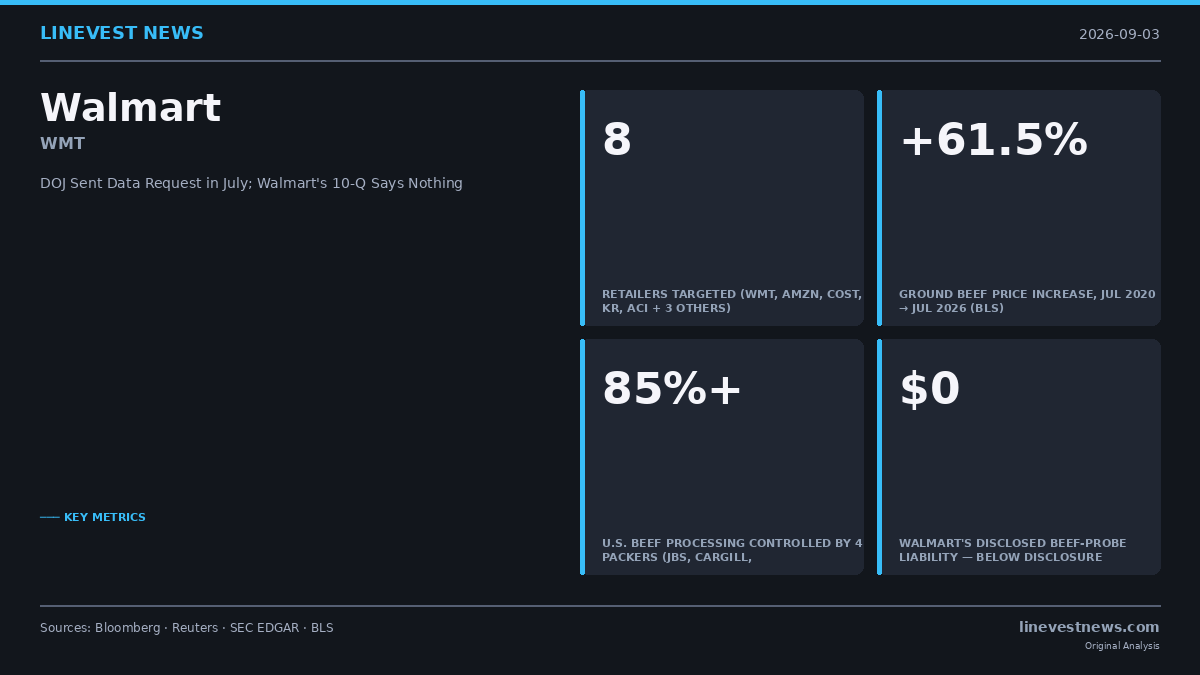
The department made the letters public on Tuesday. Associate Attorney General Stanley Woodward had written to eight food retailers about what the DOJ described as recent increases in the retail price of beef. Walmart Inc. (NYSE: WMT), Amazon.com Inc. (NASDAQ: AMZN) and warehouse club operator Costco Wholesale Corp. (NASDAQ: COST) are on the list, according to Bloomberg. So are Kroger Co. (NYSE: KR), Albertsons Cos. (NYSE: ACI), Florida-based Publix Super Markets, discount grocer Aldi, and the U.S. unit of Ahold Delhaize — the Dutch-Belgian owner of Food Lion, Giant Food and Stop & Shop, per Reuters.
None of the eight is accused of wrongdoing. The letters ask for information. Both Bloomberg and Reuters describe them as letters rather than compulsory legal process, and that distinction is the whole story for an investor. A government letter and a government case sit in very different places on a balance sheet.
The gap between the writing and the telling is worth noting on its own. The requests went out in mid-July. The market learned of them at the start of September, when the department chose to say so. The recipients spent weeks knowing something their shareholders did not. That is ordinary, and it is why the filing record beats the news cycle here.
Why It Matters
A document request is not a case, and the distance between the two is where the money sits. An investor who treats every antitrust headline as a liability will misprice this one. So will an investor who treats it as nothing.
The useful question is narrower than the headline. It is not whether beef got expensive, because it plainly did. It is whether the retailers at the end of the chain kept any of that increase or simply passed it along. Those two stories look identical on a price tag and entirely different on an income statement.
Shareholders cannot settle that from the outside. No disclosure rule obliges a retailer to break out what it earns on a single product. What follows is a triangulation from the records that are public.
What Walmart Did Choose to Disclose
Walmart's legal contingencies note is not thin. It runs through a Mexican competition ruling against its Walmex unit, an Indian competition investigation of Flipkart, foreign-investment notices in India, and roughly 77,000 equal-value pay claims at Asda in the U.K. It also confirms two settled federal opioid matters — the most recent being the case filed in December 2020. The beef inquiry is not in there.
Now look at the size of what did make the cut. The Mexican penalty is 93.4 million pesos, which Walmart's own filing converts to about $5 million. Walmart U.S. booked $125.2 billion of net sales in the same quarter. The disclosed matter is roughly four-thousandths of one percent of one segment's quarterly sales.
The rule behind that note is worth spelling out, because it governs what a reader gets to see. A company books a liability when a loss is probable and can be reasonably estimated. It discloses without booking when a material loss is merely reasonably possible. Below that, nothing appears at all. A request for documents, carrying no allegation and no claim for money, normally sits under the line.
So the threshold for a mention is low, and the beef letter still did not clear it. Walmart's lawyers evidently rated the odds accordingly. The silence is a classification, not a concealment. It tells you how the company scores this today. That is the only read available until a complaint says otherwise.
The Window in the Letters Is Not Arbitrary
Woodward asked for beef purchasing and strategy, retail pricing, profit margins and market analysis covering 2020 through 2026. That is the seven-calendar-year span over which a pound of ground beef changed price more than in any comparable stretch in decades.
Bureau of Labor Statistics figures — the federal series that tracks retail grocery prices — put ground beef at $4.264 a pound in July 2020. Six years later, the July average was $6.885. LineVest computed the change from that series: a 61.5% rise over a period that closely matches the window the letters cover.
There is a well-documented explanation that has nothing to do with grocers. The USDA cattle report released on January 30, 2026 counted 86.2 million head of cattle and calves. That is a 75-year low.
The breeding base tells a similar story. Beef cows numbered 27.6 million, the fewest since 1961 — a 65-year low for that subsector.
Fewer cattle means less beef, and less beef means higher prices, without anyone agreeing to anything. Drought, expensive feed and thin heifer retention built the shortage over several years. Rebuilding a herd also takes longer than depleting one, because a cow held back to breed is a cow not sold. Industry analysts do not expect meaningful expansion before 2028.
Separating a scarcity story from a coordination story is the whole analytical problem here. Both produce the same headline outcome, which is a higher shelf price. They differ in where the extra money lands. If scarcity is doing the work, the gain accrues upstream to whoever owns the animals. If something else is doing the work, it shows up further down the chain.
Why the Margin Request Is the Live Part
Prices rising alongside a shrinking supply is ordinary economics. Margins widening while supply tightens is the thing an antitrust lawyer wants to see. That is why the request for profit margins over that span matters more than the request for price data alone.
Walmart does not report a beef margin, and neither does any large U.S. grocer. It does not break out a gross margin for its U.S. segment either. The closest public figure is company-wide. Walmart's quarterly filing puts gross profit — sales minus the cost of the goods sold — at 25.4% of net sales last quarter, against 24.5% a year earlier.
The filing does not leave that increase unexplained. Walmart attributes it "primarily due to tariff refunds, partially offset by price investments and higher fuel costs within our supply chain." Beef is not named. Neither is grocery. The company credits grocery only for its comparable-sales strength — sales at stores open at least a year.
So the margin line cannot carry much weight here, and it should not. LineVest reported on August 20 that roughly $2.9 billion in tariff refunds ran through Walmart's quarter, with about $2.3 billion pushed back into lower prices. Grocery also spans thousands of items. Beef is one of them.
Proving the coordination version at the retail level is harder than it sounds. Grocers buy beef from packers at wholesale and resell it. Investigators would need evidence that retailers coordinated with one another, or used buying power in a way the law forbids. Passing an upstream cost shock through to customers is not, by itself, an antitrust violation.
The Closest Precedent Ended in a Report
This is not the first time these companies have been asked for their pricing files. In 2021 the FTC — the U.S. antitrust and consumer-protection agency — ordered Walmart, Amazon, Kroger, Tyson Foods and five others to hand over supply-chain and pricing data. Three of the eight letter recipients — Walmart, Amazon and Kroger — also appeared on the FTC's 2021 list.
The FTC published its findings in March 2024:
| Metric | Finding |
|---|---|
| Food/beverage retailer margin (2021) | >6% above total costs |
| Prior peak margin | 5.6% (2015) |
| Margin through Q3 2023 | ~7% |
| Enforcement actions vs. retailers | None |
In other words, the agency documented widening retailer margins during a period of consumer price complaints, published the finding, and stopped there. That is the base case a reader should hold for a document request. It is not the only possible path, but it is the one with the closest match on overlapping companies and sector.
One difference between that episode and this one deserves flagging. The FTC ran a market study, a tool built to produce a public report rather than a lawsuit. The Justice Department's antitrust arm exists to bring cases. The same stack of documents in different hands can end in different places, and that is the real uncertainty here.
Two DOJ Files, Days Apart
LineVest covered a different Justice Department matter at Walmart the week before this one surfaced. On August 28 we reported that Walmart had settled the federal opioid case filed in December 2020, with neither side disclosing terms.
The quarterly report filed that same day supplies the missing word. Walmart settled, in its own language, "for an immaterial amount, which was accrued as of July 31, 2026."
Read those two facts side by side and the shape changes. Walmart's opioid liability — the more recent of the two federal matters — closed at a cost its own accountants call immaterial. In the same quarter, a second Justice Department inquiry arrived and did not clear the disclosure bar at all. Both readings are the company's characterization rather than a court's, and both point the same way.
Market Reaction
| Retailer | Ticker | Sept. 1 Close | Aug. 31 Close | Change |
|---|---|---|---|---|
| Walmart | WMT | $106.09 | $105.92 | +0.2% |
| Kroger | KR | $58.22 | $57.94 | +0.5% |
| Costco | COST | $928.48 | $939.76 | −1.2% |
No retailer named in the letters had responded to Reuters' request for comment at publication. That muted price reaction is itself information. Equity markets price enforcement risk, and on the day the news broke they priced almost none of it. Whether the judgment holds depends on whether the letters stay letters. Nothing announced so far settles that.
The Other Leg of the Inquiry
The retail letters are the second stage of a wider case. DOJ opened an antitrust investigation in May into the four companies that dominate beef processing — JBS, Cargill, Tyson Foods (NYSE: TSN) and National Beef. The department says those four control more than 85% of U.S. beef processing and that it has reviewed more than 3 million documents.
Ranchers welcomed the expansion. R-CALF USA, the largest producer-only trade association for U.S. cattle and sheep ranchers, said it is "encouraged that the Department of Justice is expanding the scope of its beef affordability investigation to include the retail sector." Chief executive Bill Bullard has long argued that both the packing and the retail ends of the chain are concentrated while ranchers remain price takers.
Tyson has separately settled a grocer-led beef price-fixing class action, per Reuters.
What Would Make This Reading Wrong
The interpretation above rests on one unverified point. If the July letters were in fact compulsory demands rather than voluntary requests, then their absence from the quarterly report becomes a disclosure question rather than a classification. The story changes considerably in that case. Neither Bloomberg nor Reuters described them as compulsory process, and no recipient has said otherwise. That is the assumption to watch.
One document will settle it. Walmart's fiscal third quarter ends October 31, and the quarterly report normally follows within about a month. If the beef inquiry appears in the contingencies note of that filing, the company's own lawyers have re-rated it. If it is absent again, the FTC precedent remains the base case.
Disclaimer: This article is journalism, not investment advice. LineVest is not a registered investment adviser and does not recommend the purchase or sale of any security. All figures trace to SEC filings, the BLS, USDA, the FTC and the news organizations named above.