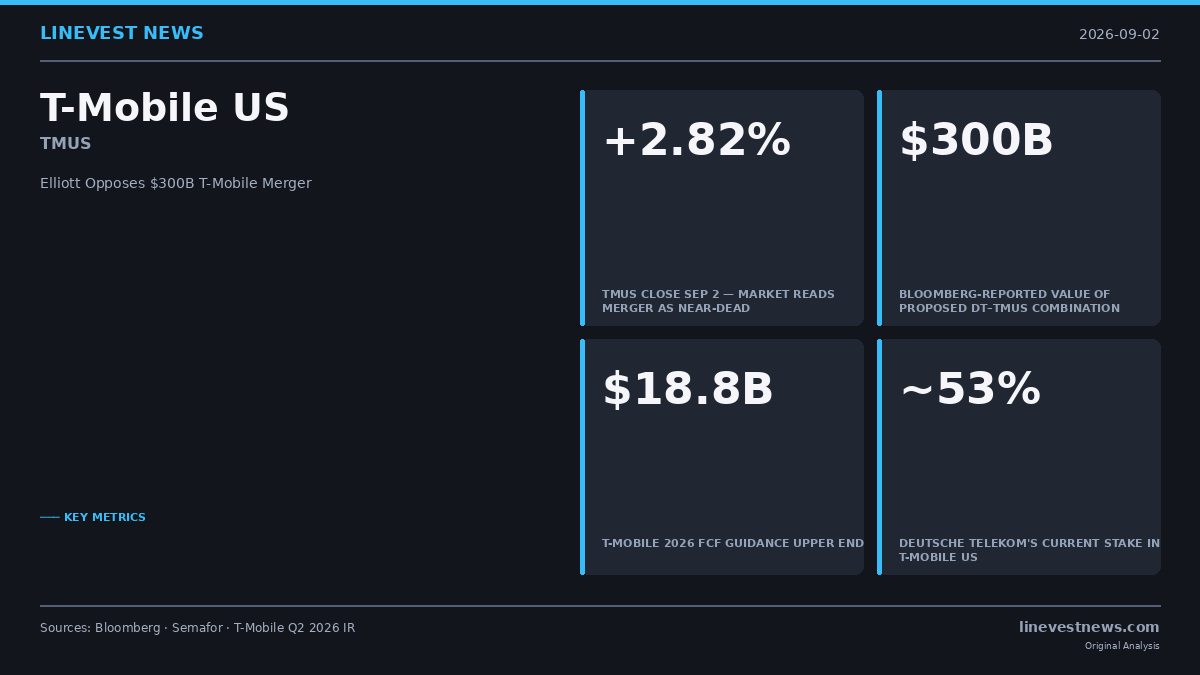
TL;DR - Elliott Investment Management has built a stake in Deutsche Telekom AG (DTEGY) and is pushing the German carrier to abandon its proposed full merger with T-Mobile US (TMUS). - Bloomberg reported the proposed combination at approximately $300 billion—Deutsche Telekom's CEO Tim Hoettges had been pursuing the deal since at least April 2026. - T-Mobile's own management already withdrew support in late July 2026 before Elliott entered the picture. - Elliott is demanding Deutsche Telekom redirect capital into share buybacks rather than pursue the merger. - TMUS closed at $187.30 on September 2, up $5.14 (+2.82%), as markets read the deal as increasingly unlikely to proceed.
Part A: The Activist Intervention
On September 2, 2026, Bloomberg reported that Elliott Investment Management—the large activist hedge fund run by Paul Singer—had accumulated a sizeable stake in Deutsche Telekom AG (DTEGY) and communicated its opposition to the German carrier's proposed full combination with T-Mobile US (NASDAQ: TMUS).
The move puts Elliott directly at odds with Deutsche Telekom CEO Tim Hoettges, who has championed a full merger since at least April 2026. Bloomberg first reported on April 21–22, 2026, that the two companies were in early discussions about combining into a cross-listed holding company that would own both operators.
Background: What Deutsche Telekom Was Pursuing
Deutsche Telekom currently holds approximately 52–53% of T-Mobile US, per Bloomberg and Semafor reporting as of mid-2026. Hoettges's plan envisioned a new all-share holding company that would acquire both Deutsche Telekom and T-Mobile US, creating a combined transatlantic wireless group. Bloomberg pegged the proposed deal's implied value at approximately $300 billion, which would have ranked among the largest proposed mergers in corporate history.
The proposed structure was complex: a new cross-listed entity would issue shares to existing holders of both companies, with the combined group listed on both U.S. and European exchanges. No definitive agreement was ever reached, and discussions remained at an exploratory stage.
T-Mobile Management Withdrew Support in July
Even before Elliott's entry, the deal was under strain from T-Mobile's own side. On July 31, 2026, Semafor reported that T-Mobile's U.S.-based executives had told Deutsche Telekom they no longer support the merger. The reasons cited were two-fold:
Shareholder opposition. Large institutional investors holding non-controlling TMUS stakes told T-Mobile's management they would oppose any combination with Deutsche Telekom, which they view as a slower-growing business than T-Mobile US on a standalone basis.
Regulatory obstacles. The Committee on Foreign Investment in the United States (CFIUS) was expected to impose conditions requiring that T-Mobile's U.S. revenues be reinvested domestically—a condition that would have severely limited Deutsche Telekom's ability to access T-Mobile's cash generation for European purposes, gutting the deal's strategic rationale. Additionally, under German corporate law, any capital raise associated with the transaction would require a 75% supermajority of share capital represented at Deutsche Telekom's general meeting.
Elliott's Demands
With the merger already on life support from T-Mobile's side, Elliott's entry marks a second front of opposition—from inside Deutsche Telekom's own shareholder base. The activist is pushing DT to formally abandon the deal and instead expand its share buyback program, according to people familiar with the matter cited by Bloomberg.
Elliott's exact stake in Deutsche Telekom was not disclosed. Under German securities law, investors must make a public filing when their position reaches at least 3% of a company's shares outstanding.
Bernstein analysts responded that Elliott's involvement "could increase pressure on management" and suggested that a buyback announcement by Deutsche Telekom "could serve as a near-term catalyst" for DTEGY shares. Deutsche Telekom's stock has declined approximately 9% over the past twelve months, with its market capitalization at roughly €138 billion ($160 billion).
Market Reaction
T-Mobile US shares closed at $187.30 on September 2, up $5.14 or 2.82% for the session. The positive reaction reflects investor preference for T-Mobile's independence and continuation of its standalone buyback and capital return story. TMUS has traded between $165.66 and $256.69 over the past 52 weeks.
Part B: What This Means for TMUS Investors
T-Mobile's FCF Story Stays With TMUS Shareholders
The key implication for minority TMUS shareholders is straightforward: a deal's collapse preserves the full minority share of T-Mobile's free cash flow generation.
Deutsche Telekom already consolidates T-Mobile and receives dividend income proportional to its majority stake. What a full merger would change is the claim on the non-DT minority shareholders' portion of T-Mobile's cash flow, which under a full combination would flow to the combined holding company rather than to independent TMUS investors.
T-Mobile raised its 2026 adjusted free cash flow guidance to $18.4–$18.8 billion following its Q2 2026 results in late July—an increase of $200 million at the midpoint from prior guidance. The company's underlying fundamentals remain strong:
| Metric | Q2 2026 | YoY Change |
|---|---|---|
| Total Revenue | $22.8 billion | +8% |
| Core Adjusted EBITDA | $9.5 billion | +12% |
| Adjusted Free Cash Flow | $4.8 billion (Q2 only; H2 typically moderates seasonally) | +4% |
| EPS | $2.99 | Beat $2.58 consensus by 16% |
| Postpaid Net Account Adds | 277,000 | — |
T-Mobile has authorized a total shareholder return program of up to $18.2 billion through December 31, 2026, which includes share repurchases and quarterly dividends of $1.02 per share.
Current Valuation Snapshot
At $187.30, TMUS trades meaningfully below its 52-week high of $256.69—a period that predated merger-related uncertainty. Key financial reference points:
| Metric | Value |
|---|---|
| Stock Price (Sep 2 close) | $187.30 |
| 52-Week Range | $165.66 – $256.69 |
| 2026 FCF Guidance | $18.4–$18.8 billion |
| Net Debt (excl. tower obligations) | $84.1 billion (Q2 2026) |
| Quarterly Dividend | $1.02 per share |
Of 29 analysts tracked by TIKR, approximately 25 carry Buy or Outperform ratings on TMUS, with a mean price target near $263—approximately 40% above the current price. Morgan Stanley, which initiated coverage with an Overweight rating and a $260 target, projects mid-single-digit revenue growth and high-single-digit EBITDA growth as T-Mobile's standalone trajectory. Analyst estimates point toward approximately $24 billion in annual free cash flow by 2030—a roughly 6–7% compound annual growth rate from the current guidance midpoint of $18.6 billion.
What Could Still Go Wrong
Investors should not assume the outlook is uniformly positive. Three risk factors deserve monitoring:
1. No Standalone Takeover Premium. With Deutsche Telekom as a majority controlling shareholder of approximately 52–53%, T-Mobile's board composition and strategic direction remain under DT's de facto influence. Even if the current merger proposal is set aside, no rival acquirer can easily approach TMUS minority shareholders without DT's cooperation.
2. Elevated Debt. T-Mobile carries approximately $84 billion in net debt (excluding tower obligations as of Q2 2026), a legacy of its 2020 Sprint integration. While the company's guided free cash flow comfortably covers interest service and management targets a 2.5x Core EBITDA leverage ratio, any sustained rise in benchmark rates or subscriber deceleration would tighten this picture.
3. DT May Return with a Revised Approach. The current merger structure appears dead. But Deutsche Telekom has long viewed full control of TMUS as a strategic priority, and Hoettges has not publicly abandoned that goal. A revised offer structure—perhaps a partial buyout, an enhanced governance arrangement, or a restructured capital framework—remains possible.
The Elliott Factor: A Potential Catalyst for DT Shareholders
Elliott's campaign at Deutsche Telekom introduces a new dynamic. If the activist successfully pressures DT into an expanded buyback program, DT shares could recover from their recent 9% trailing decline. A Deutsche Telekom that is generating value for its own shareholders through capital return is, by extension, a more stable and predictable controlling shareholder for TMUS—reducing the merger-overhang uncertainty discount that has weighed on TMUS's multiple since merger talks began in April.
Bernstein's framing—that a DT buyback announcement would be a near-term catalyst—is consequential for TMUS investors too. Activist pressure that normalizes DT's capital allocation makes a renewed merger push less likely in the near term.
Three Scenarios for TMUS Over the Next 12 Months
| Scenario | Likelihood | TMUS Implication |
|---|---|---|
| Merger formally abandoned; DT expands buybacks | High | Uncertainty discount narrows; re-rates toward analyst targets near $263 |
| DT returns with a revised or smaller deal structure | Moderate | Near-term overhang persists; stock likely trades sideways |
| DT reduces its TMUS stake, diluting control | Lower | Potentially bullish—removes control premium discount on minority shares |
Sources
- Bloomberg (September 2, 2026): "Elliott Builds Deutsche Telekom Stake, Opposes T-Mobile Merger"
- Bloomberg (April 21–22, 2026): initial reporting on Deutsche Telekom–T-Mobile early merger discussions
- Semafor (July 31, 2026): "T-Mobile, Deutsche Telekom merger stalls over US, shareholder concerns"
- Euronews (April 28, 2026): "Deutsche Telekom eyes full T-Mobile merger"
- T-Mobile US Q2 2026 Earnings Release (July 23, 2026)
- T-Mobile US Q2 2026 10-Q (filed with the SEC): net debt $84.1 billion, total revenue $22.8 billion
- Bernstein Analyst Note, September 2026
- Morgan Stanley TMUS Initiation Note, Overweight, PT $260
This article is for informational purposes only and does not constitute investment advice. LineVest is an independent financial news publication and is not a registered investment adviser. All data reflects conditions as of September 2–3, 2026.