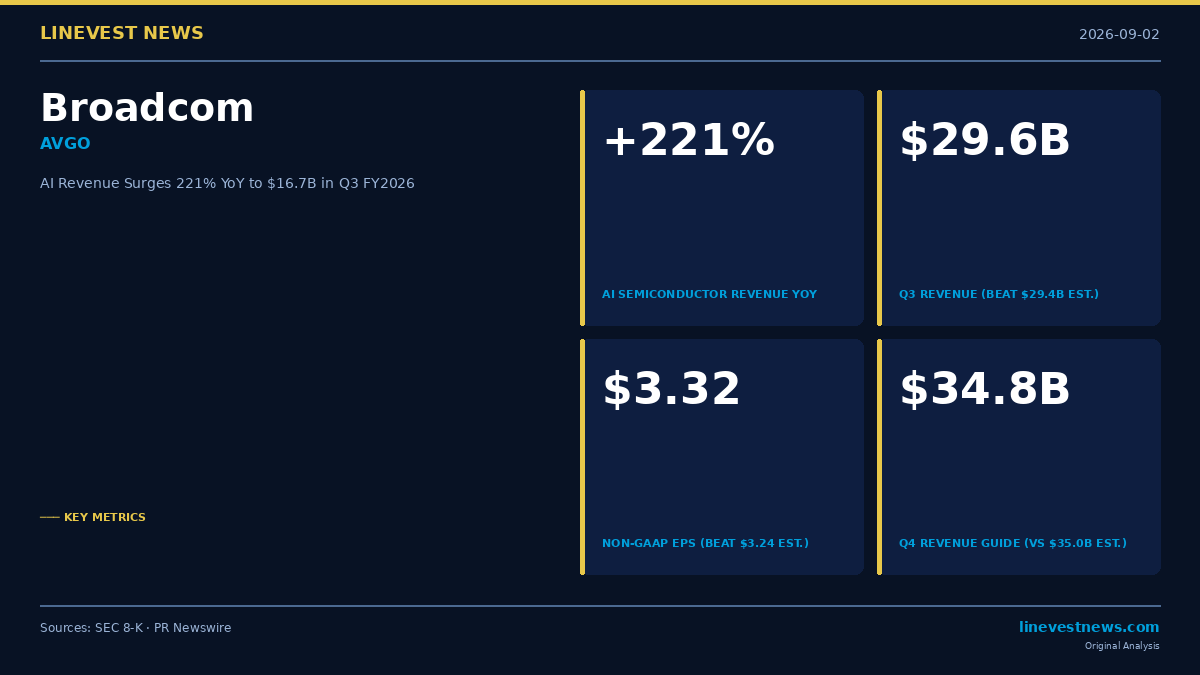
TL;DR - Q3 FY2026 revenue $29.591B (+86% YoY) beat the ~$29.4B consensus; non-GAAP EPS $3.32 (+96%) topped the $3.24 estimate - AI semiconductor revenue hit $16.7B (+221% YoY, +54% QoQ) — now 56% of total company revenue - Record free cash flow: $13.7B (46% of revenue), up 95% YoY - Q4 FY2026 guidance of $34.8B (+93% YoY) came in ~$230M below the $35.03B Wall Street consensus - AVGO fell as much as 6% after hours, settling near –3.5% to around $354 in extended trading
Part A — Q3 FY2026 Filing Highlights
Broadcom Inc. (NASDAQ: AVGO) filed an 8-K with the SEC on September 2, 2026 (Accession No. 0001730168-26-000076), reporting fiscal third-quarter results that exceeded analyst expectations on revenue and earnings per share, while fourth-quarter guidance landed modestly below the street consensus.
Q3 FY2026 Financial Summary
| Metric | Q3 FY2026 | Q3 FY2025 | YoY Change |
|---|---|---|---|
| Revenue | $29.591B | $15.950B | +86% |
| GAAP Net Income | $13.088B | $4.140B | +216% |
| Non-GAAP Net Income | $16.372B | $8.393B | +95% |
| GAAP Diluted EPS | $2.68 | $0.85 | +215% |
| Non-GAAP Diluted EPS | $3.32 | $1.69 | +96% |
| Non-GAAP Operating Income | $20.095B | $10.467B | +92% |
| Non-GAAP Operating Margin | 68% | — | — |
| Operating Cash Flow | $14.197B | $7.171B | +98% |
| Free Cash Flow | $13.665B | $7.017B | +95% |
Segment Revenue Breakdown
| Segment | Q3 FY2026 | % of Total | YoY |
|---|---|---|---|
| Semiconductor Solutions | $20.839B | 70% | +127% |
| — of which: AI revenue | $16.700B | 56% | +221% |
| Infrastructure Software | $8.752B | 30% | +29% |
| Total | $29.591B | 100% | +86% |
CEO Hock Tan stated: "Demand for our custom AI accelerators and networking continues to be very strong. Q3 AI semiconductor revenue of $16.7 billion grew 221% year-over-year, and 54% quarter-over-quarter."
CFO Amie Thuener added: "Broadcom achieved record revenue, operating profit and free cash flow in Q3. We delivered non-GAAP operating income growth of 92% year-over-year."
Q4 FY2026 Guidance
| Metric | Q4 Guide | Consensus | Delta |
|---|---|---|---|
| Revenue | ~$34.8B | $35.03B | –$230M (–0.7%) |
| AI Semiconductor Revenue | ~$21.7B | — | +236% YoY |
| Non-GAAP Operating Margin | ~66% | — | — |
The board declared a quarterly dividend of $0.65 per share, payable September 30, 2026, to shareholders of record as of September 19, 2026.
Part B — What This Quarter Means
The Guidance Paradox: 93% Growth Isn't Enough
Broadcom's Q4 revenue guide of $34.8B represents 93% year-over-year growth — an acceleration from Q3's 86% pace — yet the $230M shortfall against the $35.03B consensus triggered an outsized stock response. AVGO fell as much as 6% after hours before narrowing to roughly –3.5%, with shares trading near $354 in extended trading.
This disconnect illustrates the compounding expectations problem for hyper-growth semiconductor stocks. When AI revenue becomes the dominant driver — now 56% of total Q3 revenue — any guidance number that fails to clear an ever-rising bar registers as disappointment regardless of absolute growth rates. Management's Q4 AI semiconductor projection of $21.7B would be a $5 billion sequential increase from Q3 and represents 236% year-over-year growth, figures that would be extraordinary by any historical standard in the chip industry. The market, however, had priced in even more.
For investors weighing the stock at current levels, the core question is whether a 0.7% revenue guide miss warrants a 5–6% multiple compression — particularly when the underlying FCF yield and revenue trajectory remain intact.
Six Hyperscalers, One Differentiated Strategy
Broadcom's AI business is architecturally distinct from the general-purpose GPU market. Rather than selling standardized accelerators at scale, Broadcom co-develops custom AI accelerators — called XPUs — tailored to each hyperscaler's specific neural network workloads. CEO Hock Tan confirmed during the earnings call that the company now serves six hyperscale XPU customers, including Google, Meta, Anthropic, and OpenAI, with two additional unnamed partners.
This co-design model creates substantial switching costs. Once a hyperscaler invests in jointly developing a chip generation with Broadcom — integrating architecture-specific toolchains, memory hierarchies, and interconnect topologies — migrating to a different ASIC partner requires rebuilding years of co-development investment. That stickiness is a key reason why AI revenue grew 221% year-over-year in Q3, significantly outpacing the broader Semiconductor Solutions segment's 127% growth.
At the current trajectory, Broadcom is tracking toward management's previously stated FY2026 AI semiconductor revenue target of approximately $56 billion. The company has also guided for AI semiconductor revenue in excess of $100 billion for FY2027, though that long-range forecast assumes continued hyperscaler capex expansion and successful ramp of next-generation XPU programs.
VMware's Second Act: From Integration Burden to Enterprise AI Platform
Infrastructure Software — which primarily reflects the VMware segment acquired in Broadcom's $69 billion deal closed in late 2023 — posted $8.752B in Q3 revenue (+29% YoY). While the segment's growth rate trails the semiconductor division, a significant strategic development emerged one day before the earnings release.
On August 31, 2026, Broadcom launched VMware Private AI Cloud at VMware Explore 2026, positioning its enterprise virtualization platform as a complete private AI infrastructure stack. The product supports more than 150 open-source and commercial AI models — including offerings from Nvidia and AMD — within a unified enterprise cloud environment.
Central to the launch is AgentMinder, a governance layer designed to manage and constrain autonomous AI agents operating inside enterprise private clouds. The system provides hardened agent sandboxes with a deny-by-default security model and auditable governance via an AI gateway.
The strategic significance is clear: Broadcom holds a dominant position in large-enterprise data center infrastructure through VMware's installed base. Converting those deployments into AI-ready private cloud environments extends Broadcom's AI revenue opportunity well beyond the six hyperscaler relationships and into the broader Fortune 500 market — a customer segment more likely to run on-premises AI workloads due to data governance and regulatory requirements.
Free Cash Flow: The Structural Advantage
At $13.665B in a single quarter (46% of revenue), Broadcom's FCF generation stands out as a structural competitive advantage. The 95% year-over-year FCF growth reflects:
- Near-zero incremental capex: $500M in Q3 capital expenditures against $14.2B operating cash flow — Broadcom is a fabless designer that outsources manufacturing to TSMC and other foundries
- Software economics in the mix: Infrastructure Software's ~30% revenue share contributes near-100% incremental margins once development costs are sunk
- Operational discipline: Non-GAAP operating margin reached 68% in Q3 even as absolute revenue roughly doubled
The resulting $24.0B cash balance gives Broadcom strategic flexibility for debt reduction (the company carried substantial leverage from the VMware acquisition), share buybacks, or incremental R&D investment in next-generation XPU designs.
Key Variables for Q4 and Beyond
1. AI Revenue Cadence vs. Valuation The $21.7B Q4 AI guide implies that AI will represent roughly 62% of total Q4 revenue at the $34.8B top line. If delivered, that mix shift would represent another step-change in Broadcom's business profile — from a diversified semiconductor and infrastructure company toward a pure-play AI infrastructure provider.
2. Infrastructure Software Trajectory The VMware integration has stabilized but the segment's 29% growth rate bears watching. Enterprise customers are on multi-year contracts renegotiated under Broadcom's restructured licensing model. The pace of contract renewals and any churn in the VMware installed base will be a signal of integration success.
3. XPU Customer Concentration Risk Six customers driving the majority of AI revenue creates asymmetric downside if any single hyperscaler pauses development cycles, brings chip design in-house, or shifts architectural approaches. Alphabet's internal TPU program and Meta's MTIA initiative illustrate that the largest customers have both the capability and motivation to partially internalize accelerator design over time.
4. FY2027 Path to $100 Billion Management's FY2027 AI revenue target of more than $100B would represent roughly 78% growth above the FY2026 $56B trajectory. Achieving that figure requires at minimum one or two of the existing six XPU relationships to ramp a next-generation program and the potential addition of new hyperscale partners. Investors will scrutinize Q4 commentary for any indication of program wins or ramps beyond the current customer roster.
This article is based on Broadcom's 8-K filed with the SEC on September 2, 2026 (Accession No. 0001730168-26-000076), the accompanying press release, and additional reporting. All financial data cited is sourced directly from SEC filings or company press releases. This article is for informational purposes only and does not constitute investment advice or a recommendation to buy or sell any security. LineVest News is not a registered investment adviser.
Sources - Broadcom 8-K — SEC EDGAR, September 2, 2026 - Broadcom Q3 FY2026 Press Release — PR Newswire - VMware Private AI Cloud Launch — Globe Newswire, August 31, 2026