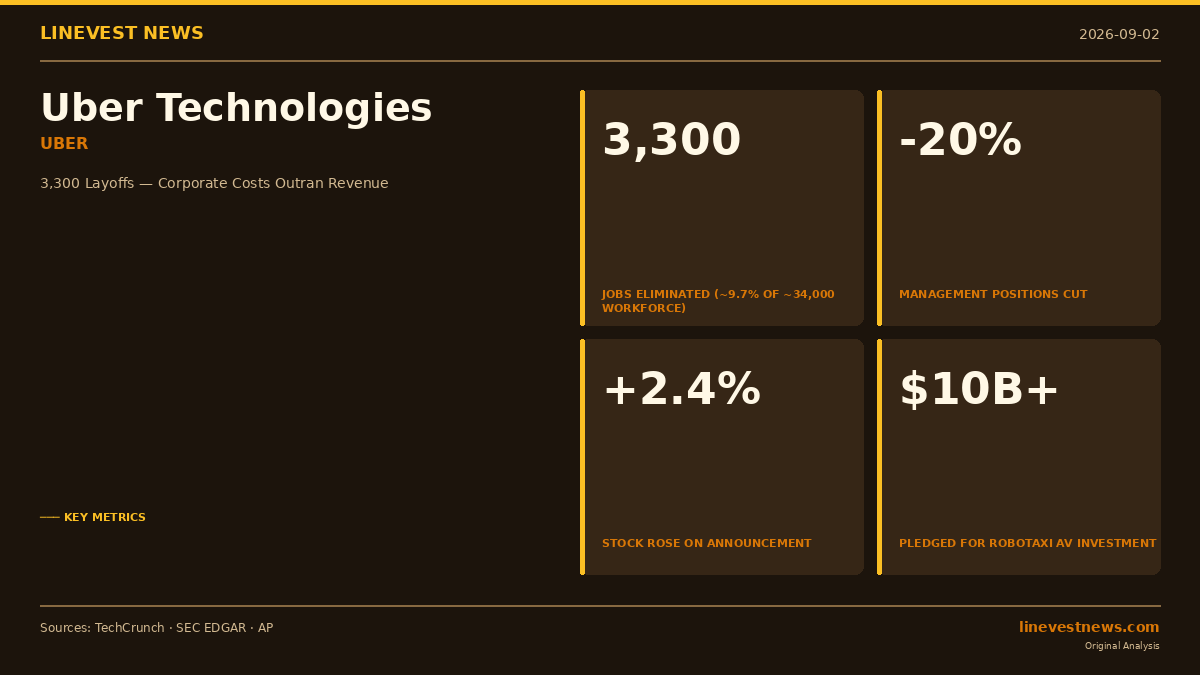
TL;DR - Uber is cutting 3,300 jobs (~9.7% of its ~34,000-person workforce) — its largest reduction since COVID-19 in 2020 - CEO Dara Khosrowshahi cites "complexity" and too many management layers - The real data: four corporate operating-expense lines grew 26% YoY against revenue growth of just 12% - Managers cut by 20%; teams with one or two direct reports halved; remote work limited to ~1% of staff - Savings earmarked for robotaxi push ($10B+ pledged with Avride, Lucid, Nuro, Rivian) - UBER stock +2.4% on the announcement
Uber Technologies (NYSE: UBER) is cutting about 3,300 jobs, and the memo announcing it blames organizational complexity. Its own quarterly filing, submitted four weeks earlier, points somewhere more specific: the expense lines that carry Uber's corporate payroll grew at roughly twice the pace of revenue.
Chief Executive Dara Khosrowshahi delivered the news to staff on Wednesday. "We are removing layers, simplifying team structures, refining our global location strategy, and focusing our people and investments against the biggest opportunities ahead of us," he wrote, in a memo quoted by TechCrunch and Gizmodo. He added that "a leaner organization will mean clearer ownership, faster decisions, and more time spent building rather than coordinating," according to the Associated Press account carried by GV Wire, a Fresno-based news outlet.
Shares rose about 2.4% on the day, Yahoo Finance reported.
What is actually being cut
The reduction equals roughly 10% of Uber's global headcount. The latest annual report said the company and its subsidiaries had "approximately 34,000 employees globally" at the end of 2025.
About 20,300 of those employees worked outside the United States, that same Form 10-K said. The form is the audited yearly disclosure every U.S.-listed company must file.
That base matters. Uber's payroll is not concentrated in San Francisco; most of it sits overseas, in support and operations hubs. That is part of why the memo talks about a "global location strategy" rather than an office closure list.
The cut is aimed at the middle of the org chart, not its edges. Management roles fall by about 20%. Teams with only one or two direct reports are being halved. Staff sitting more than seven levels below the CEO are thinned by roughly a fifth. Engineering and science teams merge, and delivery operations are being consolidated, per TechCrunch and Gizmodo.
The location policy tightens at the same time. Fully remote roles drop to about 1% of the company, and the three-day office requirement stays, GV Wire reported. Most remaining remote staff are being asked to relocate to a hub.
One absence is worth flagging. Khosrowshahi did not attribute the decision to artificial intelligence, Gizmodo noted — unusual in a year when AI has been the stated reason for so many technology layoffs.
Why It Matters
A cut this size at a profitable company is a statement about how it wants to be run. Uber is not retreating from a market, and it has not warned about demand.
That puts the burden of proof on the filings rather than the memo. A word like "complexity" cannot be audited. Expense lines can be.
It matters beyond Uber, too. The company is preparing to buy Delivery Hero, the Frankfurt-listed group behind Korea's Baemin app. How it treats its own middle layer previews how it may treat an acquired one.
The number the memo does not give you
"Complexity" is a description, not a measurement. Uber's Form 10-Q for the June quarter, filed Aug. 5, contains the measurement. Below cost of revenue sit four expense lines that carry most of the company's salaried staff, its marketing and its research spending. Here is how each moved against the year-earlier quarter.
| Q2 line item (USD millions) | Q2 2025 | Q2 2026 | Change |
|---|---|---|---|
| Revenue | 12,651 | 14,191 | +12.2% |
| Cost of revenue | 7,611 | 7,815 | +2.7% |
| Operations and support | 696 | 805 | +15.7% |
| Sales and marketing | 1,210 | 1,515 | +25.2% |
| Research and development | 840 | 1,043 | +24.2% |
| General and administrative | 669 | 935 | +39.8% |
| Four lines combined | 3,415 | 4,298 | +25.9% |
| Income from operations | 1,450 | 1,890 | +30.3% |
Source: Uber Form 10-Q filed Aug. 5, 2026. Percentage changes are LineVest's calculation from the filed figures.
Read the table from the bottom and the quarter looks excellent. Operating profit grew far faster than sales. Read it from the middle and a different picture appears. Cost of revenue barely moved, and that is what widened the margin. Everything below the cost-of-revenue line grew at more than double the rate of the business those functions support.
Those four lines are not pure payroll. Sales and marketing includes consumer promotions. Research and development includes the autonomous-vehicle program. Uber does not disclose the salary component inside them. No one outside the company can derive the savings from public filings.
What the filing does establish is direction. The corporate layer was compounding faster than the revenue underneath it. It was doing so during a stretch the company itself described as record-setting.
That is the concrete version of the word "complexity." It also explains why the decision arrived after a strong quarter rather than a weak one. Nothing broke. Something simply grew faster than management wanted.
What it costs — and where that number is not
Uber has not put a dollar figure on this restructuring. As of the close of business on Sept. 2, the most recent Form 8-K on Uber's SEC filing index was dated Aug. 7, and it covered a term loan tied to the Delivery Hero deal, not a workforce reduction. There is no Item 2.05 filing — the disclosure companies use to report costs associated with exit or disposal activities.
Uber has filed one before. On May 18, 2020, it filed an 8-K under Item 2.05 that named the cost the same day it told employees.
That filing disclosed a reduction of "approximately 3,000 full-time employee roles" and estimated charges of $175 million to $220 million. It also referenced the 3,700 roles announced on May 6.
Companies file that item once they can estimate the cost. The silence today most likely means the estimate is not final. It also means investors have no sanctioned figure to work with, only a headcount.
An estimate can still be built from Uber's own history. The 2020 program, covering 6,700 roles, was designed to deliver "at least $1 billion" of annual savings, that filing said. Divide one by the other and it is roughly $149,000 of annual cost per role.
Apply the same figure to 3,300 people and the yearly saving lands near $490 million. That is about 9% of the $5.57 billion of operating income Uber reported for 2025.
Treat that as an order of magnitude, not a forecast. Salaries have risen since 2020. This cut also targets managers rather than the customer-support and recruiting staff who bore the brunt six years ago. Both factors argue the per-head figure is low. A cleaner way to hold it: at Q2's revenue base, every $100 million of quarterly cost removed adds about 0.7 of a percentage point to the operating margin.
The hiring it undoes
The headcount arithmetic is the plainest thing in this story, and it is not in any filing.
Uber's FY2024 annual report put headcount at approximately 31,100 at that year's end. The FY2025 report put it at approximately 34,000. The company therefore added roughly 2,900 people during 2025.
Cutting 3,300 removes all of that hiring and then some. On the 10-K figures, Uber comes out of this with about 30,700 employees — below where it started last year.
Revenue moved the other way over the same stretch. Full-year revenue was $43.98 billion in 2024 and $52.02 billion in 2025, an 18% increase, per the FY2025 10-K.
Set the two series side by side. Revenue per employee rose from roughly $1.41 million to $1.53 million during 2025. Hold last year's revenue flat against a 30,700-person company and it becomes about $1.69 million.
So this is not a company fixing a productivity slide. Output per head was already improving. The cut accelerates a trend rather than reversing one — which is a different management decision, and a harder one to make from a position of strength.
What 2020 actually taught
The precedent everyone reached for on Wednesday was May 2020, when Uber cut 6,700 roles — close to a quarter of its staff.
In 2020 demand had collapsed and the cuts were survival. Uber recognized $362 million of restructuring and related charges that year, including $248 million of cash-settled costs, mostly severance, according to the FY2020 10-K.
The outcome is on the record. Uber ended 2020 with approximately 22,800 employees, per that filing. Five years later it had approximately 34,000 — about 49% more. Deep cuts at Uber have historically been refilled, and quickly.
The 2026 version has no such forcing event. That difference matters for how the savings get judged. In 2020, the test was whether Uber survived. This time the test is whether the money shows up somewhere visible.
Where the savings are supposed to go
Khosrowshahi told staff the reductions would "generate savings that we intend to reinvest in growth, innovation, and the capabilities that will matter most over the coming years," per the memo as reported by Yahoo Finance. The named destinations include driver and courier support, merchant programs, and autonomous vehicles.
The autonomous piece carries a price tag. LineVest reported on Aug. 5 that Khosrowshahi had pledged more than $10 billion in autonomous-vehicle partnerships and targeted 15 robotaxi cities by year-end. That came alongside record gross bookings — the total value of fares and orders before Uber's commission is deducted — of $58.0 billion for the June quarter. (The blended take rate, revenue as a share of bookings, eased from about 27% to 24.5% year-over-year, reflecting faster growth in Delivery, which carries a lower commission than Mobility.)
Four weeks later, a tenth of the staff is going. The two announcements are not contradictory. The second one is how the first gets paid for.
There is a second claim on the balance sheet. In July, Uber agreed to acquire Delivery Hero SE, the Frankfurt-listed food-delivery group that owns Korea's dominant Baemin app. LineVest valued the transaction at $14.8 billion in its July 17 coverage, and the accompanying 8-K targets a close in the second half of 2027.
So Uber is shrinking its own corporate ranks while preparing to absorb someone else's. Integration work of that size normally adds coordination rather than removing it. Flattening the chart now, well ahead of the close, is at least internally consistent with that sequencing.
What would prove this reading wrong
The argument here is that Uber's corporate cost base outran its revenue and that management moved before anything broke. There is a clean way to falsify it.
Watch the third-quarter Form 10-Q. Two lines settle it. The first is restructuring and related charges. Uber's accounting policy recognizes them as incurred, and the company booked just $16 million across the first half of 2026. The new figure will be visible immediately. The second is the growth rate of those four expense lines.
If they keep compounding near 26% after the cut, the problem was never management layers. It was the autonomous-vehicle build and the Delivery Hero preparation, neither of which a flatter org chart fixes. If instead the gap between that growth rate and revenue growth closes, the memo described the problem accurately.
One quieter risk sits inside any layoff of managers. Uber is moving some former managers into individual-contributor roles, per TechCrunch. Reorganizations of that kind produce voluntary departures nobody budgeted for. Uber's own annual report warns that a workforce reduction "may yield unintended consequences and costs, such as attrition beyond the intended reduction in workforce." The headcount figure is a floor, not a ceiling.
Segment-level bookings for Mobility, Delivery and Freight sit in the full report, alongside the four-quarter trend table for each operating expense line, headcount efficiency against DoorDash and Lyft, and the cash-flow bridge.
Disclaimer: This article is journalism, not investment advice. LineVest is not a registered investment adviser. Figures come from Uber's SEC filings and the sources cited inline.
Sources: TechCrunch · Gizmodo · GV Wire / AP · Yahoo Finance · Uber 10-Q (Q2 2026) · Uber 10-K (FY2025) · Uber 8-K (Delivery Hero)