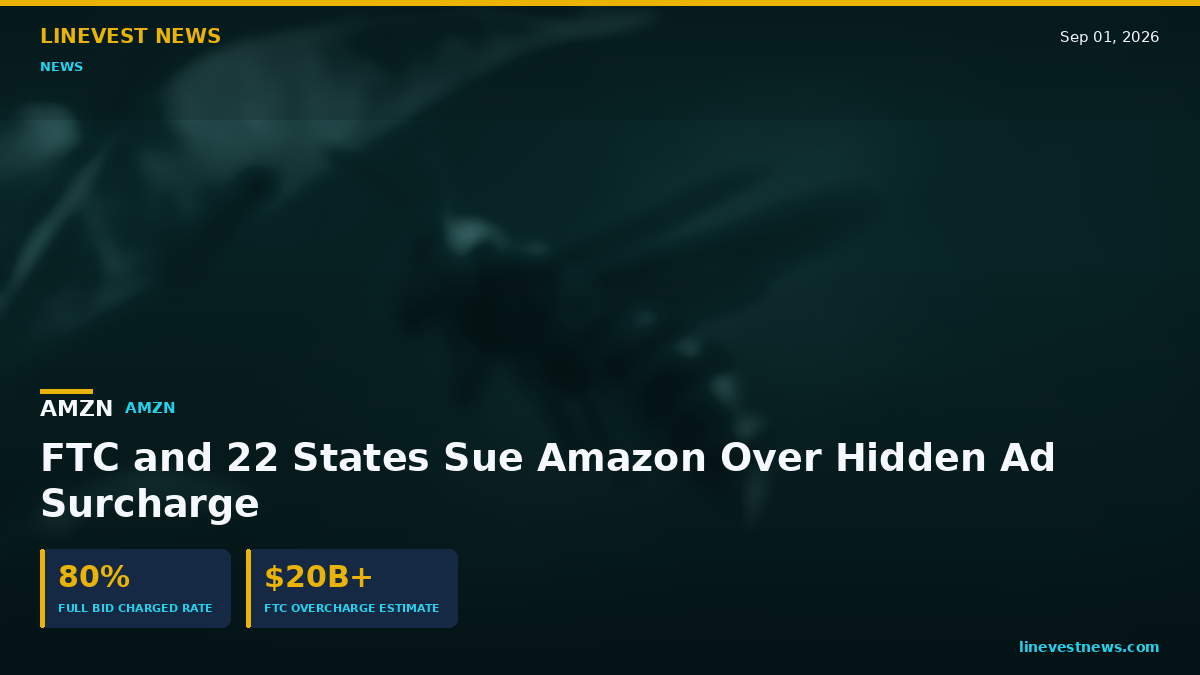
The Federal Trade Commission says Amazon charged advertisers their own full bid about 80% of the time. That share is the end of a ramp, not a constant — the agency's own account puts it at 30% to 40% in 2021. The charge the FTC describes was turned up in stages. Amazon's advertising revenue grew over that span.
The FTC — the U.S. antitrust and consumer-protection agency — and 22 state attorneys general sued Amazon.com (NASDAQ: AMZN) on Monday. The case was filed in the U.S. District Court for the Western District of Washington, according to the FTC's announcement. The agency alleges a "secret ad surcharge scheme" that ran for more than seven years.
More than one million brands and sellers were affected, the FTC says, including over 500,000 small and medium-sized businesses. The commission voted unanimously to authorize the filing.
Amazon shares fell about 2.5% in Monday afternoon trading, to $259.77, according to Investing.com.
What Amazon said the auction was
Amazon told advertisers it ran what the industry calls a generalized second-price auction. The idea is simple. You bid what a click is worth to you. If you win, you pay a penny more than the next-highest bidder — not your own bid. In a single-item second-price auction, that design removes any incentive to shade a bid downward, because truthful bidding is a dominant strategy. Economists have shown, however, that the generalized version covering multiple ad slots does not share that property: in a generalized second-price auction, truthful bidding is not a dominant strategy, and bid-shading is rational.
The FTC says that promise stopped being true in 2019. The agency alleges Amazon added an undisclosed floor it called internally a "soft reserve price." That reserve could push the winner's payment up even when no rival bid required it. One internal document, per the FTC, described an "invented auction participant" — in effect, a bidder that did not exist.
The surcharges applied to Sponsored Products ads, Sponsored Brands ads and display ads, the agency says. The payment-rate series is worth reading closely. Here is how often Sponsored Products advertisers paid their own full bid, per the FTC:
- 2021: 30% to 40% of the time
- 2022: roughly 70%
- 2024: about 80%
That progression matters more than the headline figure. A single bad year reads as an error. A three-step climb reads as a policy. The FTC is arguing the second, and the ramp is what makes it hard to dismiss the conduct as a technical glitch that nobody noticed.
The quotes are the case
The most damaging material in the complaint is not the mechanic. It is what the FTC says Amazon employees wrote about the mechanic. One employee called the hidden surcharges "good for Amazon" because "advertisers must pay more for the same advertising." The same employee added that "the benefit to Amazon comes at the cost of advertisers."
Correspondence from 2024 between two senior executives described the company's "clever non-transparent way to charge first price" as an "incredibly effective way to drive revenue," per the FTC. The agency also says Amazon gave false answers when advertisers asked directly, and feared that disclosure would cause "irrevocable damage to advertiser trust."
FTC Chairman Andrew N. Ferguson framed the harm as reaching past the advertisers themselves. "When one of the world's largest online retailers engages in unfair and deceptive conduct, the impact can be staggering," he said. The higher advertising costs were "largely passed on to American consumers," Ferguson said in the agency's announcement.
Why It Matters
Amazon sells advertising against a promise about how price gets set. An advertiser who believes the auction charges a cent above the runner-up can bid freely. The bid is a ceiling, not a bill. Change that quietly and the bid becomes the bill, while the buyer keeps bidding as though nothing changed.
The disputed fact is narrow but load-bearing. It is not whether the ads worked, or whether Amazon's storefront is worth advertising on. It is whether the rule that told buyers how to bid still applied.
The reach lifts this above a billing dispute. Sellers who advertise on Amazon set shelf prices with that cost inside them. The FTC says the cost ends up with shoppers.
How big is this against the advertising line?
The FTC's announcement says the practice took "tens of billions of dollars" from advertising customers. Search Engine Journal, a digital-marketing trade publication, reported the estimate at above $20 billion. Take the low end and do the arithmetic against the business it came from.
- Low-end estimate of extra advertiser cost since 2019 (Search Engine Journal): $20 billion
- Amazon advertising revenue, 2025: $68 billion (securities filings, per Investing.com and TechCrunch)
- Simple average per year across 7.67 years (LineVest calculation): about $2.6 billion
- That annual average as a share of the 2025 advertising line: about 3.8%
- Amazon advertising services revenue, Q2 2026: $19.8 billion, up 26% from a year earlier
One year of the alleged surcharge, on that arithmetic, is roughly one-seventh of what Amazon booked in advertising in a single quarter. The average is not the shape, though. The FTC's own payment-rate series says the charge bit hardest in the later years, when the advertising line was also at its largest. The yearly figures likely fan out around that average rather than sitting on it.
Monday's trading made a related point about scale. Amazon's market value has been near $2.8 trillion, per LineVest's earlier coverage. A 2.5% move on that base is roughly $70 billion. The market repriced more value in one afternoon than the low end of the FTC's seven-year overcharge estimate. The agency's own "tens of billions" language leaves room for a much higher figure.
Amazon's numbers answer a different question
Amazon "strongly disagrees" with the suit and calls it "misguided," the company said in a response posted to its corporate newsroom. "The FTC's claim fundamentally misunderstands how advertisers operate," the statement reads. "Advertisers adjust bids based on real-world performance, not descriptions of auction mechanics."
The company brought its own figures, published on that same page:
- Average winning bid on Sponsored Products search ads, 2019 to 2025: down 50%
- Share of selected Sponsored Products ads that were not the highest bid: about 92%
- Advertiser savings from relevance-weighted selection, 2021 to 2025: more than $8 billion
- Average cost-per-click, 2019 to 2024: flat, adjusted for inflation
Set the two sets of numbers side by side and something becomes visible. Amazon is answering a question about which ad wins and how high bids run. The FTC is asking a narrower one: what the winner was charged relative to the runner-up. A winning bid can fall every single year while the gap between that bid and the price actually charged closes to nothing.
Both accounts can be true at the same time. That is not a rhetorical point — it is why this case will be slow. Neither side has yet produced the figure that would settle it: the average difference between what winners paid and what the second-highest bid would have required. Until that number exists, the parties are measuring different things and calling it disagreement.
What the last FTC settlement cost
Amazon has settled with this agency before, and the price is on the record. In September 2025, the company agreed to pay $2.5 billion to end the FTC's case over Prime sign-up and cancellation design. The split was $1 billion in civil penalties and $1.5 billion in refunds to consumers, and the FTC described it as one of the largest settlements in its history.
That precedent cuts both ways. The Prime case involved consumers, where a refund per person is straightforward to calculate. This one involves businesses that bid different amounts, on different days, for different placements. Reconstructing what each advertiser would have paid in a clean second-price auction over seven years is a much harder exercise. That difficulty works in Amazon's favor at the remedy stage, not merely as an accounting inconvenience.
A larger Amazon case is already on the calendar in the same courthouse. The FTC's monopoly suit over Amazon's marketplace conduct is set for a bench trial on March 29, 2027, after both sides moved it back from February, according to MLex, a legal and regulatory news service. The two cases are separate matters. They will now run on parallel tracks before the same district court.
What LineVest wrote about this line before
We covered Amazon's second quarter on August 23. Advertising services revenue was $19.8 billion, growing 26% from a year earlier — faster than the company's 12% overall growth. We treated that line as evidence of a retail-media business, meaning advertising a retailer sells on its own storefront, reaching maturity. The FTC now alleges part of the price inside that line was set by a mechanism advertisers were never told about.
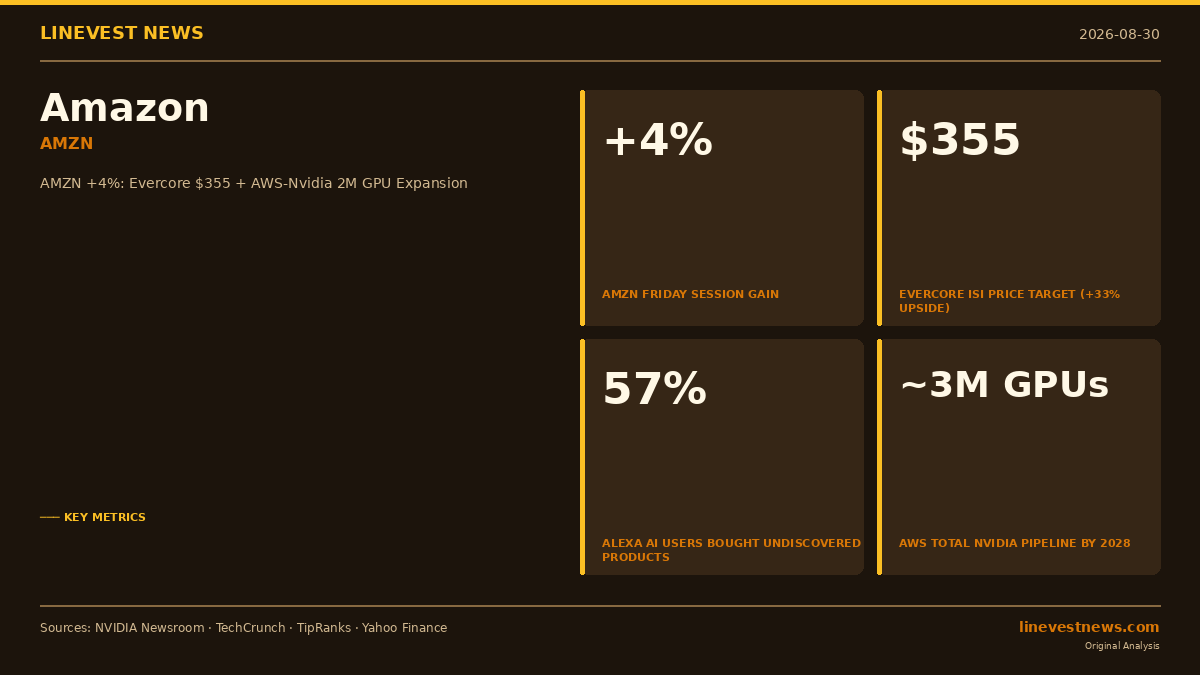
Three days before the suit landed, we also covered a roughly 4% one-day rally in the stock, driven by an Evercore ISI target increase and an expanded AWS-Nvidia chip agreement. Evercore ISI is a New York research and advisory firm. Monday gave a chunk of that back. Nothing in the complaint touches AWS or the retail business. It touches the one large segment at Amazon whose pricing mechanism is now a matter for a federal judge.
What would make this reading wrong
The case is strongest if Amazon's own disclosures said what the FTC says they said. That is the pivot point. If the binding advertiser terms never actually promised a second-price auction — if "one cent more than the next bidder" lived only in sales decks and help pages — the deception claim gets far harder to prove. The payment ramp would then describe a pricing change rather than a lie.
Everything above assumes the FTC's characterization of Amazon's promises survives a motion to dismiss. It may not.
The next clear signal will be Amazon's formal answer or motion to dismiss in the Western District of Washington, where the company must state its legal position on every count in the complaint. That filing will show whether Amazon contests the facts, the law, or both.