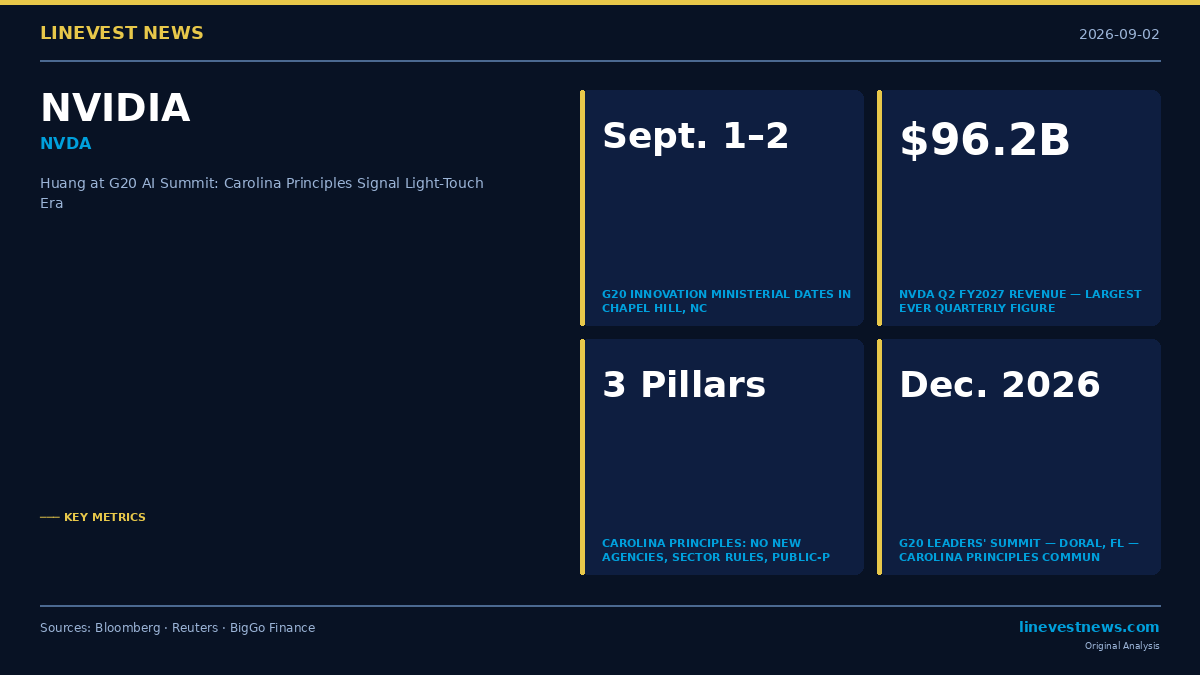
TL;DR - G20 Innovation Ministerial: Sept. 1–2, 2026, Carolina Inn, Chapel Hill, NC - Jensen Huang (NVDA) and Sam Altman (OpenAI) appear in person on Sept. 2 for fireside chats with Commerce Secretary Howard Lutnick - Elon Musk, David Sacks, and Meta Board Director Dina Powell McCormick join virtually on Sept. 1 - The U.S. is pushing a non-binding governance framework called the "Carolina Principles": avoid new regulatory agencies, adopt differentiated sector-specific rules, strengthen public-private collaboration - If endorsed, the framework will be submitted as a G20 joint statement at December's leaders' summit in Doral, Florida - The direct contrast: EU's prescriptive AI Act vs. Washington's innovation-first, light-touch stance - Why it matters for NVDA: regulatory tailwinds, global adoption legitimacy, and no compliance drag on data-center expansion
Part A — The Event
What Is the G20 Innovation Ministerial?
The G20 Innovation Ministerial is a two-day meeting organized by the White House Office of Science and Technology Policy (OSTP) and the U.S. Department of Commerce, scheduled for September 1–2, 2026, at the Carolina Inn in Chapel Hill, North Carolina.
The event is one of a series of G20 ministerial meetings hosted across the U.S. ahead of the G20 leaders' summit, which President Trump will host in December at Trump National Doral in Doral, Florida. The Chapel Hill gathering focuses specifically on artificial intelligence and emerging technologies, bringing together officials from G20 member nations alongside leading U.S. tech executives.
Who Is Attending — and How
| Date | Speaker | Format | Role |
|---|---|---|---|
| Sept. 1 | Elon Musk | Virtual | SpaceX CEO |
| Sept. 1 | David Sacks | Virtual | White House AI & Crypto Czar |
| Sept. 1 | Dina Powell McCormick | Virtual | Meta Board Director |
| Sept. 2 | Sam Altman | In-person | OpenAI CEO — fireside chat with Lutnick |
| Sept. 2 | Jensen Huang | In-person | NVIDIA CEO — fireside chat with Lutnick |
| Both days | Michael Kratsios | In-person | OSTP Director |
| Both days | Howard Lutnick | In-person | Commerce Secretary |
Other featured speakers include Bob Mumgaard of Commonwealth Fusion Systems and Arizona State University President Michael Crow.
The Carolina Principles — Three Pillars
The centerpiece of the ministerial is a proposed non-binding AI governance framework that U.S. officials have dubbed the "Carolina Principles." The framework's three core elements are:
- Avoid establishing new regulatory agencies — no new bureaucratic layer on top of existing industry regulators
- Adopt differentiated regulatory approaches tailored to each industry — sector-specific rules rather than blanket AI legislation
- Strengthen public-private collaboration on technology testing — industry and government share responsibility for evaluating emerging AI capabilities
If endorsed by G20 member states, the principles would be submitted as a joint communiqué at the December leaders' summit. The framework is explicitly non-binding, meaning adoption would depend on each nation's domestic policy process.
Organizers describe the goal as achieving "smarter regulatory approaches, lower barriers to AI adoption, and strong workforce development" across G20 economies.
Part B — What It Means for Investors
Why NVDA Is the Direct Beneficiary of a Light-Touch Global Framework
With $96.2 billion in Q2 FY2027 revenue — of which approximately $89 billion came from the data-center segment — NVIDIA's business is almost entirely a bet on accelerating AI adoption. Every policy mechanism that lowers the friction for deploying AI infrastructure directly expands the addressable market for NVDA chips.
The Carolina Principles, if they gain traction among G20 nations, accomplish three things simultaneously that benefit NVIDIA:
1. No compliance ceiling on AI infrastructure build-out. Unlike the EU AI Act's prescriptive risk classification system, which places mandatory obligations on high-risk AI applications and their underlying compute providers, a light-touch framework does not impose ex-ante caps on what AI can be built or where chips can be deployed. For an infrastructure business like NVDA, which sells Blackwell GPUs and the Vera Rubin platform indiscriminately to cloud hyperscalers, enterprises, and sovereign AI projects, fewer compliance checkpoints mean faster procurement cycles.
2. Legitimacy across 18 additional markets. A G20 joint statement on AI governance effectively sets a global floor — or ceiling — for regulatory ambition. If the G20's 21 members collectively endorse a pro-innovation, sector-specific framework, it becomes politically harder for individual member governments to enact aggressive, prescriptive domestic AI laws. That regulatory convergence compresses the compliance-cost differential between operating in the U.S. and operating in other G20 markets, reducing the friction for NVDA's international data-center customers.
3. Sovereign AI is safe to scale. One of Jensen Huang's consistent talking points since at least GTC 2024 has been "sovereign AI" — the idea that every nation needs its own AI infrastructure rather than depending on U.S. cloud providers. Huang's presence at a G20 forum that validates AI-infrastructure investment by governments signals that sovereign AI programs will proceed without being constrained by a global regulatory overhang.
The EU-U.S. Regulatory Divergence Is Now a Formal Policy Debate
The EU AI Act — which entered phased application in 2024–2026 — takes the opposite stance from the Carolina Principles on nearly every dimension:
| Dimension | EU AI Act | Carolina Principles |
|---|---|---|
| New regulatory bodies | Yes — national authorities required | Explicitly avoided |
| Risk classification | Four-tier mandatory system | Sector-differentiated, flexible |
| Compliance mechanism | Ex-ante conformity assessments | Public-private collaboration |
| Binding force | Legally binding EU regulation | Non-binding joint statement |
| Enforcement | Fines up to 7% of global annual turnover (prohibited practices) | Self-enforcement |
The divergence matters for NVDA investors because the EU AI Act creates compliance costs for downstream customers of NVIDIA chips — particularly in high-risk categories like biometric surveillance, critical infrastructure, and certain autonomous systems. If the G20 framework signals that the EU approach will remain a regional exception rather than become the global standard, the compliance headwind facing NVDA's European customers shrinks.
With the EU AI Act entering full application phase while Washington pushes the Carolina Principles, the global AI regulatory debate is now openly bifurcated between two fundamentally different governance philosophies.
What the Format of Jensen Huang's Appearance Signals
Huang is scheduled for a one-on-one fireside chat with Commerce Secretary Howard Lutnick — not a panel, not a brief prepared remarks slot. A structured one-on-one fireside chat with the cabinet-level official who oversees U.S. export controls — including chip export licenses to China — in a venue open to credentialed press suggests the conversation will be substantive, even if announcements are unlikely.
Since Nvidia's Q2 FY2027 earnings call earlier this week (August 26), where management noted the company is monitoring export-license dynamics around the Blackwell architecture in China, a Lutnick-Huang session at a G20 forum is exactly the venue where those conversations move forward. Investors should note that fireside chats at G20 ministerials rarely yield specific policy announcements, but the optics of NVDA's CEO having a dedicated session with the Commerce Secretary — days after its best-ever quarterly revenue — reinforce the company's status as the de facto infrastructure partner to the U.S. AI policy agenda.
Near-Term Catalyst Calendar
The G20 Innovation Ministerial is not a binary buy/sell catalyst for NVDA in the way that an earnings release or an export-control ruling would be. However, it anchors a broader September narrative:
| Date | Event | NVDA Relevance |
|---|---|---|
| Sept. 1, 2026 | G20 Innovation Day 1 (Musk, Sacks) | Broad AI policy tone-setting |
| Sept. 2, 2026 | G20 Innovation Day 2 (Huang fireside) | NVDA CEO, export-control optics |
| Oct. 2026 | NVIDIA GTC Washington, D.C. (expected) | Product roadmap continuation |
| Dec. 2026 | G20 Leaders' Summit, Doral, FL | Carolina Principles communiqué adoption |
If December's G20 leaders' summit produces a meaningful communiqué endorsing the Carolina Principles framework, that outcome would rank among the most significant AI governance tailwinds for U.S. semiconductor companies — explicitly avoiding new regulatory agencies and embracing sector-specific, innovation-first rules globally.
Risks to the Thesis
The Carolina Principles are non-binding. Even if G20 members endorse the framework in December, individual nations retain the right to legislate as they see fit domestically. The EU, which is already implementing the AI Act, is not obligated to roll it back. China's own AI regulatory trajectory — which includes a complex mix of state control and strategic AI promotion — will not be redirected by a U.S.-authored communiqué.
The event also carries diplomatic risk. G20 consensus requires buy-in from China, the EU, India, and other nations with materially different views on AI governance. Prior G20 communiqués on digital economy and AI have often been watered down to lowest-common-denominator language. If the Carolina Principles emerge as a diluted framework, the market implications are neutral rather than positive.
Key Figures at a Glance
| Metric | Value | Source |
|---|---|---|
| NVDA Q2 FY2027 Revenue | $96.2B (+106% YoY) | NVIDIA Q2 FY2027 earnings (Aug 26, 2026) |
| NVDA Data Center Revenue (Q2 FY2027) | ~$89B | NVIDIA earnings |
| NVDA Q3 FY2027 Guidance | ~$108B | NVIDIA earnings |
| NVDA 52-Week Range | $164.07 – $236.54 | NASDAQ |
| G20 Members | 21 (19 countries + EU + African Union, since 2023) | G20.org |
Sources
- Musk, Sacks, Altman, Huang to Speak at G20 Tech Meeting — Bloomberg (Aug 27, 2026)
- OpenAI, Nvidia CEOs to Speak at Tech-Focused G20 Meeting — Reuters via lufkindailynews
- Musk and Tech Titans Converge on G20 Tech Summit — BigGo Finance
- Walter Bloomberg on X — G20 Ministerial Schedule
- G20 Innovation Ministerial Media Advisory — U.S. International Trade Administration
This article is for informational purposes only and does not constitute investment advice. LineVest News is an independent financial publication and is not affiliated with any brokerage or investment advisory firm.