TL;DR
- Nvidia is reportedly in advanced talks to acquire Hugging Face for $12.9 billion, according to The Information; Business Insider reports no agreement has been signed and talks could collapse.
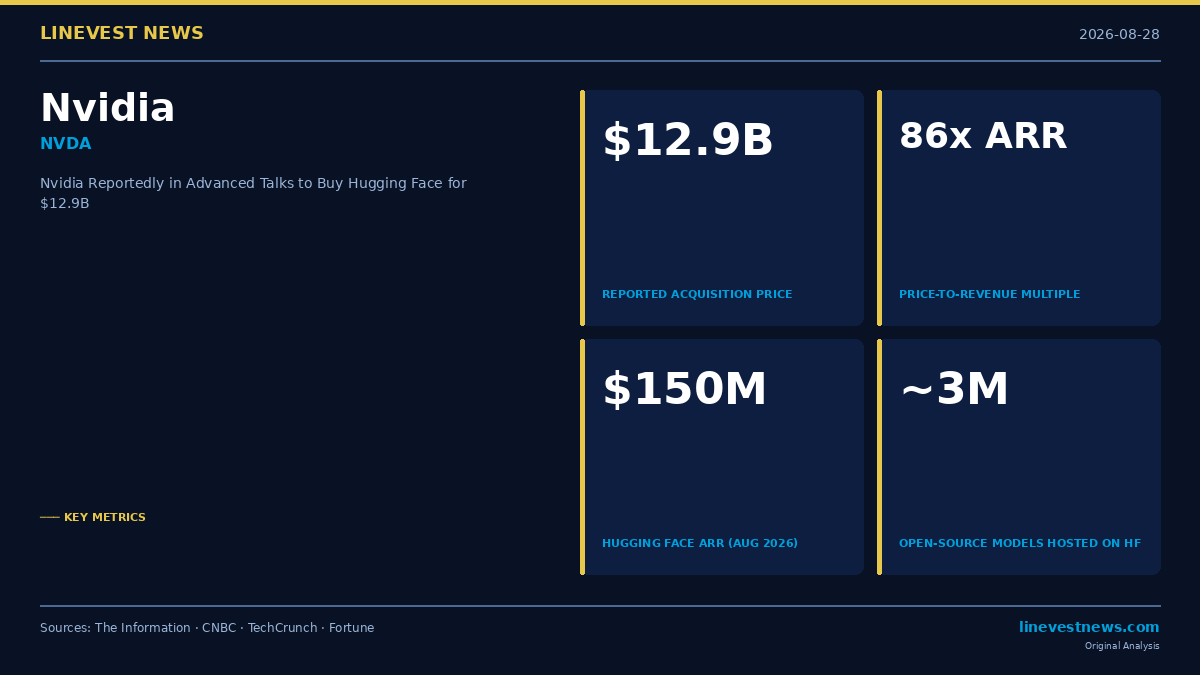
- The price implies 86x Hugging Face's $150 million annualized revenue. At $12.9 billion, the reported price is approximately 2.87x the company's $4.5 billion 2023 private valuation and 84% above the $7 billion valuation at which Hugging Face rejected an Nvidia investment offer in late 2025.
- Strategic rationale: own the open-source AI distribution layer as closed-source rivals build custom silicon to reduce GPU dependence, and re-enter cloud compute markets Nvidia scaled back from roughly a year ago.
- Regulatory risk is material: Nvidia's $40 billion Arm deal collapsed in 2022 under antitrust pressure; the FTC and EU will likely scrutinize a deal giving the dominant GPU maker control of the AI industry's primary model repository.
Part A: What Was Reported
Deal Status and Terms
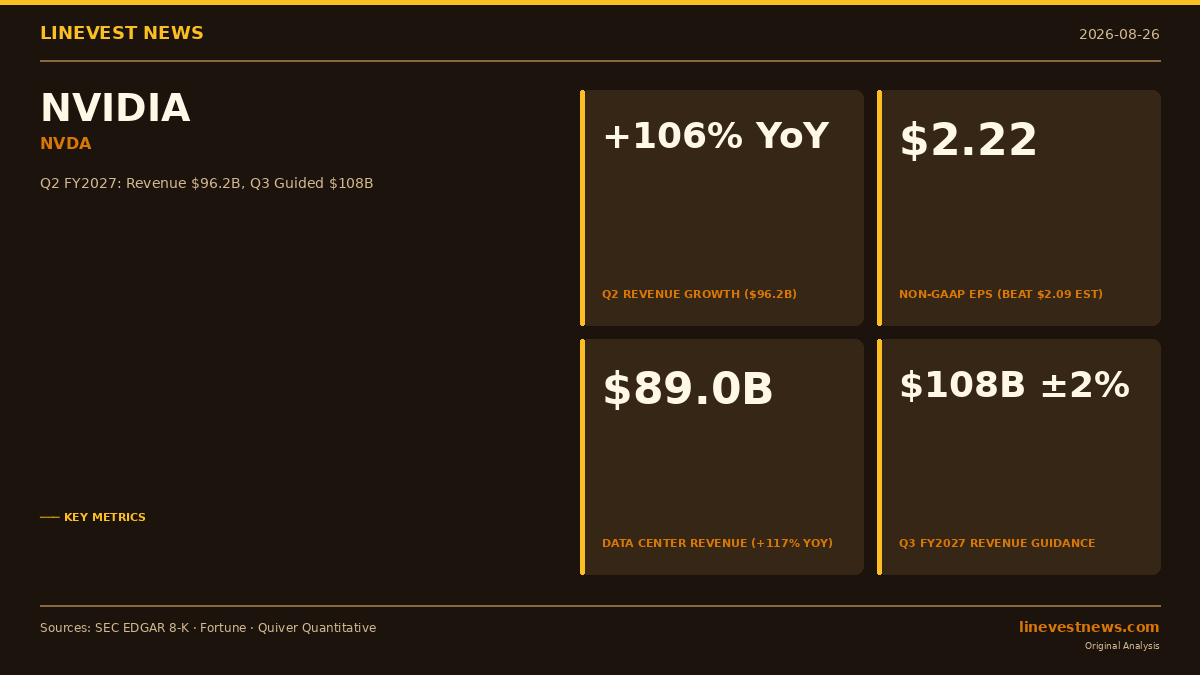
The Information first reported advanced acquisition talks on August 26; TechCrunch followed on the same day. CNBC and Fortune published coverage on August 27. The news emerged the same week Nvidia reported Q2 FY2027 revenue of $96.2 billion, up 106% year-over-year — giving the story an unmistakable "what does Nvidia do with its gains?" framing.
Business Insider subsequently reported that a signed agreement had not been reached as of publication and that talks could still fall through. Neither Nvidia nor Hugging Face responded to requests for comment.
If completed at $12.9 billion, the deal would be Nvidia's largest acquisition to close — surpassing Mellanox Technologies ($6.9 billion, 2020). Nvidia's proposed $40 billion Arm deal (announced September 2020, abandoned February 2022) was never completed.
Hugging Face at a Glance
| Metric | Value | Notes |
|---|---|---|
| Annualized revenue (ARR) | ~$150M | August 2026 (Sacra Research); up from ~$100M in June 2026 |
| Profitability status | Near breakeven | CEO Clément Delangue: "close to profitability" |
| Models hosted | ~2.96 million | Open-weight models including Meta Llama, Mistral, Alibaba Qwen, and DeepSeek |
| Datasets | More than 1 million | Used for AI training and benchmarking |
| Organizations | 50,000+ | Paying and free-tier enterprise users |
| Registered users | ~13 million | Developers and researchers globally |
| Last funding round | $235M at $4.5B valuation | August 2023 round; Salesforce Ventures led; Nvidia participated |
| Rejected Nvidia offer | $500M at $7B valuation | Late 2025; HF declined to avoid single dominant investor |
CEO Clément Delangue co-founded Hugging Face in 2016. It pivoted from chatbot software to become what the industry calls the "GitHub of AI" — a repository where developers share, benchmark, and deploy open-source models. The company raised its last external round in 2023 and, per Delangue, had barely tapped those funds before revenue growth accelerated sharply in 2025 and 2026.
Valuation History
| Date | Event | Implied Valuation |
|---|---|---|
| August 2023 | Funding round close ($235M raised) | $4.5 billion |
| Late 2025 | Nvidia investment offer (rejected by HF) | $7.0 billion |
| August 2026 | Reported acquisition price | $12.9 billion |
The reported price is 2.87x the 2023 private valuation of $4.5 billion and 84% above the rejected 2025 investment offer — a rapid repricing driven by Hugging Face's accelerating revenue growth ($100M ARR in June 2026 to $150M ARR in August 2026).
Part B: Why This Deal Matters for Investors
1. Owning the Open-Source Distribution Layer
The core strategic logic is straightforward: the more open-source models developers download and run on GPUs, the more GPUs they need. Hugging Face is where most of those downloads happen. By owning the platform, Nvidia gains:
- Preferential placement and integration — Hugging Face's compute rental service could be optimized for Nvidia hardware, nudging developers toward NVDA-compatible workflows rather than AMD MI-series or cloud-provider chips.
- Competitive intelligence — Visibility into which model architectures and training methods are gaining traction, enabling more targeted hardware roadmap decisions for Rubin-generation and beyond.
- Counter-positioning against closed labs — As OpenAI (via Broadcom co-design) and Google (TPU roadmap) accelerate their own custom silicon to reduce GPU dependence, Nvidia's training dominance faces structural pressure. An open-weight model ecosystem anchored to Nvidia through Hugging Face would be a durable counterweight.
2. The Cloud Re-Entry Play
Nvidia scaled back its DGX Cloud direct-compute operations roughly a year ago as hyperscaler competition proved difficult to displace at scale. Hugging Face's existing compute rental infrastructure — where developers pay to run inference on hosted models — could provide a lower-friction re-entry point. Nvidia could also use the platform to monetize excess capacity from committed datacenter customers, converting stranded compute into recurring revenue.
3. Regulatory Path: Arm Déjà Vu?
Nvidia's most instructive M&A precedent is the failed $40 billion acquisition of Arm Holdings, announced in 2020 and abandoned in February 2022 after the U.S. FTC sued to block it, the UK CMA opened a Phase 2 in-depth investigation, and the EU opened its own Phase 2 probe. The core concern: a dominant chip company owning foundational semiconductor IP would disadvantage rivals.
The Hugging Face case presents an analogous concern. A company controlling nearly 3 million open-weight AI models and compute pipelines used by 50,000+ organizations would, under Nvidia's ownership, create a vertically integrated stack from GPU to model distribution. Regulators are likely to ask whether AMD, Intel, and custom-silicon providers such as Broadcom and Marvell would be disadvantaged if Hugging Face's infrastructure tilted toward Nvidia hardware.
There is an additional geopolitical layer. Chinese open-source models — including Qwen (Alibaba), DeepSeek, and GLM (Zhipu AI) — are prominently hosted on Hugging Face. A deal putting this distribution platform under the ownership of a U.S. chip company subject to export control frameworks creates potential complexity on two fronts: the standard Hart-Scott-Rodino (HSR) antitrust pre-merger filing will apply for FTC/DOJ review, and separately, the Bureau of Industry and Security (BIS) may scrutinize how U.S.-controlled infrastructure serves Chinese open-weight models subject to export control frameworks.
4. The Neutrality Risk: Will Developers Flee?
Hugging Face's core asset is developer trust in its neutrality as a shared commons. That trust is precisely why Hugging Face rejected Nvidia's $500 million investment proposal in late 2025 — the company explicitly sought to avoid dependence on a single hardware vendor.
The acquisition closes that circle. If Nvidia takes full ownership, open-source communities, enterprise users, and AI labs building AMD-based or custom-silicon infrastructure may migrate to alternative repositories. Alternative distribution channels — self-hosted model servers (Ollama, LM Studio), cloud-provider model catalogs (Amazon SageMaker JumpStart, Azure AI Model Catalog), and academic repositories — would benefit from any trust erosion at Hugging Face.
Investor Playbook: Five Signals to Watch
| Signal | Bearish Scenario (for deal) | Bullish Scenario (for deal) |
|---|---|---|
| FTC/DOJ review (U.S.) | Formal complaint or second request issued | Early clearance; Hart-Scott-Rodino closes without action |
| Developer sentiment | Migration to alternative model hubs | Surge in HF enterprise sign-ups under NVDA |
| Official announcement | Talks collapse (HF rejected NVDA in 2025) | Signed deal within 30 days |
| EU DG Comp | Phase 2 in-depth investigation opened | Deal cleared with behavioral remedies |
| UK CMA | Phase II referral (Phase 2 referral) | Phase 1 clearance (standard review, no issues found) |
Balance Sheet Capacity
As of July 26, 2026 (Q2 FY2027 quarter end), Nvidia reported approximately $22.4 billion in cash and equivalents and $34.1 billion in marketable debt securities — a combined $56.5 billion in cash and fixed-income investments. The reported $12.9 billion acquisition price represents approximately 23% of that cash-and-fixed-income pool. Note that Nvidia returned approximately $26 billion to shareholders in Q2 FY2027 through buybacks and dividends — hence the relatively measured cash position despite record revenues. Nvidia also holds additional equity investments not included in the above figure.
Reporting based on The Information, TechCrunch, CNBC, and Fortune (August 26-27, 2026) and Business Insider (August 28, 2026). This article is for informational purposes only and does not constitute investment advice.
Sources
- The Information: Nvidia in Advanced Talks to Buy Hugging Face (Aug 26, 2026, subscription required)
- Business Insider: Nvidia's potential Hugging Face deal (Aug 28, 2026)
- TechCrunch: Nvidia closes in on Hugging Face acquisition (Aug 26, 2026)
- CNBC: Nvidia reportedly in talks to acquire Hugging Face for $12.9 billion (Aug 27, 2026)
- Fortune: Nvidia nears $12.9B deal to buy Hugging Face (Aug 27, 2026)
- Nvidia Q2 FY2027 Earnings Press Release — SEC EDGAR