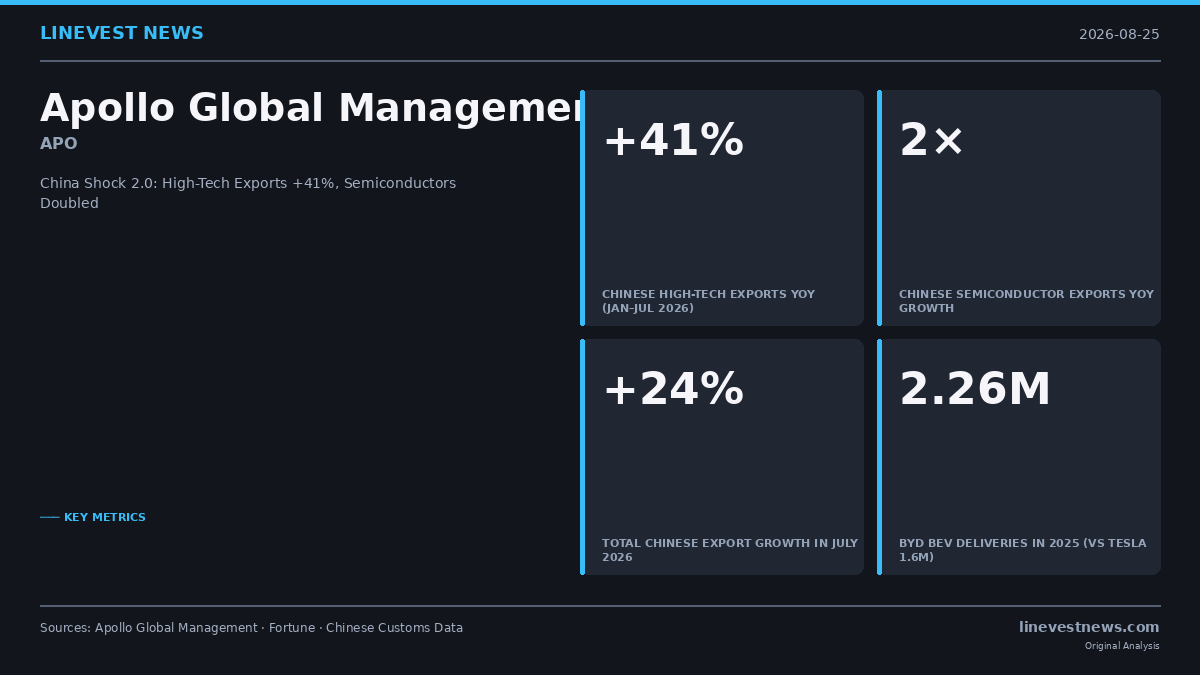
TL;DR - Apollo Global Management chief economist Torsten Slok declared "China Shock 2.0 is here" in an August 21 note, citing a surge of nearly 41% in Chinese high-tech exports through July 2026 (year-over-year). - Chinese semiconductor exports doubled over the same period; the EV sector shows BYD already outselling Tesla globally in battery-electric vehicles (2.26M vs. 1.6M in 2025). - Unlike the original China Shock (cheap consumer goods, circa 1999–2011), this wave targets advanced sectors—chips, EVs, industrial robotics, AI data-center components—where U.S. companies have historically earned premium margins. - For equity investors: semiconductor equipment, EV manufacturers, and AI hyperscalers each carry distinct exposure to the trend.
The Warning and Its Source
On August 21, 2026, Torsten Slok—chief economist at Apollo Global Management, one of the largest alternative asset managers with over $1 trillion in assets under management—published a note titled China Shock 2.0 Is Here. The note received wider attention when Fortune covered it on August 25. The headline phrase deliberately echoes the research by economists David Autor, David Dorn, and Gordon Hanson covering 1999–2011, which documented how Chinese manufacturing imports eliminated roughly 985,000 U.S. manufacturing jobs directly, and contributed to an estimated two million jobs lost across the broader economy.
Slok's argument is that a second, structurally more dangerous wave has begun—this time targeting the advanced technology industries where the United States and its allies have competitive advantages and high profit margins.
The Data Behind the Warning
The claim rests on Chinese export statistics through July 2026:
| Metric | Period | Reading |
|---|---|---|
| High-tech export growth (YoY) | January–July 2026 | ~+41% |
| Semiconductor export growth (YoY) | January–July 2026 | approximately doubled |
Sources: Chinese customs data via Fortune, Apollo Daily Spark
To put the semiconductor figure in context: China's legacy chip output (28nm and older process nodes) has expanded aggressively as domestic foundries—backed by government subsidies—filled capacity. While Chinese fabs have not yet matched TSMC or Samsung at leading-edge nodes, they have driven down prices for the commodity chips used in automobiles, industrial machines, consumer electronics, and IoT devices.
The broader 41% high-tech export growth covers EVs, robotics components, battery systems, and hardware used in data centers.
Why This Shock Is Different From the First One
The original China Shock displaced low-margin labor-intensive manufacturing: apparel, furniture, basic electronics assembly. The U.S. economy ultimately adjusted, though the adjustment was painful and uneven at the regional level.
China Shock 2.0, in Slok's framing, is harder to absorb for two reasons:
1. No viable relocation target. When Chinese labor costs rose in the 2010s, multinational companies could move supply chains to Vietnam, Bangladesh, or Mexico. Chinese dominance in advanced technology sectors—including the equipment and materials needed to build that technology—leaves fewer low-cost alternatives. Slok's note cited Brad Setser of the Council on Foreign Relations, who has argued there is "nowhere left to move production when China controls the cutting edge."
2. Domestic demand cannot absorb the surplus. China's domestic consumer demand growth has slowed. Excess production in EVs, chips, and robotics is therefore directed outward—flooding global markets at prices that undercut established Western and Japanese producers.
Kit Conklin, a supply-chain risk expert at Exiger, put it bluntly: "China Shock 2.0 threatens the foundation of all manufacturing outside of China."
Sector-by-Sector Exposure for U.S. Investors
Electric Vehicles
The clearest data point is BYD versus Tesla. In calendar year 2025, BYD delivered 2.26 million battery-electric vehicles globally, compared to Tesla's 1.6 million. BYD is effectively blocked from the U.S. market by a 100% tariff specifically on Chinese-made electric vehicles, but it has been taking market share from Tesla in Europe, Latin America, and Southeast Asia—markets that matter for Tesla's long-term growth story.
For Tesla (TSLA) investors, the relevant question is not U.S. sales, which tariffs protect, but global pricing power. If BYD continues to hold EVs to lower price points in third markets, Tesla's ability to maintain premium margins outside the U.S. narrows.
Semiconductors
China's semiconductor export surge is concentrated in legacy (mature-node) chips, not leading-edge processors. The practical impact for U.S.-listed chipmakers varies by segment:
- Logic chips (advanced nodes, e.g., NVIDIA, AMD, Qualcomm): Not yet directly price-competitive from Chinese suppliers. Chinese fabs remain multiple generations behind at leading-edge nodes (below 7nm); the near-term exposure is limited.
- Legacy-node logic (28nm and older): This is where Chinese foundry overcapacity is most acute. The price pressure falls on commodity chips used in automobiles, industrial machines, and consumer electronics—squeezing margins for companies that compete in those application spaces.
- Memory (Micron): Chinese DRAM producers (CXMT) and NAND producers have been expanding capacity; Micron's China revenue is already constrained by regulatory restrictions, and global memory pricing remains sensitive to new supply entering from Chinese memory IDMs.
- Semiconductor equipment (Applied Materials, Lam Research, KLA): Paradoxically, Chinese chipmakers' capacity expansion requires wafer fabrication equipment. U.S. export controls have partially curtailed equipment sales to China, but Chinese equipment manufacturers are accelerating their own alternatives—a medium-term risk to the export-control moat.
AI Hyperscalers
Slok has separately written about an AI-specific channel for China Shock 2.0. His concern: if Chinese AI models (DeepSeek and successors) continue to narrow the capability gap with U.S. frontier models, and if inference costs continue to fall due to competition among Chinese AI providers, the revenue assumptions embedded in hyperscaler capital-expenditure buildouts may prove too optimistic.
Meta (META), Microsoft (MSFT), Alphabet (GOOGL), and Amazon (AMZN) have collectively committed hundreds of billions of dollars to AI infrastructure through 2027. Those investments are predicated on sustained pricing power for AI services. Cheaper inference from Chinese-developed models could compress the return on those investments.
Industrial Robotics and Machinery
Less visible to equity investors but significant at the global supply-chain level: Chinese robotics companies—backed by state policy and cheap capital—have been expanding exports of factory automation equipment at prices below Japanese and European competitors. For U.S.-listed industrial companies with global manufacturing customers, this is an emerging competitive headwind.
What Investors Should Monitor
Near-term signals: - Monthly Chinese customs data: If high-tech export growth sustains above 30% YoY through Q3 2026, the trend is not a one-month spike. - EV market-share data in Europe and Southeast Asia (monthly from JATO Dynamics, Rho Motion). - Memory pricing: DRAM spot prices as a leading indicator of Chinese memory producer supply additions and their effect on global chip economics.
Medium-term watch: - Progress of Chinese AI models in benchmark performance relative to U.S. frontier models — a capability gap closure accelerates the inference-cost channel. - U.S. export-control rulemaking: The Commerce Department's expanded entity-list actions on semiconductor equipment are the primary policy lever constraining the advanced-chip channel. - Corporate commentary in Q3 2026 earnings calls (October–November): Listen for any mention of "pricing pressure from Asia" or "increased competition in [non-U.S.] markets" across semiconductor, EV, and industrial categories.
Risk to the China Shock 2.0 thesis: - Chinese domestic demand recovery: If Chinese consumer spending revives, some of the export surplus could be redirected inward, easing global price pressure. - Trade-policy escalation: Higher tariffs by the EU, Canada, or emerging-market nations on Chinese tech goods could limit the displacement effect. - Technology plateau: Chinese chipmakers' scaling to advanced nodes continues to lag; if the gap widens rather than narrows, the semiconductor channel may matter less than feared.
Bottom Line
Apollo's Torsten Slok is not an obscure commentator. He manages macro research for a firm that allocates capital across credit, private equity, and real assets globally. When he says "China Shock 2.0 is here" and backs it with a 41% high-tech export figure, equity investors should take it seriously—not as a reason to sell broad U.S. equities, but as a sector-specific filter.
The companies most exposed are those competing with Chinese exporters in global (non-U.S.) markets: Tesla in EVs, memory chipmakers in commodity DRAM, industrial machinery players in Asia and Latin America. The companies least exposed in the near term are those protected by the U.S. tariff wall or by leading-edge technological moats that Chinese competitors have not yet closed—NVIDIA's Blackwell architecture (B-series accelerators), TSMC's advanced nodes (not a U.S.-listed company but relevant for supply-chain analysis), and U.S.-only B2B software.
The intermediate term is where the uncertainty lies. Watch the data.
This article is for informational purposes only and does not constitute investment advice. LineVest News is an independent publication and is not affiliated with any brokerage or investment firm. Always conduct your own due diligence before making investment decisions.
Sources - Apollo Daily Spark: China Shock 2.0 Is Here (Torsten Slok) - Fortune: Apollo chief economist says 'China Shock 2.0 is here'