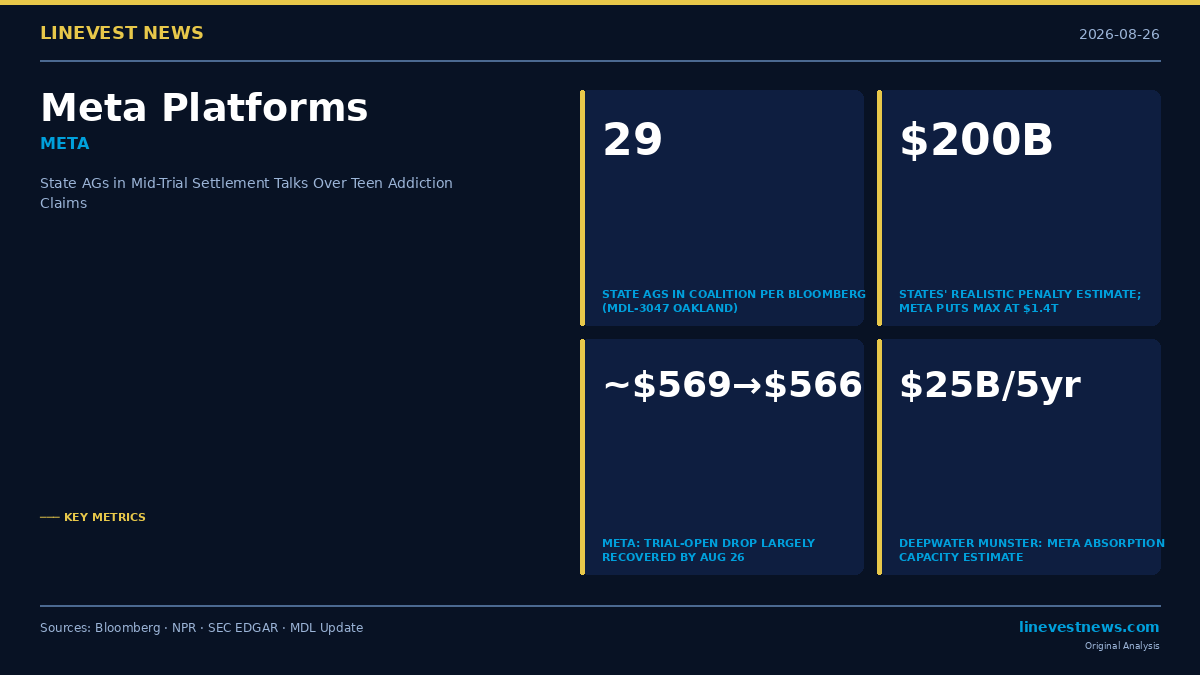
TL;DR - Bloomberg reported Aug. 26 that Meta and a coalition of state attorneys general (Bloomberg and MDL Update describe 29 states) have discussed a potential mid-trial settlement in the federal teen social media addiction case (MDL-3047, Oakland). - State lawyers told the court that $200 billion is a realistic penalty target; Meta's own legal team has separately calculated that the states' theories, if fully accepted, imply $1.4 trillion in maximum liability. - Nevada's AG announced a press conference for a "major consumer protection" matter — a potential signal that a settlement is near, though no deal has been confirmed. - Gene Munster of Deepwater Asset Management estimates Meta has the balance-sheet capacity to absorb roughly $25 billion in cumulative fines over five years; mandatory platform redesign is seen as the bigger long-run threat to the advertising business.
Part A: The Trial and the Settlement Talks
What Is MDL-3047?
On August 18, 2026, an eight-person advisory jury was seated in a federal courtroom in Oakland, California, for what the presiding judge — the Honorable Yvonne Gonzalez Rogers — has described as a landmark test of social media platform liability for harm to minors.
The case is the consolidated state attorney general track of the Social Media Adolescent Addiction Products Liability Litigation (MDL-3047, Northern District of California). The broader docket counts 3,137 pending cases and has grown 153% since January 2025, according to MDL Update. The prior federal MDL bellwether case (Breathitt County v. Meta) settled pre-verdict for approximately $27 million in May 2026. MDL Update describes the current Oakland trial as the first in the federal social media litigation to go all the way to a jury.
Meta had sought to halt the trial on Section 230 immunity grounds, but the Ninth Circuit Court of Appeals dismissed that appeal as premature on August 10, removing the company's last procedural escape hatch before trial began.
The Coalition of State AGs
A coalition of state attorneys general — Bloomberg and MDL Update describe 29 states — is active in the trial, led in court by California, Colorado, Kentucky, and New Jersey. The complaint alleges that Meta deliberately engineered Instagram and Facebook to addict teenage users, then concealed evidence of harm from regulators and the public.
Key evidence presented at trial: - A 2016 internal email listing "teen time spent" as an explicit Instagram company objective - A study titled "Long Term Retention: The Young Ones Are The Best Ones" examining adolescent usage patterns and lifetime revenue - Testimony from a former Instagram data scientist on the accuracy of internal safety reporting
California Deputy Attorney General Megan O'Neill framed the case in opening statements as a story about Meta's business model: to "hook" users, "hold" them, "harvest" data, then "hide" the truth.
Meta's defense, led by attorney Paul Schmidt, argued states cherry-picked isolated documents, that social media addiction is "not a recognized psychiatric condition," and that Meta has made meaningful efforts to protect children on its platforms.
What States Are Seeking
States are pursuing two categories of relief:
Civil monetary penalties. The complaint alleges violations of consumer protection statutes and the Children's Online Privacy Protection Act (COPPA). COPPA protects children under 13; the states additionally invoke broader state consumer protection laws covering all minors under 18. Specific allegations include collecting personal data from users Meta knew were under 13 without parental consent, using that data to train machine learning models, and misrepresenting platform safety. State lawyers told Judge Gonzalez Rogers that $200 billion is their realistic penalty estimate. Meta's own legal team has separately calculated that the states' theories, if fully accepted, imply $1.4 trillion in maximum liability.
Mandatory platform redesign. Beyond cash, states are seeking structural changes potentially including restrictions on algorithmic content ranking for under-18 users, mandatory chronological feed options, data deletion requirements for minors' accounts, and transparency reporting on usage and mental health outcomes.
Related Litigation Landscape
For context, the Oakland trial sits within a broader legal campaign:
| Case | Amount | Type | Date |
|---|---|---|---|
| K.G.M. v. Meta (state court) | $6M ($3M compensatory + $3M punitive) | Jury verdict | March 2026 |
| Breathitt County v. Meta (federal MDL bellwether) | ~$27M | Pre-verdict settlement | May 2026 |
| Snap + TikTok AG settlements | Confidential | AG settlements | January 2026 |
| New Mexico v. Meta (separate) | Seeks up to $62.85B | Pending trial | Sept. 8, 2026 |
Note: New Mexico row reflects the amount sought, not an award or settlement.
These cases vary widely in scope. The 29-state consolidated Oakland trial is categorically larger than any prior individual or AG action.
The Settlement Signal
Bloomberg News reported August 26 — in the trial's second week — that Meta and state attorneys general have discussed a potential mid-trial settlement of the case. Late on the same day, several AGs' offices issued press advisories announcing upcoming press conferences. Nevada Attorney General Aaron Ford's office described an upcoming announcement about "a major consumer protection" matter.
Important note: As of the time of this article's publication, no settlement has been announced, no amount has been confirmed, and both parties may still be far apart on financial terms and required platform changes. Mid-trial settlement discussions in high-profile multistate litigation frequently precede a deal — but do not guarantee one.
The trial is expected to conclude around October 2026. Because much of the relief sought is equitable, the advisory jury's verdict is non-binding; Judge Gonzalez Rogers will issue the final ruling.
Part B: What This Means for META Investors
Meta's Financial Position
Meta's Q2 2026 revenue grew 28.0% year-over-year to $60.8 billion, reflecting strong advertising demand. Net income declined 13.6% year-over-year in part because a $2.4 billion legal charge — related to the Manus AI deal unwind, a separate matter from the teen litigation — was recorded in the quarter alongside higher AI infrastructure spending.
| Metric | Q2 2026 | Q2 2025 | Change |
|---|---|---|---|
| Total revenue | $60.8B | $47.5B | +28.0% |
| Net income | $15.85B | $18.34B | −13.6% |
| Diluted EPS | $6.18 | $7.14 | −13.4% |
| H1 revenue | $117.1B | $89.8B | +30.4% |
Source: Meta Platforms Form 10-Q for the quarter ended June 30, 2026 (SEC EDGAR)
With H1 revenue of $117.1 billion — and Q4 historically Meta's strongest ad quarter — the company generates substantial operating cash flow. Gene Munster of Deepwater Asset Management has estimated that Meta has the capacity to absorb approximately $25 billion in cumulative fines over five years — roughly $5 billion annually — without materially impairing its investment trajectory. This is an absorption-capacity estimate, not a settlement-amount prediction.
Why Platform Redesign Is the Bigger Risk
Some analysts emphasize that mandatory platform redesign could ultimately prove more damaging to Meta's business than any cash penalty.
Meta's advertising model is built on engagement: the longer and more intensely a user scrolls, the more ad impressions are served and the more granular the behavioral targeting data becomes. Court-ordered changes to how content is algorithmically ranked for under-18 users, or how usage data from minor accounts can be applied to ad targeting, could create operating constraints that depress engagement metrics and targeting precision for a key user cohort.
Institutional investors appear to be distinguishing between these two risk categories. Despite the legal cloud, hedge funds Appaloosa raised its META stake by 55% in Q2 2026 and Viking Global boosted its position by 75.8% in Q2 — suggesting large allocators consider the core advertising engine resilient enough to absorb a manageable financial settlement, while watching closely for design mandates.
Precedent: What Regulators Have Extracted from Big Tech
Three significant AG settlements involving tech companies provide a reference point for scale:
| Settlement | Company | Amount | Year |
|---|---|---|---|
| Location data tracking (40 AGs) | $391.5M | 2022 | |
| Google Play antitrust (52 jurisdictions, all 50 states plus D.C. and Puerto Rico) | $700M | 2023 | |
| Facial recognition biometric data (Texas AG) | Meta | $1.4B | 2024 |
The largest single-state AG settlement involving Meta — Texas's $1.4 billion facial recognition case in 2024 — is the closest analogue involving alleged unlawful data use by Meta. The two multistate Google settlements peaked at $700 million. All three are vastly smaller than the $200 billion states are seeking in Oakland.
This record provides a reference point for investor scenario planning. That said, the nature of this case — alleged harms to minors across multiple states, COPPA violations, and internal documents — is factually distinct from the antitrust and biometric privacy cases in the table above, so prior precedents do not directly cap the outcome.
Three Scenarios
Scenario A: Settlement announced in the near term A cash settlement plus agreed platform changes ends the trial. META stock would likely respond positively as the open-ended overhang is removed. The magnitude of required platform changes would determine whether investor relief is durable. A cash figure consistent with what analysts consider within Meta's absorption capacity — Munster's estimate implies $25 billion cumulatively over five years — would shift focus to the design mandate details.
Scenario B: Trial continues to an October ruling by Judge Gonzalez Rogers The judge has discretion to award penalties below the maximum, prioritize equitable relief, or find for Meta on key claims. An October ruling with both monetary and design components would depend heavily on how she weighs the internal document evidence. This scenario provides legal certainty but the widest range of financial outcomes.
Scenario C: No October resolution — case moves into 2027 appeals If the case does not resolve through settlement or a fall ruling, the uncertainty discount on META shares persists. This is the outcome the current settlement discussions are intended to avoid.
META Stock During the Trial
Meta shares fell 4.45% on the trial's first day (August 18, 2026), closing at $543.67, with the prior session's close implied at approximately $569. By August 26, shares had recovered to approximately $566–$568, nearly back to pre-trial levels.
The trial-opening discount has largely been retraced. The key long-term variable for investors is not whether Meta pays — a settlement of some magnitude is widely expected — but whether settlement terms include platform-change components that constrain the advertising engine driving Meta's revenue growth.
What Investors Should Watch
- Nevada AG press conference: The announced "major consumer protection" matter is the most immediate potential catalyst. Timing and content will be the first concrete settlement signal.
- Trial proceedings (if no settlement): Damages expert testimony will set the financial framing for any October ruling.
- META Q3 2026 earnings (expected October 2026): Management commentary on legal reserve additions will reveal how seriously the company is treating the settlement math.
- New Mexico v. Meta (trial September 8, 2026): A separate case seeking up to $62.85B. An adverse ruling before the Oakland case resolves would shift Meta's settlement leverage.
This article is for informational purposes only and does not constitute investment advice or a recommendation to buy or sell any security. All information reflects publicly available sources as of August 26, 2026. Consult a licensed financial professional before making investment decisions.
Sources: - Meta, States Have Discussed Settling Teen Social Media Harm Case — Bloomberg - NPR: Meta heads to court in a landmark trial about kids and social media addiction - NPR: 'Profits won.' The child safety trial against Meta kicks off in federal court - Social Media Addiction Lawsuit Update August 2026 — MDL Update - Meta Platforms Form 10-Q Q2 2026 — SEC EDGAR - Yahoo Finance: Meta to face massive social media addiction trial Tuesday - BigGo Finance: Meta Tumbles as Landmark Teen Safety Trial Opens; Munster Warns Bigger Threats Loom - Investing.com: Meta, U.S. states weigh settlement in teen social media addiction case