TL;DR
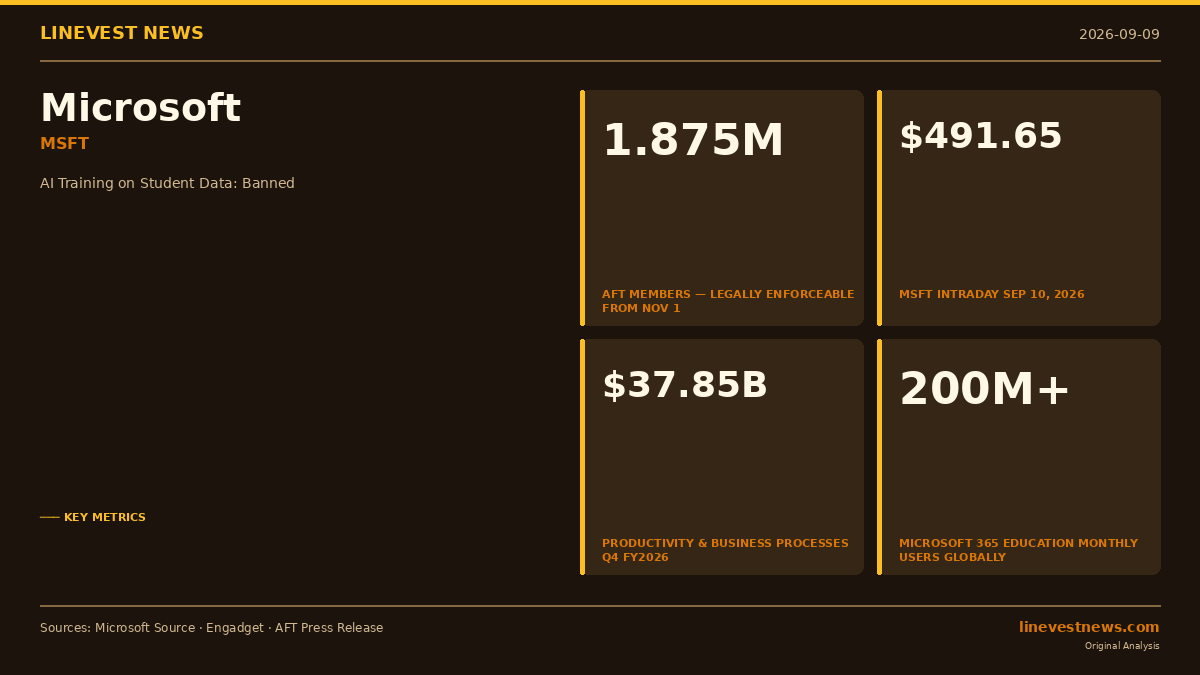
- The deal: Microsoft and the American Federation of Teachers (AFT, 1.875 million members) launched a "National AI Safety & Privacy Standard" on September 9, 2026, barring student and educator data from AI training pipelines — narrow safety and security exceptions apply — with contractual enforcement teeth.
- Stakes: School districts can incorporate these protections directly into Microsoft customer agreements and seek damages if violated; effective November 1, 2026.
- What's next: AFT is in active negotiations with OpenAI and Anthropic for identical commitments — the outcome shapes whether this is a Microsoft moat or an industry baseline.
- The stock: MSFT was trading near $491.65 on September 10 — up 41% from its 52-week low of $349.20 — as its Productivity & Business Processes segment generated $37.85 billion in Q4 FY2026.
What Happened
On September 9, 2026, Microsoft, the American Federation of Teachers (AFT), and the United Federation of Teachers (UFT — the AFT's 200,000-member New York City local) jointly announced what they call the "National AI Safety & Privacy Standard for Schools."
The agreement is built on three pillars:
| Pillar | What Microsoft Commits To |
|---|---|
| Data Protection | Student and educator data will not be used to train AI models, will not be sold, and will not be repurposed for any non-educational use |
| Safety & Human Oversight | AI systems in schools must include human decision-making checkpoints; automated decisions affecting students require human review |
| Transparency | Families receive clear, accessible explanations of how AI tools work in their children's schools |
The standard includes a narrow carve-out for genuine safety and security scenarios — cybersecurity monitoring, for example — but the baseline prohibition on AI training applies broadly across Microsoft's educational products.
Critically, this is not a voluntary pledge. School districts can attach these provisions directly to their existing Microsoft customer agreements, creating breach-of-contract liability if Microsoft violates the terms. That enforcement mechanism — damages plus the right to terminate — distinguishes it from the industry's typical privacy commitments, which often rest on internal policy rather than contract law.
The standard becomes available to school districts nationwide on November 1, 2026.
AFT President Randi Weingarten called the agreement "legally enforceable provisions" rather than voluntary commitments, explicitly contrasting it with what she described as the regulatory vacuum that currently governs AI in classrooms. The Family Educational Rights and Privacy Act (FERPA), enacted in 1974, was not designed for AI and offers no explicit prohibition on using student records for model training. The Children's Online Privacy Protection Act (COPPA) covers children under 13 but does not address AI training directly. Until Congress acts — and no comprehensive federal AI education bill has cleared committee — private contracts are the strongest available tool.
Three Watch Points for MSFT Investors
Watch Point 1: Does This Widen Microsoft's Education Moat Against Google?
Microsoft and Google are the two dominant platforms in K-12 education. Microsoft's Teams for Education reaches more than 200 million monthly users globally. Google Classroom is the other anchor tenant in most U.S. districts, with Chromebooks holding roughly 60% of K-12 device market share.
For school districts — where data privacy is not merely a preference but a legal obligation under student-data laws in more than 40 states — a contractually enforceable AI privacy commitment from Microsoft creates a differentiating signal that Google has not yet matched with an equivalent union-negotiated standard.
Microsoft's Productivity & Business Processes segment — which houses Microsoft 365 Education, Teams, and Copilot products — generated $37.85 billion in revenue in Q4 FY2026 (ended June 30, 2026), up 14% year over year. Microsoft 365 Copilot surpassed 30 million paid seats. Education is not broken out separately, but it feeds directly into the M365 installed base that sustains that growth.
If districts view this standard as a procurement differentiator — choosing Microsoft over rivals during contract renewals because the privacy commitment is contractually embedded — that stickiness compounds over multi-year technology cycles. The risk: Google or another competitor matches the standard before November 1, erasing the head start.
For investors: Watch whether Google announces an equivalent agreement with the National Education Association (NEA, the other major U.S. teachers union) before Microsoft's November 1 effective date. If it does, the moat narrows. If it does not, Microsoft's roughly 53-day window — from the September 9 announcement to November 1 availability — to lock in district renewals represents a meaningful first-mover advantage.
Watch Point 2: Regulatory Pre-Emption — Microsoft Helps Write the Rules Before Congress Does
The AFT's "National AI Safety & Privacy Standard" is not federal law. But it is the most concrete, enforceable AI governance framework yet applied to U.S. schools — and it carries the institutional weight of a 1.875 million-member union with political reach in every state.
When federal student-data privacy legislation eventually arrives — and bipartisan interest in AI-in-education rules is growing — congressional staff and state regulators will look for existing frameworks. Microsoft, having co-authored this one, is positioned to shape that conversation rather than respond to it.
This is a playbook Microsoft has used before. Azure's government cloud compliance programs (FedRAMP, DoD IL5, CJIS) gave Microsoft early enterprise contracts by pre-certifying to requirements that customers — and eventually regulators — then formalized. The AFT standard is an analogous move in the education vertical.
The near-term risk is the inverse: if a state or federal regulator adopts a stricter standard that this agreement does not fully satisfy, Microsoft may face a compliance gap despite having signed the agreement in good faith. For example, if legislation mandates affirmative opt-in consent for every AI interaction — rather than an opt-out approach for any data use outside the prohibited categories — school districts may need to renegotiate their contracts.
For investors: Track whether the New York State Legislature, California's CPRA enforcement office, or the FTC's AI task force cite the AFT standard in forthcoming guidance. Positive citations accelerate adoption; divergent requirements create compliance costs.
Watch Point 3: The OpenAI and Anthropic Negotiations — Moat or Industry Floor?
AFT is not done. The union confirmed it is in active discussions with OpenAI and Anthropic to secure equivalent commitments. This is the most consequential swing factor for MSFT investors.
Scenario A — OpenAI and Anthropic agree quickly: The AFT standard becomes an industry baseline, not a Microsoft differentiator. This is neutral-to-slightly-negative for MSFT's moat, but positive for the broader EdTech AI adoption market. Microsoft's deeper integration in K-12 (Teams, M365 Apps, Azure Active Directory) still advantages it on implementation, even if the privacy bar is shared.
Scenario B — OpenAI and Anthropic agree, but with weaker terms: Microsoft's version — with explicit breach-of-contract liability and district-level enforcement — remains structurally stronger. Districts that care about enforceability will favor MSFT's implementation. This is modestly positive for MSFT.
Scenario C — OpenAI and Anthropic refuse or stall: School districts that want AI tools but need legal cover for data protection face a binary choice: Microsoft's compliant products, or AI tools from vendors they cannot legally defend against parent lawsuits and state audits. This is the most MSFT-favorable outcome — and the most politically unstable, as union pressure would escalate. AFT's track record of sustained campaigns suggests this scenario ultimately resolves through concession, not stalemate.
For broader context: Microsoft Cloud revenue reached $59.3 billion in Q4 FY2026, up 27% year over year, with Azure surpassing $100 billion annualized for the first time. Education is not the primary driver of those numbers — enterprise and government are. But education adoption creates long-term pipeline: students trained on Teams and Copilot become the enterprise buyers of the next decade.
For investors: AFT's negotiating timeline with OpenAI and Anthropic will determine whether this agreement is a temporary competitive wedge or a permanent industry norm. Check AFT press releases in October for any update.
The Bottom Line
Microsoft's AFT agreement is simultaneously a product decision, a regulatory strategy, and a signal about where AI governance in education is heading. The contractual enforcement mechanism — unusual in corporate AI privacy commitments — gives it more practical weight than a typical policy pledge.
For MSFT trading near $491.65 on September 10, with Microsoft Cloud expanding 27% and M365 Copilot seats surpassing 30 million, this is incremental positive news rather than a valuation-moving event. The real test is whether the deal converts into measurable district retention and seat expansion during the summer 2027 back-to-school procurement cycle — and whether Google, OpenAI, or state legislators blunt the advantage before it compounds.
This article is for informational purposes only and does not constitute investment advice.
Sources
- AFT, UFT, and Microsoft Announce National AI Safety & Privacy Standard — Microsoft Source (Sep 9, 2026)
- Microsoft Strikes Deal With National Teachers Union to Not Use School Data to Train AI — Engadget
- AFT Posts Highest-Ever Membership of 1.875 Million — AFT Press Release
- Microsoft Q4 FY2026 Earnings Results — Microsoft Investor Relations
- Microsoft AI in Education 2026 Report — Microsoft Source