Xiaomi's most expensive new foldable phone costs roughly what Apple's cheapest foldable is expected to cost. Both figures reached the public within four days of each other. That overlap, not the hardware, defines the market Apple (NASDAQ: AAPL) walks into on Wednesday.
What landed on Monday
Xiaomi (HKEX: 1810), the Beijing-based phone and home-appliance maker, launched the Xiaomi 18 Fold on Monday. It is the company's most premium handset to date.
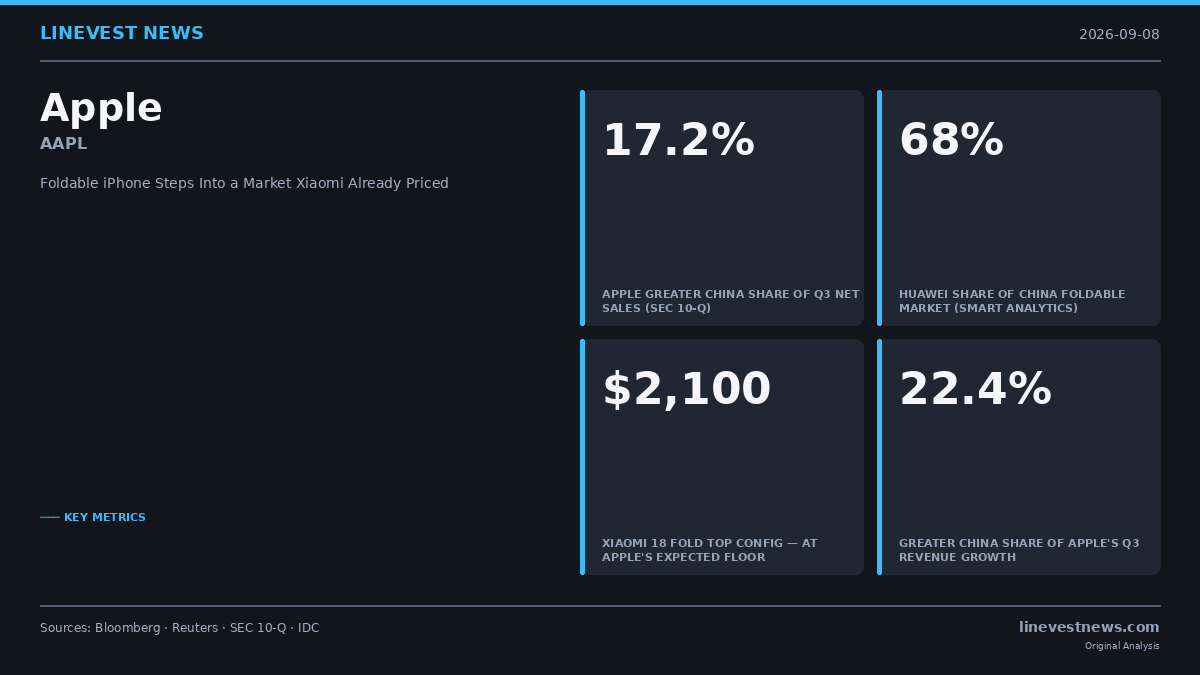
Reuters reported the top configuration at 14,999 yuan, converting that to approximately $2,100. The entry version lists at 10,999 yuan, or approximately $1,540 at the same conversion.
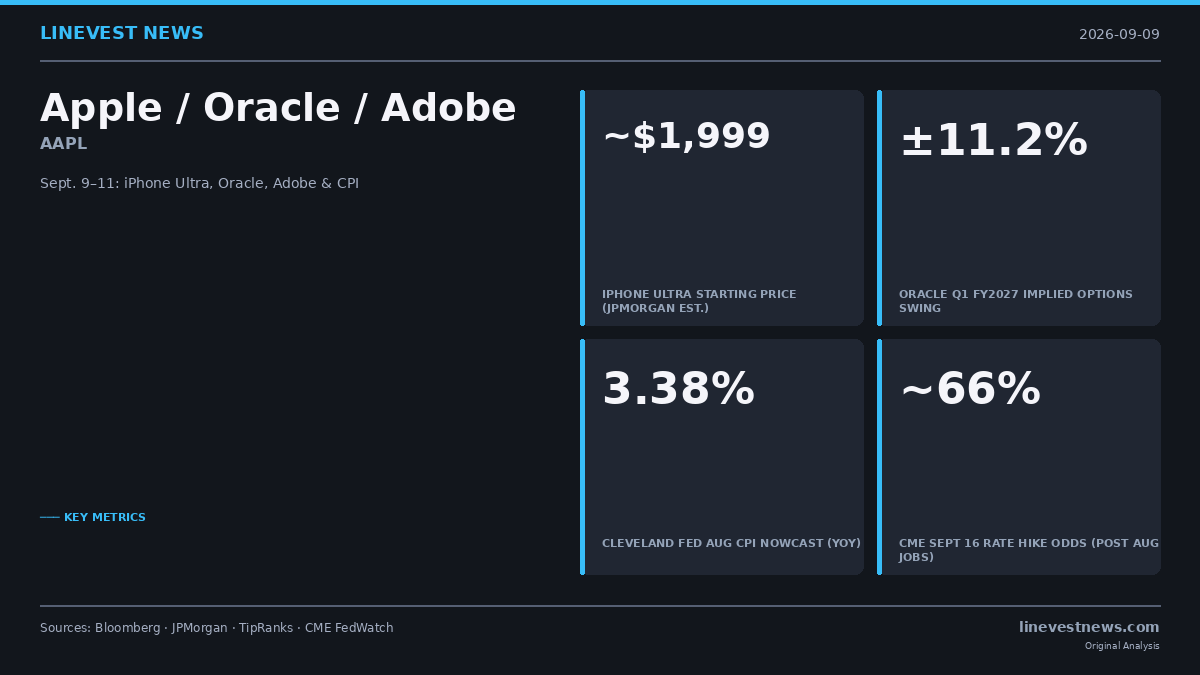
Apple has not announced a price for its own foldable. TrendForce, a Taiwanese technology research firm, published an estimate on Sept. 3. It expects the phone to start between $2,099 and $2,299 in the United States, according to MacRumors' account of that report. Citi analysts have estimated the phone's starting price above $2,000.
TrendForce's $2,099 floor sits at the level of Xiaomi's $2,100 ceiling. The lowest analyst estimate on record, $1,999, sits just below it. Apple has charged a premium in China for years and kept selling. But it has never done so in a category where the local brands shipped first, shipped for years, and already own the shelf.
Huawei aimed higher on the same day. The employee-owned Chinese telecom-equipment and handset maker showed the Mate XT2. The device folds twice rather than once, opening out to a tablet-sized screen. Sales open Saturday.
Reuters reported prices from 19,999 yuan to 24,999 yuan. At Reuters' conversion rate applied that day — which differed slightly from the rate used in its Xiaomi coverage — those translated to approximately $2,980 and $3,725.
Both Chinese companies now design their own processors. Huawei's device uses its Kirin 9050 Pro. Xiaomi's runs the XRing O3, built in house. Chief executive Lei Jun said the XRing O3 beats Apple's A19 Pro on responsiveness, Reuters reported. Apple has not answered the claim.
Why It Matters
The engineering boasts are not the story. The timing is. Two Chinese vendors put firm prices and product details in front of Chinese buyers two days before Apple describes a product that reaches stores later. In a market where the premium tier is the only tier still growing, that is a deliberate spoiler.
A spoiler launch is cheap for the company doing it and awkward for the company on the receiving end. Huawei and Xiaomi were going to ship these phones anyway. Moving the announcement forward by two days costs them nothing. What it buys is the chance to define the category's price ceiling before the newcomer speaks. Every review published this week now has a reference point that is not Apple's.
For Apple, the stake here is not a single product line. It is the standing of its pricing in a market that has been carrying an outsized share of its growth. A premium price works when buyers accept that the product is the best thing available. It works less well when rivals have spent years teaching those same buyers what a folding phone should cost. Apple is not entering an empty room. It is entering one where the furniture is already arranged.
That is the question Wednesday puts on the table. The answer will not arrive on Wednesday.
The number that decides how much this matters
Apple's own quarterly filing sizes the exposure. For the three months ended June 27, 2026, Greater China net sales were $18.816 billion. A year earlier the same segment produced $15.369 billion.
Total company net sales for the quarter were $109.417 billion. Those figures come from the Form 10-Q Apple filed with the SEC on July 31. A Form 10-Q is the quarterly financial report US-listed companies must file.
Greater China was therefore 17.2% of Apple's revenue. It supplied a bigger share of the growth. Company revenue rose $15.381 billion from the year-ago quarter, and Greater China accounted for $3.447 billion of that — 22.4%.
Neither percentage appears anywhere in the filing. Both fall out of the segment table with one division each. That is why Monday matters more than a routine product launch overseas. The region carrying an outsized share of Apple's growth is the same region where its newest product arrives last and priced highest.
That is not a contradiction. It is a dependency. Dependencies are worth watching when a rival moves first, because the cost of a stumble is not proportional to the region's size. It is proportional to the region's share of the momentum.
The same table shows Greater China segment income of $7.406 billion for the quarter, up from $5.822 billion a year earlier. As a share of segment revenue, that is 39.4%, against 37.9% a year earlier. Apple's geographic segments exclude allocated corporate costs, so these ratios are not the same as consolidated operating margins; they measure how much of each region's revenue drops to the segment line before those deductions.
Apple has been growing China revenue while expanding its segment income ratio. Whether it can hold that discipline in a category it enters from behind is the open question sitting underneath Wednesday's keynote.
Memory is the common enemy
Both Chinese executives pointed to the same input cost on launch day. Richard Yu, a Huawei executive director, said pricing "is a real challenge, because memory costs have risen sharply," per Reuters. He added that "the cost pressure has been enormous." Lei said memory is "very, very expensive," while calling his own phone value for money.
That is an unusual thing for two competitors to volunteer on a launch day. Executives introducing a flagship normally talk about what the product does, not about what it cost to build. Saying it out loud pre-empts the obvious complaint about the sticker. It also tells you the pressure is real enough that neither company thought it could be hidden.
IDC forecasts a substantially sharper rate of decline in China's smartphone market during the second half of 2026, pointing to shrinking inventories of cheaper components as a driver of the cost pressure.
Set those statements next to each other. The two incumbents are absorbing a memory-cost shock and saying so out loud. The forecaster expects the market itself to slow more sharply while that happens. Apple is introducing its most component-hungry phone into precisely that window, and at the top of the price range rather than under it.
Who owns the folding phone in China
Huawei took 68% of China's foldable shipments, according to Smart Analytics Global data cited by Reuters. That is not a narrow lead. It is incumbency, and it was built while Apple was absent from the category entirely.
The broader phone market is far closer. IDC put China smartphone shipments at roughly 66 million units in the second quarter, down 4.3% from a year earlier. Within that:
| Company | Market Share | YoY Change |
|---|---|---|
| Huawei | 22.6% | +19.4% |
| Apple | 18.1% | +24.4% |
| Xiaomi | 12.4% | −21.7% |
Those two datasets point in different directions, and the difference is the point. Apple is gaining in Chinese phones generally. It has no position at all in the folding subset. Xiaomi is doing the reverse. It is losing ground in the mainstream while pushing hard into the premium fold. A price that undercuts Apple before Apple has spoken is what that strategy looks like in practice.
Huawei, not Samsung, is the world's largest foldable vendor. Smart Analytics Global put Huawei's share of global foldable shipments at 48% last quarter, with Samsung in second place. So the company that owns the folding phone at home also leads it everywhere else.
Samsung's own record shows how unforgiving the category can be. It launched a tri-fold device in Korea in December 2025 and discontinued it after about three months on sale, MacRumors reported. In July it unveiled a new Galaxy Z Fold8 lineup at an Unpacked event in London. Scale in foldables has not guaranteed staying power for any single design.
Prior coverage
On Sept. 4 this publication laid out the price estimates circulating ahead of the event. They ran from roughly $1,999 to $2,500 across several analysts. There was nothing concrete to measure them against at the time.
Monday supplied the yardstick, and it arrived from an unexpected direction. TrendForce's entry estimate now sits at the level of Xiaomi's ceiling. Four days earlier that comparison could not have been drawn, because the Chinese prices did not exist yet.
On Aug. 27 we wrote that Apple's fiscal year ends approximately 18 days after the keynote, leaving the foldable almost no room in this year's revenue. That still holds. The second-order question has changed, though. It is no longer only whether the phone ships in time to be counted. It is what price Chinese buyers will already have anchored on by the time it does.
What would make this reading wrong
The comparison above assumes Chinese premium buyers cross-shop foldables against one another. They may not.
Apple's share gain in China last quarter came from its conventional lineup. IDC attributed it to stable pricing, targeted promotions and brand loyalty rather than to any new shape of phone. If the foldable works mainly as a halo product that draws attention to the rest of the range, the gap against Xiaomi barely registers.
The unit math points the same way. Citi estimates Apple will sell about 5 million foldables in the second half of 2026. Apple booked $54.252 billion of iPhone revenue in the June quarter alone, per the 10-Q. A first-generation product does not have to win China to matter elsewhere. Apple has historically treated first generations as a starting position, not a verdict.
Three checkpoints
Huawei's Mate XT2 goes on sale Saturday. That gives an early read on demand at close to $3,000, before Apple's phone is on any shelf. Apple sets its own price on Wednesday, and the distance from TrendForce's $2,099–$2,299 estimate is the first fact worth logging. Apple's fiscal fourth-quarter results, due in late October, will carry the first Greater China revenue line that includes any foldable at all.
The last of those is the one that counts. Everything before it is positioning, and positioning is what both Chinese launches on Monday were built to do.
Sources
- Reuters — Huawei and Xiaomi pricing, executive quotes (Sept. 7–8, 2026)
- Bloomberg — Apple's Foldable iPhone Coverage
- Apple Form 10-Q (SEC EDGAR, filed July 31, 2026)
- MacRumors — TrendForce iPhone Fold price estimate ($2,099–$2,299)
- IDC via TelecomLead — China smartphone market Q2 2026
- Smart Analytics Global — Global foldable market Q2 2026
- MacRumors — Samsung tri-fold discontinuation (March 2026)
This article is journalism, not investment advice. LineVest is not a registered investment adviser. Figures are drawn from Apple's SEC filings, Reuters reporting and named research firms as cited above. Verify all figures against primary sources before acting on them.