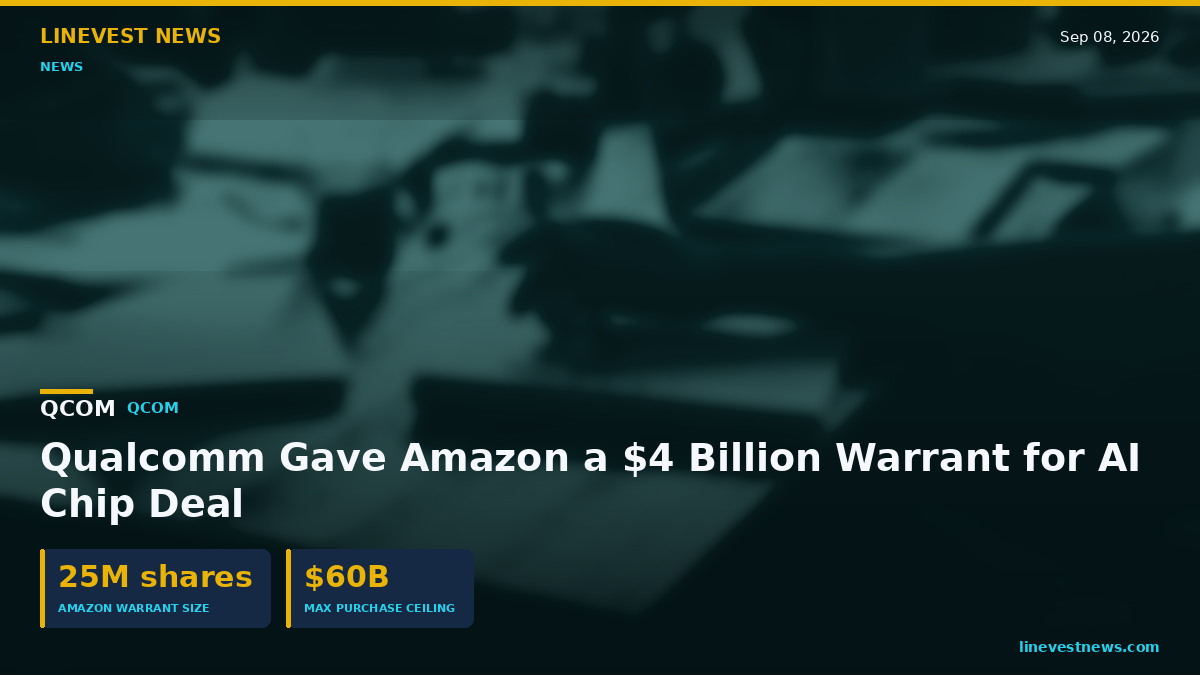
Qualcomm (NASDAQ: QCOM) said Tuesday, Sept. 8, that it will build custom AI data center silicon for Amazon (NASDAQ: AMZN). The joint announcement says nothing about equity. A separate Form 8-K, filed the same day, shows Qualcomm also handed Amazon a warrant on 25 million of its own shares — about $4 billion at the exercise price. An 8-K is the current report a company files to flag material events to shareholders between quarterly reports.
A warrant is a contract giving its holder the right to buy stock later at a price fixed today. Qualcomm's press release does not use the word. The whole disclosure sits in a four-paragraph regulatory filing that most readers of the press release will never open.
What the filing actually says
The document is a Form 8-K filed under Item 3.02. That is the item companies use when they issue stock without registering it with the SEC first. Qualcomm signed the warrant on Sept. 3, five days before either company said anything publicly.
The filing states that Qualcomm "issued a warrant ... to acquire up to an aggregate of 25,000,000 shares of the Company's common stock at an exercise price of $161.26 per share." It expires on Sept. 3, 2036.
The holder is Amazon.com NV Investment Holdings LLC, an Amazon affiliate. The commercial counterparty named in the filing is Amazon Data Services, Inc., the AWS entity that buys hardware. Qualcomm relied on Section 4(a)(2) of the Securities Act, the exemption for transactions by an issuer that do not involve a public offering.
The warrant allows cashless exercise. That means Amazon can settle by surrendering part of the position instead of writing a check. It carries no voting rights until exercised. Qualcomm added that it expects to file a resale prospectus supplement so Amazon can sell the shares once it holds them.
None of this is hidden, exactly. That item exists precisely so shareholders learn when new stock is promised to someone else. But it is a different document, aimed at a different reader, and it went out while the news cycle was busy with the product story.
The product story, briefly
The two companies said they will develop customized silicon for AI inference — running trained AI models to answer queries, as opposed to the training that builds them. Inference is the workload that scales with users rather than with research budgets, which is why it has become the contested ground in data center chips.
They also plan optical connectivity reaching 1.6 terabits per second, using Qualcomm's SerDes and optical signal-processing designs. SerDes is the circuitry that squeezes parallel data onto a high-speed serial link.
That second half matters more than it may sound. Cristiano Amon, Qualcomm's chief executive, framed the effort around data centers needing advances "in both computing and connectivity." Moving data between accelerators has become as much of a constraint as the accelerators themselves.
Why it matters
Two documents went out that day, and they tell different stories. The press release describes a partnership. The regulatory filing describes a payment.
That gap is the point. A chip designer courting an anchor customer for a product line still being built cannot lean on a discount alone. Qualcomm offered a claim on its own shares instead, and disclosed it where the fewest readers look.
The pattern is now bigger than this one deal. Equity has become a currency in the AI hardware supply chain. It flows from suppliers toward the handful of buyers large enough to make a new chip program viable. Such grants dilute existing holders, and they hinge on revenue that has not yet been booked. That is why the vesting language deserves more attention than the headline number.
"$4 billion" is what Amazon pays, not what Amazon gets
Much of Tuesday's coverage described the deal as giving Amazon the right to buy about $4 billion of Qualcomm stock. The arithmetic holds: 25 million shares at $161.26 comes to $4.03 billion. But that is the cash Amazon would hand over. It is not the value Amazon receives.
The value sits in the gap between the strike price and the market price. Qualcomm closed at $168.57 on Sept. 3, the day the warrant was signed, according to Yahoo Finance daily price data. The strike was set 4.3% below that close.
The warrant was therefore worth something the moment it was issued. Only 3,750,000 of the shares vested on day one. Measured against Qualcomm's Sept. 3 close of $168.57, also per Yahoo Finance, that first tranche carried roughly $27.4 million of built-in gain.
Qualcomm has not said how the strike was calculated. A price below the signing-day close is consistent with an average of recent trading, but the filing does not specify.
The $60 billion is a ceiling, not an order
This is the figure that moved the stock, and it rewards careful reading. It describes the most Amazon could ever spend. It is not what Amazon has agreed to spend.
The 8-K says the shares "vest in tranches tied to the execution of certain commercial arrangements, the placement of binding purchase orders and actual purchases" of Qualcomm server chips, technology, systems and manufacturing services. The ceiling is "a maximum amount of $60 billion in payments."
The shares that vested at signing did so, in the filing's words, "based on initial purchase commitments." So 15% of the warrant is already vested. The rest depends on orders that do not yet exist.
Size the ceiling against the company. Qualcomm's fiscal 2025 revenue was $44.28 billion, per its annual report. The $60 billion figure is about 1.35 times that.
Spread it across a warrant running to 2036 and it averages roughly $6 billion a year. That is the arithmetic maximum, assuming Amazon buys everything the agreement contemplates and does so evenly.
Now size it against Qualcomm's own ambition. At its June 24 investor day the company targeted "more than $15 billion" of data center revenue by fiscal 2029. Amazon's maximum average annual spend is under half of that target.
Read those two together and the deal looks like a foundation rather than a finish. Qualcomm needs Amazon plus other customers to reach what it promised investors in June. That is not a criticism of the agreement. It is a description of what one anchor account can and cannot do.
None of that makes the structure unusual. Chip designers now sell into a buyer base concentrated in a handful of cloud operators, and a new server accelerator burns years of engineering before it earns a dollar. An anchor customer is what justifies that roadmap internally.
Equity is how a supplier buys the commitment without spending cash. A price discount would show up immediately in reported margins. A warrant does not, at least not in the same way, and it pays the customer only if the supplier's own shares do well.
Amazon's side of the trade is simpler. It gains a second serious source for inference hardware and a claim on the upside of the supplier it is helping create. Neither costs it anything today. The warrant only becomes expensive for Qualcomm if the partnership works.
The precedent, and how it turned out
Advanced Micro Devices (NASDAQ: AMD) ran the same play eleven months ago. It issued OpenAI OpCo, LLC a warrant for up to 160 million shares at one cent a share. Vesting was tied to GPU purchase milestones.
The warrant was dated Oct. 5, 2025 and runs five years, according to the exhibit AMD filed with it. CNBC reported the stock "skyrocketed" 23% on the news.
The outcome so far is in AMD's own annual report. "None of the warrant shares met the vesting or exercise conditions and the warrant had no impact to our financial statements for the year ended December 27, 2025," the filing states. That covers only the twelve weeks between signing and AMD's fiscal year-end — but across that window of headlines, nothing vested.
That does not mean the AMD partnership failed. Multi-year silicon programs move slowly. It means only that the announcement and the revenue are separate events, sometimes by a long stretch.
The two warrants are not equivalent, and the difference is the interesting part. AMD's strike was a penny, which makes it close to an outright transfer. Qualcomm set its strike near the market price, so Amazon still has to pay for what it collects.
The scale differs too. AMD's 160 million shares were about 9.8% of the 1.63 billion outstanding in its latest annual report.
Qualcomm's 25 million are about 2.4% of the 1.05 billion shares its most recent quarterly report showed. Measured that way, Qualcomm gave up roughly a quarter as much of itself, and charged for it.
What this does and does not fix
LineVest reported on June 15 that Qualcomm was in advanced talks to buy Tenstorrent, a Santa Clara-based AI accelerator startup, for $8 billion to $10 billion. Neither Tuesday's press release nor the 8-K mentions Tenstorrent.
Three months on, Qualcomm has an anchor data center customer and has spent no cash to get one. Whether the warrant was always the plan or became the alternative, only the company knows. The two routes solve different problems: one buys engineering, the other buys demand.
Put the old business and the new one side by side. Handset chips brought in $5.09 billion in the June quarter — roughly $20.4 billion annualized — down 20% from a year earlier, per Qualcomm's results release. The Amazon ceiling averages about $6 billion a year.
At its theoretical maximum, over a decade, this agreement equals roughly 30% of that one shrinking product line's annualized revenue. That is the honest scale of it. It is a serious deal, and not by itself a transformation.
The market's own read shifted through Tuesday. Qualcomm opened at $180.32, up 6.9% from the prior close, and touched $183.49 during the morning, per Yahoo Finance intraday data.
Then it faded. The close was $173.65, a gain of 2.9% on the day.
Headlines written at the open and headlines written at the bell describe different events. Neither is wrong. The vesting schedule simply leaves a decade for the market to decide.