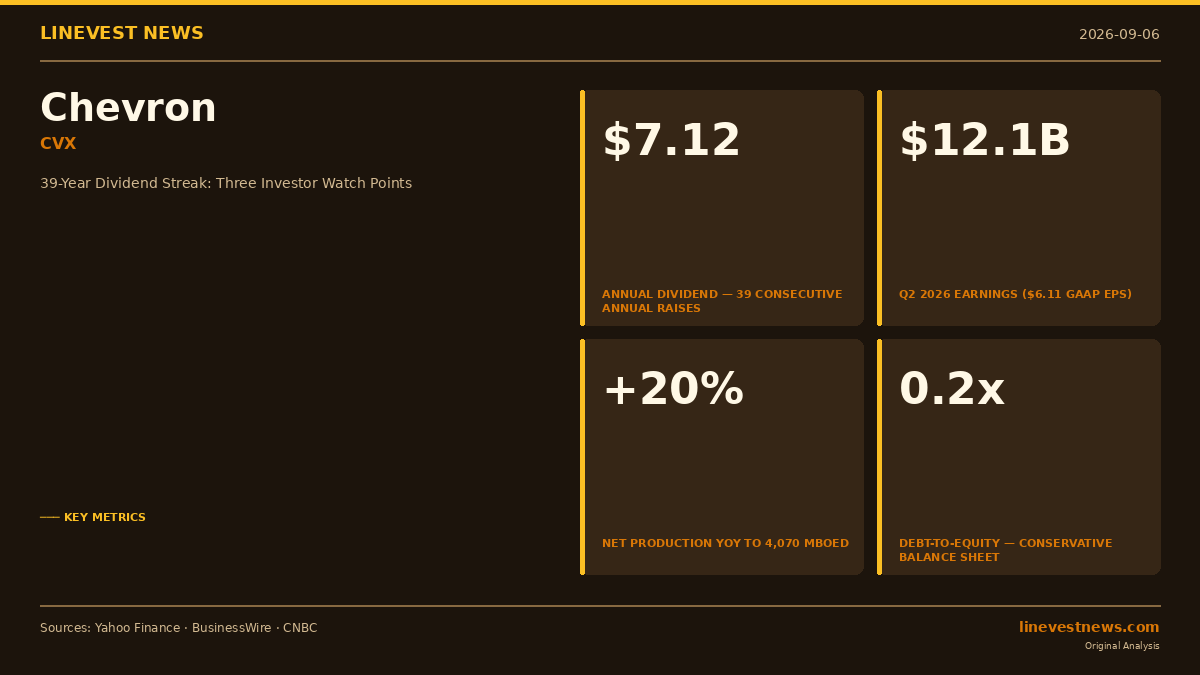
TL;DR - Q2 2026 GAAP earnings: $12.1B ($6.11/share); adjusted $6.06/share; production +20% YoY - Dividend at $1.78/quarter ($7.12 annual); 39 consecutive years of annual increases; yield ~3.4% at ~$208 - Hess acquisition (closed July 18, 2025) is the primary driver of the production jump - Three watch points: balance sheet profile, Guyana development pipeline, and Iraq's limited near-term earnings impact
Part A — Q2 2026 Financial Snapshot
Chevron Corporation (NYSE: CVX) reported second-quarter 2026 GAAP net income of $12.072 billion, or $6.11 per diluted share. Adjusted for a $230 million asset-sale gain, $86 million in pension settlement costs, and a $49 million foreign-currency headwind, earnings were $12.0 billion, or $6.06 per diluted share.
For comparison, Q2 2025 adjusted earnings were $3.1 billion ($1.77/share adjusted; $2.5B GAAP). The Q2 2025 quarter preceded the July 18, 2025 close of the Hess acquisition and included one-time charges tied to the deal process.
Net oil-equivalent production reached 4,070 thousand barrels of oil equivalent per day (MBOED), approximately 20% higher year-over-year per Chevron's press release. The jump reflects the Hess acquisition — which added a 30% working interest in ExxonMobil-operated Guyana's Stabroek Block, plus other Hess assets — as well as the August 2025 first-oil milestone for the Yellowtail/ONE GUYANA FPSO and continued organic production growth across legacy Chevron assets. U.S. refinery throughput set a record at 1.07 million barrels per day.
| Metric | Q2 2026 | Q2 2025 |
|---|---|---|
| Net income (GAAP) | $12.07B | $2.50B |
| Diluted EPS (GAAP) | $6.11 | $1.45 |
| Diluted EPS (adjusted) | $6.06 | $1.77 |
| Net production (MBOED) | 4,070 | — |
| Operating cash flow | $22.6B | — |
| Free cash flow | $18.1B | — |
| Capex | $4.5B | — |
| Quarterly dividend | $1.78 | $1.71 |
| Share buybacks (Q2) | $3.12B | — |
| ROCE | 21.4% | — |
The Board of Directors declared a quarterly cash dividend of $1.78 per share, payable September 10, 2026 — a 4.1% increase from the $1.71/share paid in Q2 2025. At a recent closing price near $208.60, the indicated annual dividend of $7.12 produces a yield of approximately 3.41%.
Total gross debt declined to $37.1 billion at June 30, 2026, from $40.8 billion at year-end 2025 — a reduction of approximately $3.7 billion in the first half of the year. In Q2 alone, Chevron also returned $3.1 billion to shareholders via buybacks alongside that debt paydown.
Part B — Three Watch Points for CVX Investors
Watch Point 1: Balance Sheet Discipline Sustains the 39-Year Streak
Chevron has raised its dividend in each of the last 39 consecutive years — a run spanning the 1990s oil bust, the 2008 financial crisis, and the 2020 pandemic collapse. The mechanism is deliberate financial architecture: borrow when oil prices fall to sustain the dividend; restore the balance sheet rapidly when prices recover.
Chevron's debt-to-equity ratio of approximately 0.2x as of Q2 2026 reflects a conservative capital structure with meaningful capacity to absorb sustained commodity-price weakness before any dividend adjustment would be considered.
The dividend's recent growth trajectory:
| Year | Annual dividend per share | YoY change |
|---|---|---|
| 2024 | $6.52 | — |
| 2025 | $6.84 | +4.9% |
| 2026 | $7.12 | +4.1% |
Chevron's dividend has grown at a mid-single-digit annual rate over the past several years, broadly in line with or modestly above headline inflation — a meaningful characteristic for income investors seeking real purchasing-power preservation alongside yield.
What to watch: Chevron operates with a conservative gearing philosophy; management has consistently prioritized debt reduction over accelerated buybacks when cash generation is strong. The $3.7 billion first-half debt reduction while maintaining $3.1 billion in Q2 buybacks illustrates this balanced approach. Monitoring the gross debt trajectory and quarterly buyback pace in Q3 and Q4 2026 will signal how management calibrates the two in a moderating commodity environment.
Watch Point 2: Guyana Drives the Next Phase, But the Easy YoY Comparison Is Fading
The 20% production increase year-over-year reflects a combination of: the July 2025 Hess acquisition (adding Chevron's 30% stake in ExxonMobil-operated Stabroek Block), Yellowtail first oil in August 2025 (contributing from Q3 2025 onward), and organic production growth across legacy Chevron assets.
Stabroek partner structure: ExxonMobil 45% (operator), Chevron 30%, CNOOC 25%.
Four Stabroek FPSOs are now producing or ramping: - Liza Phase 1 (Destiny FPSO): first oil December 2019 - Liza Phase 2 (Unity FPSO): first oil February 2022 - Payara (Prosperity FPSO): first oil November 2023, plateau reached 2024 - Yellowtail (ONE GUYANA FPSO): first oil August 2025, ramping through 2026
Chevron also reported: - $3.0 billion in annual structural cost savings realized across the combined company — Chevron's company-wide efficiency program, achieved faster than its standalone deadline - $1.0 billion Hess-specific synergy run-rate reached ahead of the post-close schedule
Q2 2026 is the last quarter with a clean all-pre-Hess versus all-post-Hess YoY comparison. Beginning with Q3 2026, the prior-year period also contains partial Hess production (Q3 2025 had approximately two and a half months of Hess output, given the July 18, 2025 close date). By late 2026 and into 2027, YoY production comparisons will be Hess-to-Hess and growth will depend primarily on the next Stabroek development: Uaru, targeting first oil in 2026–2027. Hammerhead, the following major Stabroek phase, targets first oil around 2029.
What to watch: Uaru first-oil announcement and initial production rates. Uaru's startup is the next discrete production catalyst at Stabroek following Yellowtail's ramp. Any delay there would moderate Chevron's organic production trajectory into 2027–2028.
Watch Point 3: Iraq — Exploration Agreements, No Producing Assets Yet
Media coverage has highlighted Chevron's Iraq activities and a reported pipeline project intended to route Iraqi crude to export terminals that bypass the Strait of Hormuz — through which approximately 20% of global petroleum liquids consumption flows annually, per U.S. Energy Information Administration estimates.
A critical context: as of Q2 2026, Chevron holds exploration agreements in Iraq signed in 2025 but has no producing Iraqi assets. No Iraq production volumes appear in Chevron's Q2 2026 earnings disclosures, and no Iraq-specific capital expenditure line was broken out. The Iraqi pipeline project, if developed, is a decade-scale infrastructure undertaking — not a near-term earnings driver.
Chevron's 39-year dividend streak survived Gulf War I, Gulf War II, the Arab Spring, and the 2019 Abqaiq attacks without relying on Iraq production or the proposed pipeline. The balance sheet and diversified global portfolio — Guyana, the Permian Basin, Kazakhstan, Australia, and others — are what sustained those consecutive raises.
The practical investor takeaway: Iraq warrants monitoring for long-term scenario planning around Middle East geopolitics. For near-term CVX analysis, focus on Uaru startup timing, Yellowtail ramp progression, and the quarterly balance sheet trajectory against Chevron's conservative gearing philosophy.
This article is for informational purposes only and does not constitute investment advice. LineVest is not a registered investment adviser. All data sourced from Chevron investor relations and public filings.