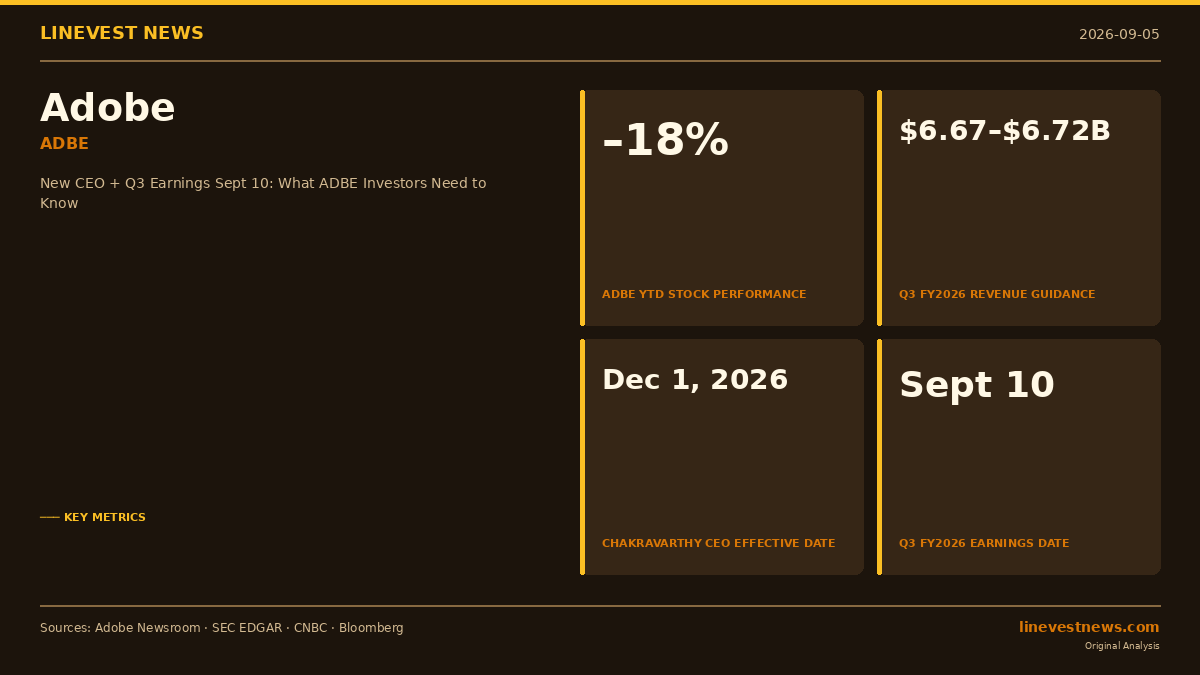
TL;DR - Adobe's board named Anil Chakravarthy president and CEO, effective December 1, 2026; Shantanu Narayen moves to executive chair after 19 years at the helm - ADBE stock is down roughly 18% year-to-date as investors price in AI disruption risk to the creative software subscription model - Q3 FY2026 earnings land September 10; company guidance of $6.67–$6.72B revenue sits above analyst consensus of ~$6.64B - No permanent CFO has been named since Dan Durn's departure in June 2026; interim CFO Steve Day holds the role
Part A: The CEO Transition and the Company It Inherits
On September 3, 2026, Adobe's board of directors confirmed Anil Chakravarthy as the company's next president and CEO, effective December 1, 2026. Shantanu Narayen — who had signaled his plans to step down in March 2026 — will transition to executive chair, remaining involved in strategic oversight while handing day-to-day operations to Chakravarthy.
Narayen's 19-year tenure as CEO transformed Adobe from a packaged-software company into one of the world's largest SaaS platforms. He presided over the 2013 pivot to Creative Cloud subscriptions and the 2018 acquisition of Marketo, guiding the company to sustained double-digit revenue growth across both cycles.
Chakravarthy joined Adobe in January 2020 as executive vice president and general manager of the Digital Experience business. He most recently led Adobe's Customer Experience Orchestration business and worldwide field operations, overseeing the development of Adobe CX Enterprise, GenStudio, and Brand Visibility — enterprise-facing product lines at the intersection of AI and marketing automation.
ADBE Stock Snapshot (September 3, 2026)
| Metric | Value |
|---|---|
| Share price | ~$285.75 |
| Market cap | ~$113.6B |
| YTD performance | –18% |
| Analyst ratings | 4 Strong Buy / 8 Buy / 23 Hold / 4 Sell / 1 Strong Sell |
| HSBC Buy target (July 2026) | $308 |
The CEO announcement came with shares already under sustained pressure. Adobe has spent much of 2026 as the software market's default short thesis: if AI-generated images and text reduce the hours a designer or marketer needs to spend in Photoshop, Illustrator, or Acrobat, subscription renewals slow. The bear case is not about the current quarter; it is about the five-year demand curve.
Q2 FY2026 Baseline
Q2 results, reported in June 2026, were operationally strong. Revenue of $6.62 billion grew 13% year over year, a record for the quarter. Non-GAAP EPS of $5.96 beat expectations.
| Q2 FY2026 | Result | YoY |
|---|---|---|
| Revenue | $6.62B | +13% |
| GAAP EPS | $4.25 | — |
| Non-GAAP EPS | $5.96 | — |
| FY2026 Revenue Guidance (raised) | $26.5–$26.6B | ↑ |
| FY2026 Non-GAAP EPS Guidance (raised) | $24.35–$24.45 | ↑ |
The quarter also brought an unexpected personnel change: CFO Dan Durn announced his departure effective June 15, with Steve Day stepping in as interim CFO. Adobe has not named a permanent replacement, leaving the company entering its most strategically consequential product cycle without a permanent CFO or, as of now, a fully onboarded incoming CEO.
Part B: Three Watch Points for ADBE Investors
Watch Point 1 — What Will Narayen's Final Earnings Calls Signal About AI Monetization?
Chakravarthy does not assume the CEO role until December 1, 2026, meaning Narayen hosts the September 10 Q3 call and, depending on timing, potentially the Q4 FY2026 call in December as well. Those calls will function as the handoff document for the incoming CEO — establishing the AI monetization baseline that Chakravarthy inherits.
The market's central frustration with Adobe is not an absence of AI product activity — Firefly, GenStudio, and Acrobat AI Assistant are real and growing — but an absence of visible monetization clarity. Investors have struggled to isolate how much of Adobe's 13% revenue growth is driven by AI incremental spend versus legacy subscription renewals.
Key metric to watch: AI-first ARR. Per analyst estimates cited in financial media, this metric has grown to above $500 million on a year-over-year basis, with Firefly as the primary driver. Adobe does not separately break out AI-first ARR in SEC filings. Management commentary on the September 10 call — including any disclosed growth rate or absolute figure for AI-driven ARR — will be the primary source of precision. Any data point that exceeds current analyst estimates would be read as a beat on the AI monetization dimension even if top-line revenue lands in range.
Chakravarthy's background in Customer Experience Orchestration means his instinct runs toward enterprise B2B use cases. Investors will watch whether Narayen's final calls begin to lay the groundwork for that strategic pivot, or whether AI monetization commentary remains broadly worded.
Watch Point 2 — The Q3 Revenue Setup: Beating Adobe's Own Raised Bar
The Q3 FY2026 guidance configuration is unusual: Adobe's own midpoint guidance of $6.695 billion sits above the analyst consensus of approximately $6.644 billion. That means the company has effectively set a high bar for itself.
| Q3 FY2026 | Adobe Guidance | Analyst Consensus |
|---|---|---|
| Revenue | $6.67–$6.72B | ~$6.64B |
| Non-GAAP EPS | $6.05–$6.10 | ~$5.88 |
Options markets are pricing an implied earnings move of approximately ±5.4%, which equates to roughly ±$15 per share from the current price. A beat against Adobe's own raised guidance — not just analyst consensus — is the threshold for a meaningful upward move. A miss against the company's own bar, even if consensus is cleared, would reinforce the thesis that demand is softening faster than the company's own forecasts anticipated.
The September 10 call will also provide the first detailed FY2027 guidance framework. Whether management signals continued 12–14% top-line growth or guides more conservatively will reset the valuation framework as Chakravarthy prepares to take the helm.
Watch Point 3 — The CFO Vacancy and Capital Allocation Signals
The CFO vacancy is underappreciated in most commentary focused on the CEO headline. Three months without a permanent CFO is manageable; six months — spanning two consecutive earnings cycles — introduces ambiguity in capital allocation decisions at a moment when AI infrastructure investment, M&A, and buyback pacing are all consequential.
The September 10 call will signal whether Adobe's buyback cadence has accelerated (a confidence signal) or moderated to preserve cash for AI investment. Chakravarthy is unlikely to announce major M&A or strategic restructuring before formally assuming the CEO role in December, but investor questions about the CFO search timeline will set expectations for his first formal months.
HSBC analyst Stephen Bersey, who upgraded ADBE to Buy with a $308 target in July 2026 — representing approximately 8% upside from the September 3 close — believes the market has not yet fully priced in Adobe's AI product pipeline. With 23 of 40 covering analysts at Hold, any combination of a strong Q3 beat, a named permanent CFO, and a clearer AI ARR disclosure could trigger renewed analyst interest and positive estimate revisions. Until those catalysts materialize, the stock is likely to remain range-bound as the market awaits clarity on whether AI disruption risk has a ceiling.
This article is for informational purposes only and does not constitute investment advice or a solicitation to buy or sell any security. All figures are sourced from Adobe's SEC filings, press releases, and published analyst commentary. Past performance is not indicative of future results.