AbbVie (NYSE: ABBV) completed its acquisition of Apogee Therapeutics on September 3, 2026. Apogee's shares stopped trading on NASDAQ that morning, ending a ten-week span since AbbVie's June 22 official announcement.
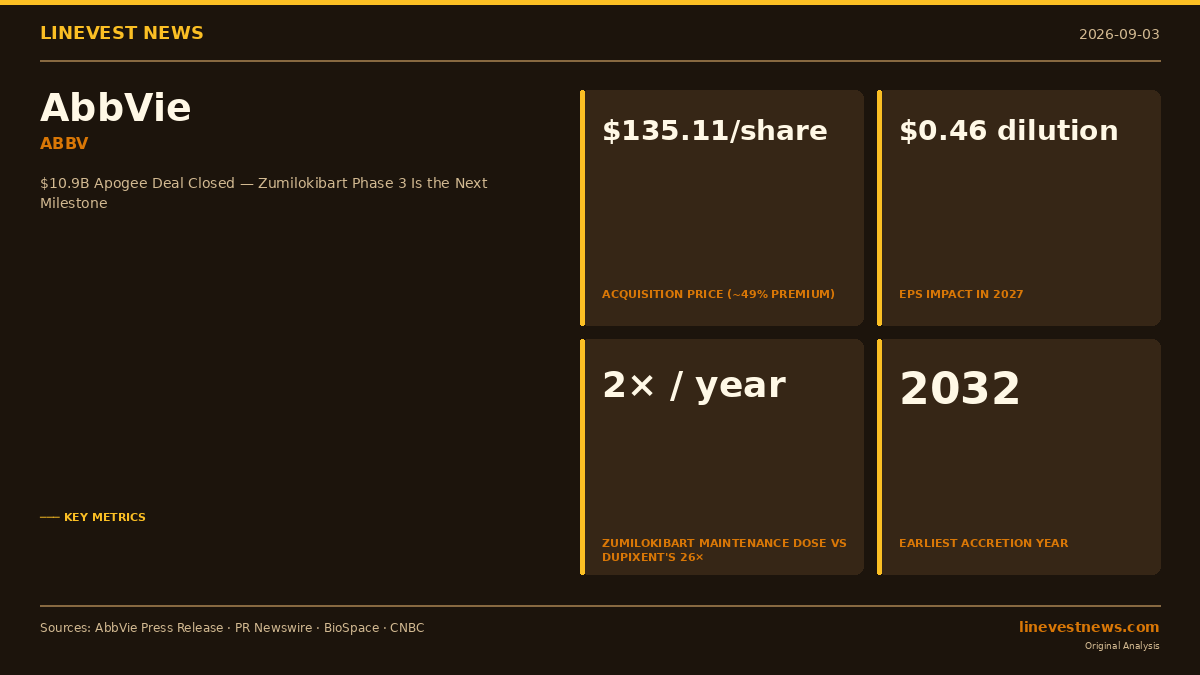
The price was $135.11 per share in cash — approximately $10.9 billion in total equity value. It rests almost entirely on a drug that has never been tested in a Phase 3 trial.
TL;DR
- AbbVie paid $135.11 per share — roughly a 49% premium to Apogee's closing price immediately before deal reports emerged — for a total equity value of approximately $10.9 billion
- The core asset is zumilokibart (APG777), a Phase 2 IL-13 antibody that achieved significant skin clearance in about two-thirds of atopic dermatitis patients at 16 weeks, with maintenance dosing as infrequent as twice a year
- That dosing schedule compares to Dupixent's every-two-week injection regimen — the central convenience argument for zumilokibart
- AbbVie expects $0.14 per share in EPS dilution for 2026 and $0.46 for 2027; at the 2027 rate applied through 2031, cumulative dilution reaches at least $2.44 per share before accretion begins in 2032
- ABBV rose 0.67% to $261.72 on deal close; AbbVie reaffirmed full-year 2026 adjusted EPS guidance of $13.87–$14.07
The Drug AbbVie Is Buying
Apogee built its pipeline around a technique called half-life extension. The approach engineers antibodies to remain active in the body far longer than standard biologics. Drugs designed this way can be given far less often without losing effectiveness. That engineering principle is the commercial argument for everything Apogee built.
Zumilokibart, also called APG777, blocks interleukin-13 (IL-13) — a protein that drives the inflammation behind atopic dermatitis (eczema) and asthma. In Phase 2 atopic dermatitis trials, approximately two-thirds of patients achieved a meaningful measure of skin clearance at 16 weeks. Long-term maintenance data supported dosing as infrequent as once every three months or twice a year.
For comparison, Dupixent — developed by Sanofi (NASDAQ: SNY) and Regeneron Pharmaceuticals (NASDAQ: REGN) and the established standard of care for moderate-to-severe atopic dermatitis — requires subcutaneous injections every two weeks. A patient on twice-yearly zumilokibart receives two injections per year instead of twenty-six. For a chronic disease managed over years or decades, that difference is more than incremental.
The competitive case for zumilokibart is about convenience, not efficacy. Its Phase 2 skin-clearance data is broadly comparable to Dupixent's approval-era numbers, but the two drugs have not been tested head-to-head. Dupixent blocks both the IL-4 receptor alpha and IL-13 pathways together. Zumilokibart targets IL-13 alone. Whether that narrower mechanism produces different outcomes in specific patient subgroups remains an open question.
Beyond zumilokibart, Apogee's pipeline includes a combination therapy pairing zumilokibart with a long-acting antibody that blocks thymic stromal lymphopoietin (TSLP) — a signaling molecule that triggers airway inflammation upstream of IL-13. The combination targets asthma and is in Phase 1b. The TSLP-blocking component alone, per Phase 1 data, showed suppression of inflammatory markers for up to six months after a single dose.
AbbVie CEO Robert A. Michael said at deal close: "By combining Apogee's innovative science with AbbVie's proven development, regulatory and commercial capabilities, we aim to accelerate these programs and bring promising new treatment options to patients."
The Price and the Payback
The $135.11 per share price represents approximately a 49% premium to Apogee's closing price immediately before Bloomberg reported deal talks in mid-June 2026. At $10.9 billion in total equity value, the acquisition is roughly equivalent to 16% of AbbVie's projected 2026 annual revenue of approximately $67.6 billion.
AbbVie financed the acquisition in part through a $10 billion investment-grade bond offering completed on August 4. That sale drew approximately $63 billion in peak demand — a 6.3-times oversubscription ratio. Credit markets, in other words, accepted AbbVie's balance-sheet case without objection. LineVest covered that financing milestone on August 5.
The EPS drag is clearly quantified. AbbVie expects the deal to reduce adjusted diluted EPS by $0.14 in 2026 — a partial year of ownership — and by approximately $0.46 in 2027. Guidance beyond 2027 was not provided. Adding the disclosed figures — $0.14 in 2026 and $0.46 in each of the five full years from 2027 through 2031 — cumulative EPS dilution reaches at least $2.44 per share before accretion begins in 2032.
That arithmetic is the most precise statement of the deal's risk. AbbVie is asking shareholders to carry a dilutive position for at least six years on a drug that has not yet started Phase 3.
AbbVie reaffirmed its full-year 2026 adjusted diluted EPS guidance of $13.87–$14.07 — a range first set at Q2 earnings on July 31 to reflect the then-pending Apogee acquisition. Q3 2026 adjusted EPS guidance of $3.84–$3.88 was also reaffirmed.
How the Market Has Responded
ABBV shares rose 0.67% to $261.72 on September 3. That contrasts with the stock's initial reaction to the deal's financial terms. LineVest reported on August 2 that ABBV fell roughly 2% on July 31 — the day AbbVie first disclosed the EPS dilution at its Q2 2026 earnings call. The improvement over five weeks suggests investors absorbed the dilution forecast and returned to pricing ABBV on the performance of its current portfolio.
That portfolio is performing well. Q2 2026 net revenues reached $16.99 billion, up 10.2% year over year. Skyrizi, an IL-23 inhibitor for psoriasis and Crohn's disease, generated $5.5 billion in the quarter — matching Humira's all-time quarterly peak, as LineVest's August 2 coverage noted. Rinvoq, a JAK inhibitor for arthritis and inflammatory bowel disease, added $2.5 billion, up 24.5%. Humira fell 35.9% to $756 million as biosimilar competition continued.
Together, Skyrizi and Rinvoq generate approximately $8 billion per quarter. That scale gives AbbVie the financial runway to carry the Apogee EPS drag while zumilokibart moves through clinical development. The current earnings power funds both the dilution and the Phase 3 program without stretching the balance sheet.
Why Phase 3 Timing Is the Key Variable
Zumilokibart's path to 2032 accretion requires a Phase 3 trial, regulatory approval, commercial launch, and a market-share ramp — all in sequence, within roughly five to six years. AbbVie has not announced a Phase 3 protocol, start date, or primary endpoint structure.
Atopic dermatitis Phase 3 trials for biologics typically enroll several hundred patients over 52 to 104 weeks, meaning a trial starting in 2027 would not read out until 2028 or 2029. Regulatory review and approval would push the first commercial sale to 2030 or 2031. That timeline allows for a 2032 accretion start, though without schedule slippage.
Two variables will determine whether zumilokibart meets that timeline. First, whether the twice-yearly maintenance schedule from Phase 2 holds in a Phase 3 population. Dose-ranging studies do not always reproduce the same maintenance interval in larger and more diverse groups of patients. A shift to quarterly-only dosing would narrow the convenience gap versus Dupixent. Second, whether AbbVie includes a head-to-head arm against Dupixent in the pivotal trial.
A positive head-to-head result would make the commercial case for switching directly. Its absence leaves the convenience advantage as the primary differentiator — a harder argument to make when prescribers have years of comfort with an established drug.
Dupixent will have accumulated additional years of real-world safety data and prescriber familiarity by the time zumilokibart reaches the market. Switching from a biologic with a known long-term risk profile is a higher bar than earning first-line prescriptions from newly diagnosed patients.
A Bet AbbVie Has Made Before
AbbVie navigated a comparable challenge when Humira's U.S. exclusivity ended in January 2023. Humira had reached more than $21 billion in global annual sales at its peak. Within two years of U.S. exclusivity ending, biosimilar competition had pulled its revenue toward $3–4 billion annually. Skyrizi and Rinvoq replaced it — an outcome that was far from certain in the years before it happened.
That precedent is the strongest argument for giving AbbVie credibility on the 2032 accretion forecast. The company has demonstrated it can manage a large revenue transition and build successor franchises on schedule.
The difference is that Skyrizi and Rinvoq were already approved drugs with commercial traction when AbbVie was depending on them to carry the Humira transition. Zumilokibart has not yet entered a Phase 3 trial. The runway is shorter and the execution requirements are higher.
What Would Break the Thesis
If zumilokibart's Phase 3 data shows narrower skin-clearance margins than Dupixent's accumulated post-approval history, the convenience argument alone may not be enough to drive meaningful physician switching. In the biologics market, demonstrated efficacy non-inferiority is typically required before dosing schedules become the primary reason to choose a new drug. A Phase 3 delay extending the trial readout past 2029 would push accretion past 2032 and extend the dilutive period for investors.
What This Article Did Not Cover
The segment-level immunology pipeline model, four-quarter trend tables for Skyrizi and Rinvoq, peer M&A multiple comparison for Phase 2 pharmaceutical assets at comparable deal sizes, and AbbVie's updated SEC filings following deal close are in the full report.
This article is editorial journalism, not investment advice. LineVest News is an independent publication and is not affiliated with any brokerage or investment advisor. Nothing in this article constitutes a recommendation to buy, sell, or hold any security.