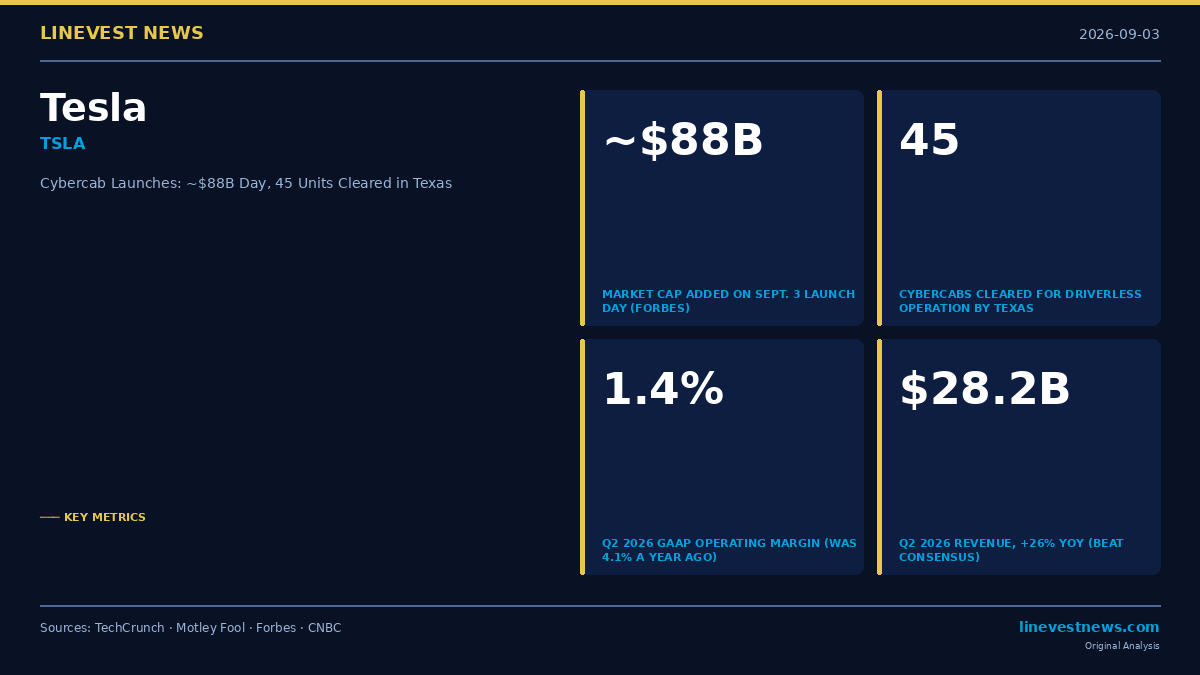
TL;DR - TSLA added roughly $88 billion in market value on Sept. 3, per Forbes — the stock's best day in more than two months - Texas had cleared 45 Cybercabs for driverless operation as of Wednesday, Sept. 2 (the night before the launch), per CNBC; TechCrunch separately counted 420 Tesla vehicles registered for autonomous operation statewide in Texas - Cybercab: 2-seat, no steering wheel, no pedals, butterfly doors — commercially available via Tesla's Robotaxi app in Austin - NHTSA review of millions of FSD-equipped vehicles for camera performance in glare and dust remains open — a heavier overhang on a car with no steering wheel to grab - Q2 2026 context: Revenue $28.24B (+~26% YoY, beat); GAAP operating margin 1.4%; non-GAAP EPS $0.33 (missed $0.53 est.)
Tesla (NASDAQ: TSLA) had its best trading day in more than two months on Thursday, Sept. 3, hours before anyone outside the company had ridden in a Cybercab. Forbes calculated the session gain at roughly $88 billion in market value — roughly 7% by its reckoning. Texas had cleared 45 Cybercabs for driverless operation as of Wednesday night, the night before the launch, CNBC reported.
Spread that $88 billion across the 45 authorized vehicles and it comes to nearly $2 billion added per cleared car. That is not a forecast. It is what the market added, divided by what the state had authorized.
Why It Matters: What Buyers Were Actually Buying
Investors were not paying for the cars already authorized. They were paying for the idea that a vehicle built without a steering wheel can be manufactured cheaply and then driven all day, every day, with no wage attached to it. That is the entire robotaxi argument, compressed into one sentence. The only question that follows is how fast the fleet behind it grows.
The Cybercab is a two-seat vehicle with no steering wheel and no pedals. It has butterfly doors, and the launch cars are gold. Tesla began building it at its Austin plant earlier this year, and Thursday's event was the first time members of the public could ride in one on open roads. TechCrunch called the moment a "fork in the road" for the company.
That framing is worth stating in full, because it sets out the stakes clearly: this is "either the moment the company begins to transform urban transportation as we know it, or the moment that reveals that, despite its many efforts, Tesla really is just an automaker after all," TechCrunch wrote. A carmaker and a transport network are valued on very different things. Thursday was the market making a directional bet on which category applies.
The Fleet Math
The 45 Cybercabs sit inside a larger Texas fleet, and the proportion is the part worth watching. TechCrunch counted 420 Tesla vehicles registered for autonomous operation across Texas — a statewide figure spanning Austin, Dallas, Houston, and other markets where Tesla's Robotaxi service operates. The Cybercab is roughly one in ten of those statewide registrations. Everything else is a Model Y.
That distinction carries the economics. A Model Y running as a robotaxi is a consumer product doing a commercial job, and it costs what a consumer product costs. The Cybercab is the first vehicle Tesla has built for the job itself. If the robotaxi business is going to earn a margin, it earns it on this car, not on the ones currently doing most of the driving.
Waymo, Alphabet's driverless-taxi unit, is the benchmark everyone reaches for. It runs a commercial service in 14 U.S. cities with a fleet of about 4,000 driverless vehicles, The Motley Fool reported.
The city-level comparison is sharper than the national one. In Austin specifically, FOX 7 Austin counted roughly 300 Waymo cars against about 160 Tesla Model Y robotaxis deployed in the city — roughly half of what its main rival runs in the same market, before accounting for any Cybercab additions.
Cars are also only part of what a robotaxi network needs. Somebody has to clean them, charge them, park them overnight and guide a stranded vehicle through a construction zone. Waymo has been building that unglamorous layer for years. It is the part of the business that does not appear on a stage, and the part that determines whether a fleet can actually be scaled.
Tesla's answer to that gap has always been unit cost rather than head start. Its cars navigate on cameras and software instead of the spinning laser sensors that rivals mount on the roof. TechCrunch put the difference plainly: Tesla can build dozens of Cybercabs for roughly what Waymo spends on fewer than ten of its vans. If that holds, the fleet gap closes on factory throughput, not on how much capital each side can raise.
The Part the Reveal Did Not Settle
The camera-only approach is also the open risk. The National Highway Traffic Safety Administration escalated its review of millions of Tesla vehicles equipped with Full Self-Driving to an engineering analysis in March 2026, the last investigative stage before it can pursue a recall. Its stated concern was camera performance in glare and dust.
Nothing announced at Thursday's launch changes that. What changed is the consequence. In a Model Y, a rider who does not like what the software is doing can take the wheel. In a Cybercab there is no wheel to take. The same sensor approach now carries a heavier burden than before Thursday's launch, and the regulator examining it has not closed its file.
An adverse finding would land differently on this product than on the rest of the range. A recall on an owned car is an inconvenience and a repair bill. A recall on a hailing fleet takes the revenue with it, because the vehicle earns nothing while it sits. The regulator's timetable is therefore now part of the commercial story, not a side issue.
Tesla's position is that its own record already answers the question. More than 14.1 billion miles have now been driven on Full Self-Driving, with collision rates the company puts at seven times lower than human drivers, The Motley Fool reported. TechCrunch counted a few dozen incidents since the Austin pilot began in June 2025, mostly minor contact with stationary objects. Neither side of that argument was resolved on a stage in Austin.
It Has Gone the Other Way Before
There is a precedent for a Cybercab event moving this stock, and it moved it down. Tesla first showed the vehicle at its We, Robot event in October 2024. Shares fell about 8% the next day, TipRanks reported. Barclays said the event "failed to highlight any near-term opportunities for Tesla that will boost the company's sales," and Piper Sandler said it was "underwhelmed by the Robotaxi unveiling."
What Elon Musk promised that night is the useful part of the comparison. He put the price under $30,000 — a claim he reaffirmed in February after the first Cybercab rolled off the Giga Texas line — and said the car would be available before 2027. On availability, production has started and Austin riders can hail the Cybercab through the same app that already dispatches the Model Y fleet. On price, Tesla has not published a consumer configurator with a final MSRP; that commitment remains open.
The difference this time is physical. The earlier event had a concept car on a film lot and a promise. This one has vehicles on a public street, an authorization record and a working app. Whether that is enough to hold the gain is a question for the weeks ahead.
Why the Timing Matters to the P&L
The robotaxi story also has to carry more weight than it did a year ago. Tesla's GAAP operating margin fell to 1.4% in the second quarter from 4.1% a year earlier, The Motley Fool reported. Q2 revenue hit $28.24 billion, up approximately 26% year over year and ahead of estimates, but non-GAAP earnings per share came in at $0.33 against a $0.53 consensus. The company has guided to $25 billion of capital spending this year. Spending is climbing while the margin on the core car business thins.
That is the pressure behind the timing. A thin margin on cars is survivable if something else is scaling underneath it. Investors on Thursday were watching to see whether that something else had arrived. The Cybercab is the clearest physical evidence Tesla has offered that it might.
The share price had already traveled a long way before Thursday. LineVest reported TSLA at $328.58 on Aug. 7. By the Wednesday session before the launch, the stock had already risen materially from that level, meaning Thursday's roughly 7% gain landed on top of an already elevated position.
The year still reads differently from the month. Tesla was down about 21% year-to-date as of Wednesday's close, while the S&P 500 was up 12%, per Forbes. After Thursday's gain, the year-to-date decline narrowed to roughly 15%.
What Settles It
Fleet size, not the reveal, is what decides how this session ages. Morgan Stanley's analysts framed the same test before the event: a limited rollout could send shares lower, while a meaningful increase in the fleet could push them higher. If clearances for Cybercabs in Texas climb from double digits into the hundreds over the coming weeks, the deployment case holds up. If the count sits near 45 while the waitlist grows, this was a reveal rather than a rollout.
Two sources of evidence will resolve it, and neither requires taking anyone's word. CNBC and other outlets have demonstrated that state authorization data surfaces through press reporting, so the count can be tracked without waiting for a company disclosure. The second is Tesla's next quarterly report, where any robotaxi ride revenue would surface in the Services line and any FSD deferred-revenue release would land in automotive revenue. Until those fleet counts or financial lines move, roughly $88 billion sits on top of 45 cars.
Sources: TechCrunch · The Motley Fool · Forbes · CNBC · FOX 7 Austin · TipRanks · Morgan Stanley via Yahoo Finance
This article is journalism, not investment advice. LineVest is not a registered investment adviser and makes no recommendation about any security. Figures are attributed to the sources named inline and were accurate as of publication.