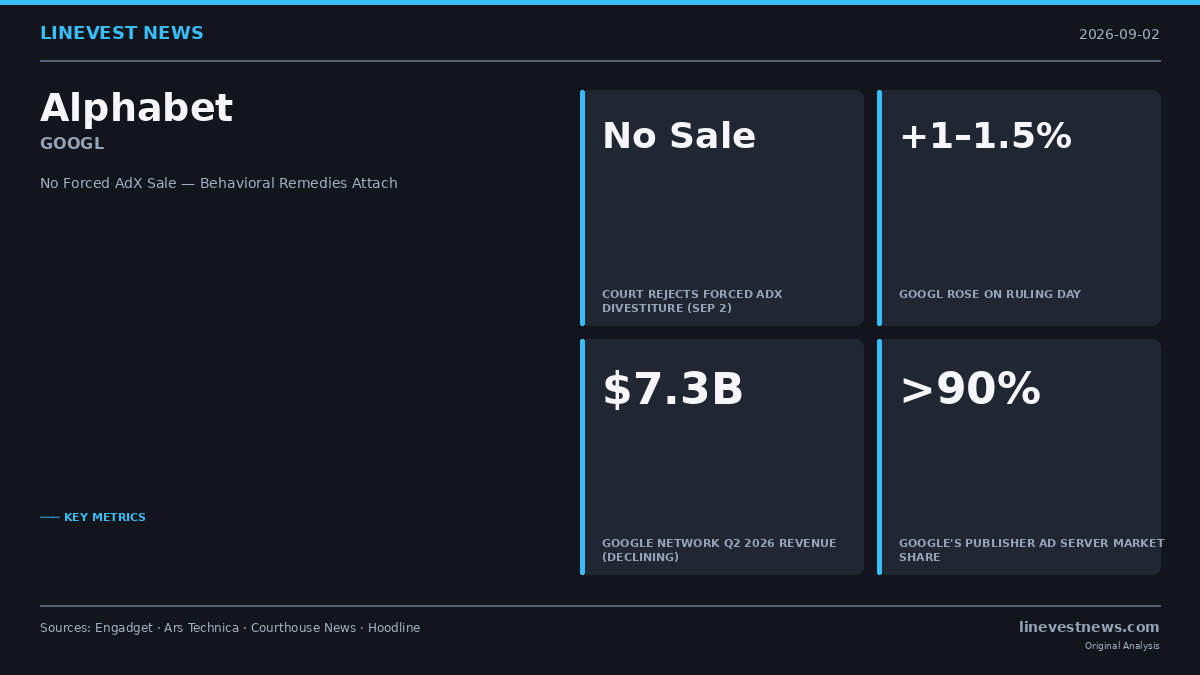
TL;DR - Judge Leonie Brinkema (E.D. Va.) rejected the DOJ's bid to force Google to sell its AdX ad exchange on September 2, 2026. - The court accepted behavioral remedies as alternatives to forced divestiture — requiring Google to open its ad tech tools to rivals; specifics remain sealed for up to 14 days. - Google Network (which includes AdX) generated $7.3 billion in Q2 2026 and has been declining as a share of Alphabet revenue for multiple consecutive years. - Three remaining investor risks: a DOJ appeal of the remedies ruling, Google's own appeal of the underlying monopoly finding, and private damages lawsuits from major publishers.
Part A: What Happened in Court
A Legal Battle Spanning More Than Three Years
In January 2023, the Department of Justice and eight state attorneys general filed an antitrust lawsuit against Alphabet's Google, targeting the company's grip on the digital advertising supply chain. The case focused on three interconnected products: Google Ad Manager (the large-publisher ad server), Google AdX (the real-time ad exchange), and Google Ads (the advertiser-facing demand platform).
The central allegation was a tying violation: Google forced publishers using Google Ad Manager — which the court later found controlled more than 90% of the large-publisher ad server market — to route their real-time auctions exclusively through AdX. That arrangement gave AdX a captive supply of premium ad inventory and crowded out rival exchanges.
April 2025: Google Found Guilty of Two Monopolies
On April 17, 2025, Judge Brinkema issued her liability ruling: Google had illegally monopolized two distinct markets — the publisher ad server market and the ad exchange market. The decision weighed on Alphabet's stock in the short term, though investors discounted an outright breakup as unlikely given the parallel search antitrust case's outcome.
What the DOJ Originally Sought
Heading into the remedies phase, the DOJ proposed three structural measures:
| DOJ Remedy Request | Description |
|---|---|
| AdX divestiture | Force sale of the ad exchange to an independent buyer |
| Auction logic disclosure | Open-source Google Ad Manager's proprietary final-auction algorithm |
| Contingent DFP Remainder sale | Sell the ad server's remaining components if AdX sale proved insufficient |
Had these been granted, it would have been the most aggressive antitrust remedy applied to a U.S. technology company since the proposed Microsoft breakup in 2000 — which was reversed on appeal.
September 2, 2026: No Breakup
Judge Brinkema rejected all three structural measures. Her September 2, 2026 sealed order accepted behavioral remedies as alternatives to forced divestiture — specifically, requiring Google to make its ad tech tools interoperable with competing platforms. The precise terms remain under seal for up to 14 days from the ruling date. Both parties have been ordered to submit a proposed final judgment within 30 days.
Google VP of Regulatory Affairs Lee-Anne Mulholland: "We're very pleased the Court rejected the DOJ's proposal to break apart tools that help small businesses reach new customers and grow."
Alphabet shares rose approximately 1% to 1.5% immediately following the ruling.
Part B: What This Means for GOOGL Investors
How Big Is AdX, Really?
The most important context: Google Network — the segment that houses AdX and the publisher-facing ad server — has been declining structurally for years and is not a meaningful growth driver for Alphabet at today's scale.
| Metric | Q2 2026 | Q2 2025 |
|---|---|---|
| Google Network Revenue | $7.3B | ~$7.4B |
| Network as % of Alphabet Revenue | ~6.1% | ~7.6% |
| Total Google Ads Revenue | $81.6B | $71.2B |
| Alphabet Total Revenue | $119.8B | $96.6B |
Source: Alphabet Q2 2026 and Q2 2025 earnings releases.
Googhe Network's share of the company's own advertising revenue has fallen from approximately 11.5% in late 2024 to approximately 8.9% by mid-2026. The segment's revenue declined roughly 1% year-over-year in Q2 2026 — a relatively small business on an absolute basis for a company generating nearly $120 billion in quarterly revenue.
The 20% Take Rate: The Number to Watch
Publishers currently pay Google approximately a 20% fee for AdX real-time auction access. That take rate is the revenue line most directly exposed to behavioral remedies. If the sealed order requires Google to lower barriers for publishers to route inventory to rival exchanges, some auction volume may shift away from AdX over time.
Industry estimates suggest that a 2–4 percentage point reduction in the effective take rate would cost Google several hundred million to over a billion dollars annually in Network revenue. That would be meaningful for Google's Network segment, but would represent a fraction of Alphabet's projected FY2026 revenue of approximately $498 billion. The sealed remedy specifics, once disclosed, will allow investors to calibrate the actual exposure.
A Pattern U.S. Courts Are Establishing
This ruling fits into a clear pattern: U.S. federal courts are systematically rejecting structural breakups of major technology companies in favor of behavioral constraints.
| Case | Judge | Structural Remedy Sought | Court Decision |
|---|---|---|---|
| DOJ v. Google (ad tech) | Brinkema (E.D. Va.) | Forced AdX sale | Rejected — behavioral remedies ordered |
| DOJ v. Google (search) | Mehta (D.D.C.) | Chrome/Android divestiture | Rejected (Sept 2025) — data-sharing rules |
U.S. antitrust law requires remedies be "tailored to restore competition" in the specific affected market — not to restructure the company broadly. Forced divestitures carry implementation costs, integration risks, and uncertain competitive benefits that make courts reluctant to impose them absent compelling necessity. The ad tech ruling reinforces this judicial posture.
Three Remaining Risks Investors Must Track
1. DOJ Appeal of the Remedies Ruling
The DOJ secured a liability finding (Google is an illegal monopolist in two markets) but lost the remedy it sought. The government can appeal the remedies decision to the Fourth Circuit Court of Appeals. DOJ appeals of antitrust remedy decisions are uncommon but not unprecedented. Given the current administration's stated posture on Big Tech enforcement, an appeal is a live possibility — though the timeline would extend the uncertainty by two to four years.
2. Google's Appeal of the Underlying Liability Finding
Google has signaled it intends to appeal the April 2025 monopoly finding itself. If Google succeeds in overturning the liability ruling at the Fourth Circuit or the Supreme Court, the entire remedies framework would collapse. A Google win on appeal would be a meaningful positive catalyst. Realistically, appeals of this magnitude take three to five years to resolve.
3. Private Publisher Damages Lawsuits
The antitrust judgment opens the door for private plaintiffs. Major publishers — including Gannett and the Daily Mail — have filed separate damages lawsuits arguing they were harmed by Google's tying conduct. Under Section 4 of the Clayton Act, private antitrust plaintiffs may seek treble damages, and these cases may be brought on behalf of large plaintiff classes. These cases are in earlier stages and represent a long-tail financial exposure whose magnitude is difficult to quantify from the outside.
What Investors Should Watch in the Next 30 Days
The single most important near-term catalyst is the proposed final judgment, due from both parties within 30 days of the ruling. When the sealed behavioral remedies become public (within approximately two weeks), the key questions to assess are:
- Scope: Are interoperability requirements narrow (e.g., access already partially offered via Open Bidding) or broad (e.g., full auction-logic transparency requiring structural code changes)?
- Timeline: Does the order give Google 6 months or 3 years to comply? A longer compliance runway means limited near-term earnings impact.
- Enforcement: Who monitors compliance — the DOJ, a third-party technical expert, or a court-appointed monitor? Stringent external monitoring tends to compress a company's operational flexibility more than self-reporting.
A narrow behavioral remedy would have minimal financial impact and would likely send GOOGL higher as a "cleared event." A broad remedy requiring auction-logic changes could modestly compress AdX margins over time — but the structural decline in open-web display advertising means this business is shrinking regardless.
Analyst Snapshot (September 3, 2026)
| Metric | Value |
|---|---|
| GOOGL price (approx., Sep 3) | ~$339 |
| Market capitalization | ~$4.12 trillion |
| Analyst consensus | 25 Buy / 5 Hold |
| Mean price target | $422.59 (~25% upside) |
| Sep 2 stock reaction | +1% to +1.5% on ruling |
| FY2026 revenue consensus | ~$498B (+23.6% YoY) |
Source: Analyst consensus data, September 3, 2026.
The Bottom Line
The Google ad exchange ruling is a qualified win for Alphabet shareholders. The worst-case scenario — a forced, court-mandated sale of AdX to an unknown buyer on a compressed timeline — has been removed from this proceeding. What remains are behavioral restrictions whose financial impact depends on implementation details still to be disclosed.
Critically, the Google Network segment is declining on its own. Preserving AdX under the Alphabet umbrella means Google can manage that decline on its own strategic timeline. More broadly, the ruling reaffirms that U.S. courts are highly unlikely to break up major technology companies as an antitrust remedy — a signal with direct relevance to pending enforcement actions at Amazon, Meta, and Apple.
Investors waiting for the worst are likely overestimating the near-term financial risk. Investors ignoring the appeal dynamics and private litigation may be underestimating the long-term uncertainty.
Sources: - U.S. District Court, E.D. Va. — Judge Leonie Brinkema remedies ruling, September 2, 2026 (sealed) - Engadget: Google won't be forced to sell its ad exchange following antitrust ruling - Ars Technica: US court rules Google will not have to sell ad exchange after losing antitrust case - Courthouse News Service: Google dodges antitrust breakup of ad tech business - Hoodline: Google Dodges Ad Exchange Breakup as Judge Orders Rivals-Friendly Fixes Instead - PYMNTS: Google Escapes Forced Breakup of AdX Marketplace - Alphabet Q2 2026 earnings release (July 22, 2026)
This article is journalism, not investment advice. LineVest News is not a registered investment adviser. All content is for informational purposes only.