TL;DR - JPMorgan's Andrew Tyler reversed a bullish stance held since June, shifting to "tactically cautious" on US stocks (August 31) - September rate-hike odds surged from 35-40% to 60-70% after Fed Chair Warsh's hawkish Jackson Hole remarks - Two data releases and an FOMC decision — Jobs (Sept. 4), CPI (Sept. 11), FOMC (Sept. 16) — will determine whether a rate increase materializes - Wells Fargo Chief Equity Strategist Ohsung Kwon joined the cautious camp the same day
Part A: What Changed and Why
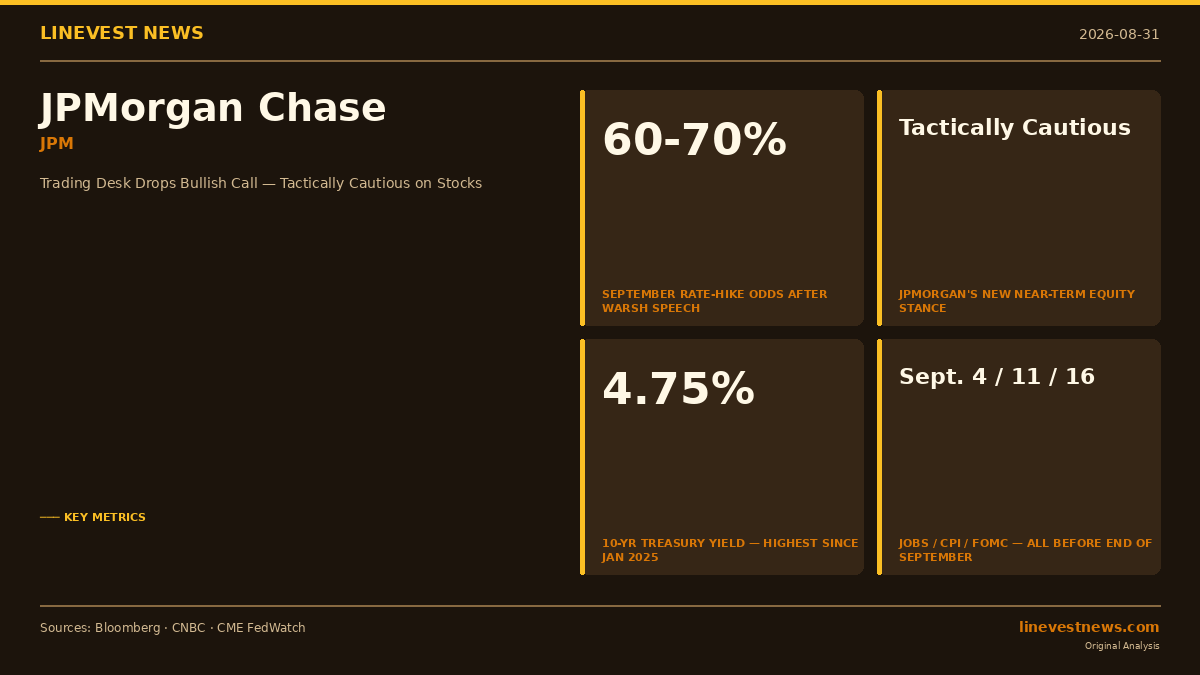
On August 31, JPMorgan Chase's trading desk — led by Andrew Tyler, head of US Market Intelligence — reversed its bullish stance on US equities, shifting to a posture the bank described as "tactically cautious" for the weeks immediately ahead.
The immediate catalyst was Federal Reserve Chairman Kevin Warsh's keynote address at the Jackson Hole symposium (August 28). Warsh signaled the central bank was open to resuming rate increases if inflation data did not convincingly improve. In his remarks, he stated that while summer inflation readings were "better than expected," they do not tell him that "underlying trends have meaningfully improved," and that the Fed must be "confident that underlying inflation is moving to its objective clearly and at sufficient speed."
Markets interpreted the speech as a live hike signal. September rate-hike probability in the CME FedWatch tool surged from a pre-speech range of 35-40% to approximately 60-70% in the days following Warsh's remarks. The 10-year US Treasury yield climbed to 4.75%, its highest reading since January 2025. The S&P 500 fell 0.5% at midday on August 31, though the index was up roughly 3% for the month and approximately 12.8% year-to-date.
On the same day, Wells Fargo Chief Equity Strategist Ohsung Kwon issued a parallel cautious note, arguing that the AI-driven market rally was "running out of positive catalysts" — earnings beats, product launches, and infrastructure spending announcements had already been absorbed by markets.
Part B: Investor Analysis
Why JPMorgan's Reversal Commands Attention
Not every desk reversal moves markets, but JPMorgan's carries weight. The bank's trading team has been credited as among 2026's most accurate market callers, with their June bullish call subsequently followed by a summer equity rally that has carried the S&P 500 up roughly 12.8% year-to-date through August. The reversal, therefore, is not background noise.
That said, Tyler was deliberate about framing the shift as narrow in scope. His exact language:
"Market fundamentals remain strong, but near-term variables could keep equities moving sideways."
He characterized a recession as "highly unlikely over the next few quarters" and described the downgrade as driven by uncertainty about the Fed's rate path — not any deterioration in the economy or corporate earnings. Equity positioning, he added, remains "broadly neutral."
Translation for investors: JPMorgan is not calling a bear market. It is flagging that the next several weeks carry asymmetric risk, because the September 16 FOMC decision has become a "live policy decision" — one where the outcome is genuinely uncertain.
Two Data Prints and a Fed Decision — September 4 to September 16
Everything pivots on three near-term catalysts between now and September 16:
| Date | Event | Why It Matters |
|---|---|---|
| Sept. 4 (Friday) | August Jobs Report | Hot labor market reinforces hike case; soft print knocks odds back below 50% |
| Sept. 11 (Friday) | August CPI | Sticky inflation is Warsh's primary stated concern |
| Sept. 15-16 | FOMC meeting; decision Sept. 16 | Rate decision + Summary of Economic Projections (dot plot) |
Historically, the Fed avoids raising rates into weak employment data. An August payrolls print below roughly 100,000 would likely bring hike odds back below 50%; a print above 175,000 in a still-hot labor market would reinforce the case for a 25-basis-point move. The dot plot released September 16 is equally important: if the Fed raises rates and signals additional increases ahead, that is materially more hawkish than a single "insurance" hike followed by a clear pause.
Where Wall Street Stands
The post-Warsh consensus is split, reflecting genuine uncertainty:
| Bank | Position on September Hike |
|---|---|
| Bank of America | Expects three hikes in 2026 — September, October, December |
| JPMorgan (trading desk) | Tactically cautious; no explicit hike call |
| Goldman Sachs | Calls September hike "very unlikely"; forecasts hold at 3.50-3.75% through 2026, cuts deferred to 2027 |
| Citigroup (Andrew Hollenhorst) | Warsh tone "more hawkish than usual but only marginally so"; no urgent case for tightening |
The divergence illustrates a core tension: Warsh's speech was hawkish relative to recent Fed communication, but the underlying economic data — while resilient — does not yet present the kind of runaway inflation that would make a rate increase unavoidable.
September Seasonality: Context Without Comfort
September is historically among the weakest calendar months for US equities. Since 1928, the S&P 500 has averaged roughly -1.2% in September, finishing positive only approximately 44% of the time. The 2026 midterm election year adds a further layer: in the last 10 midterm Septembers, the index was negative six times, averaging approximately -2%.
The bullish counter-argument has historical support, too. When August finishes positive and the year-to-date gain falls between 10% and 17.5% — conditions that match 2026 — September has historically averaged +1.0% with a 54.5% win rate. In those instances, the four-month stretch from September through December averaged gains of 5.6%, with positive returns in 10 of 11 historical cases.
The rate-hike risk and midterm uncertainty may offset that favorable seasonal setup this year. Investors sitting on double-digit 2026 gains should consider whether near-term positioning reflects that.
What This Means for the AI Trade
Both JPMorgan and Wells Fargo flag a potential AI-stock unwinding as a specific near-term risk. The Nasdaq-100 and the S&P 500 technology sector have led 2026's gains. A sustained rise in the 10-year Treasury yield compresses the valuations of long-duration growth stocks — the same dynamic that made 2022 so painful for tech investors.
However, the structural demand case for AI infrastructure (data center buildout, enterprise software adoption, sovereign AI spending) remains intact and is unlikely to reverse on a single rate decision. The distinction investors should draw: a September hike is a tactical headwind for AI-heavy portfolios, not a structural reversal of the investment thesis.
Four Things to Watch Before September 16
- September 4 jobs number: A sub-100,000 print would be the fastest way to defuse hike risk and likely trigger a market relief rally; above 175,000 keeps the pressure on
- 10-year Treasury yield: Sustained moves above 4.80% will amplify pressure on growth stocks and mortgage rates — watch for re-rating risk in rate-sensitive sectors
- Warsh's language vs. his vote: Hawkish conference speeches do not always translate to dissenting votes; Citigroup's Hollenhorst notes the economic data does not yet urgently require tightening
- Dot plot revision on September 16: A hike plus an upward revision to the terminal rate projection would be materially worse for markets than a hike framed as a one-and-done insurance move
Sources
- JPMorgan Traders Drop Bullish View on Stocks After Warsh Speech — Bloomberg
- JPMorgan shifts to cautious outlook on US stocks after Fed remarks — CryptoBriefing
- Wells Fargo analysts join JPMorgan traders in cautious stance on US stocks — CryptoBriefing
- Markets see Warsh endorsing a rate hike in September — CNBC
- CME FedWatch Provides A 66% Chance Fed Will Hike Rates In September — Forbes
- Goldman Sachs Says September Fed Rate Hike Unlikely — IndexBox
- S&P 500 September Seasonality — Yahoo Finance
- August 2026 Jobs Report: September 4 Release Date — Polymarket Trader
This article is journalism, not investment advice. LineVest News is not a registered investment advisor. Past seasonal patterns are not a guarantee of future performance.