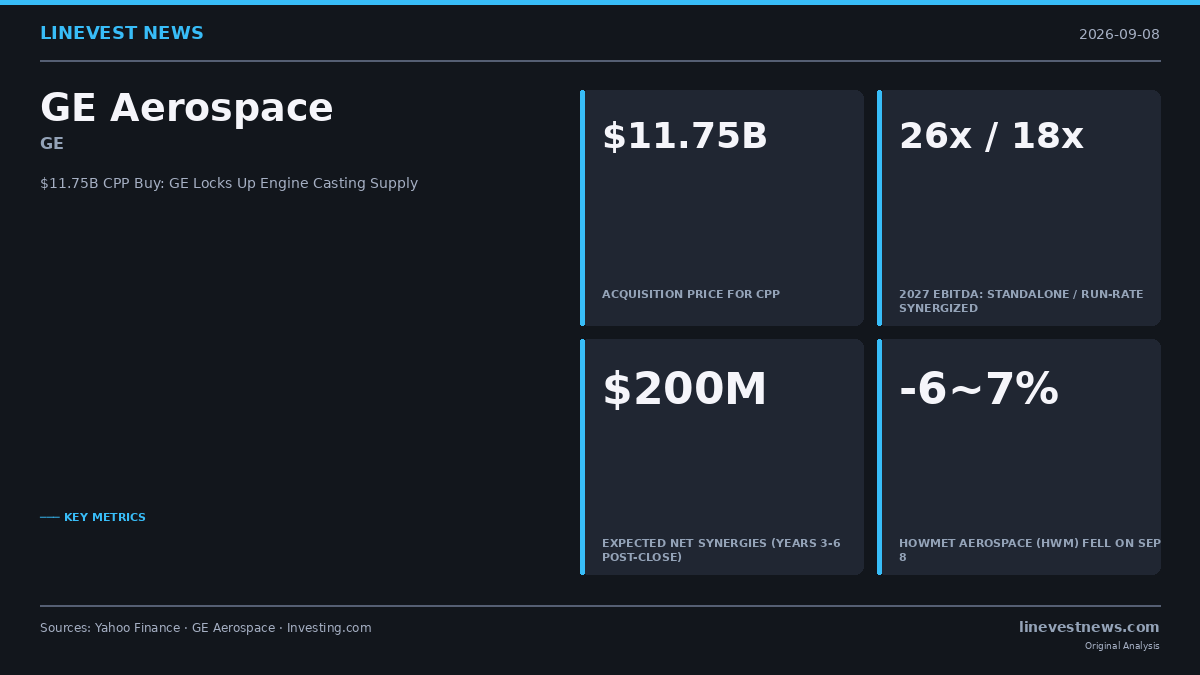
TL;DR - GE Aerospace (NYSE: GE) will acquire Consolidated Precision Products (CPP) — currently held by Warburg Pincus and Berkshire Partners — for $11.75 billion, funding $7 billion from cash and the rest via new debt. - CPP makes precision castings for CFM International's LEAP, GE's GEnx, F110, T700, and F404 engines; the deal gives GE vertical control over a supply-chain bottleneck that has been throttling global engine deliveries. - At 26× 2027 standalone EBITDA before synergies, the deal is rich — GE says it will be accretive to adjusted EPS and free cash flow within the first year post-close, excluding one-time costs and deal-related amortization. - Rival Howmet Aerospace (NYSE: HWM) fell approximately 6–7% on September 8, as the CPP deal compounded existing investor concern about SpaceX's separate plans to produce turbine blades in-house.
Part A: The Transaction
On September 8, 2026, GE Aerospace announced it will pay $11.75 billion for Consolidated Precision Products (CPP), funding $7 billion from cash on hand and financing the remainder through new debt. CPP is currently held by private equity firms Warburg Pincus — the longstanding financial backer — and Berkshire Partners, which joined via a 2019 recapitalization.
CPP is one of the world's largest manufacturers of precision investment and sand castings, converting super alloy, titanium, aluminum, magnesium, and steel into structural and airfoil components for jet engines, helicopters, weapon systems, and industrial gas turbines. The company employs roughly 6,600 people across 20-plus facilities and is projected to generate approximately $2.0 billion in revenue by 2027, with about 60% from commercial aerospace customers.
CPP has supplied GE for more than 15 years, producing critical castings for CFM International's LEAP and GE's GEnx commercial turbofans, as well as military powerplants including the T700, F110, and F404. GE projects that airfoil component demand will rise more than 30% through 2030.
The deal is priced at 26× estimated 2027 standalone EBITDA. GE also cites an 18× multiple on a fully synergized run-rate basis, reflecting the approximately $200 million in net synergies that management expects — though GE disclosed those synergies will more than double between the third and sixth years after closing, meaning the gap between 26× and 18× will close gradually over roughly a decade. GE's first-year EPS and FCF accretion comes from CPP's operating income contribution, not from synergies (which are still in early ramp at that point).
Closing is expected in the second half of 2027, subject to regulatory approvals and customary closing conditions.
GE management said the transaction addresses critical casting capacity requirements to support strong simultaneous demand across commercial engines, aftermarket services, and defence.
Part B: Three Watch Points for Investors
1. The Regulatory Gauntlet Could Add a Year to the Timeline
H2 2027 is approximately 10 to 16 months away from today, and aerospace vertical mergers draw close scrutiny from both the U.S. Department of Justice and the European Commission. The regulatory concern is predictable: CPP currently supplies engine programs across multiple OEMs. Once in-house, GE could theoretically prioritize its own engine programs for scarce casting capacity, or structure CPP's pricing to disadvantage rivals.
GE has said it intends to continue operating CPP as a multi-customer supplier. Regulators, however, routinely impose behavioral commitments — or, in contentious cases, structural divestitures — rather than accepting such assurances at face value. If the DOJ issues a formal second request (which typically adds 6–12 months to the initial review period), closing could slip into 2028 and defer the anticipated EPS accretion.
Watch: any 8-K disclosure of a DOJ second request, which GE would be required to file promptly. European Commission review timelines run in parallel and could impose separate conditions on CPP's European supply relationships.
2. Capital Allocation: Buyback Pace Slows Into a Rising-Rate Environment
GE Aerospace repurchased $4.2 billion in the first half of 2026 under its $20 billion authorization approved in December 2025 — one of the most aggressive buyback programs in the S&P 500 industrials universe. The acquisition changes the capital return picture in two ways.
First, committing $7 billion in cash to the deal reduces financial flexibility for buybacks during the integration window; GE's 2026 free cash flow guidance of $8.9–9.2 billion means the cash outlay is manageable from a coverage standpoint, but management will likely prioritize balance-sheet repair over buybacks in the quarters immediately after close.
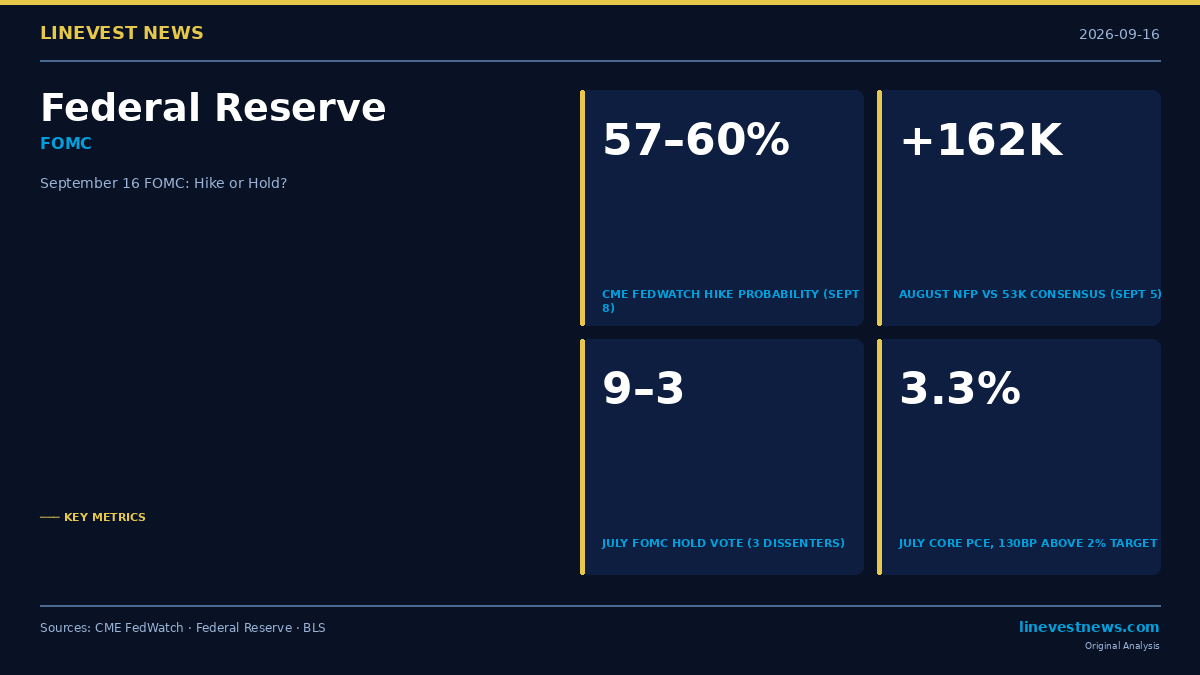
Second, the new debt is being issued into an uncertain rate environment. The Federal Reserve held rates at 3.50–3.75% at its July 2026 meeting, and futures markets currently price approximately 57% odds of a 25-basis-point rate increase at the September 16, 2026 FOMC meeting. If rates rise further before GE prices its acquisition debt, the all-in borrowing cost could be meaningfully higher than the company's current weighted-average cost of debt.
| Metric | Pre-Deal (2026) | Post-Close (2028E, estimated) |
|---|---|---|
| Net leverage (Debt/EBITDA) | ~0.5× | ~1.5–2.0× |
| Net synergy run-rate | — | Ramping, fully in years 3–6 post-close |
| Accretion (adj. EPS + FCF) | — | Year one, ex. one-time costs |
Watch: GE's Q3 2026 earnings (October 2026) for commentary on debt issuance timing, buyback pacing, and any revision to 2026 FCF guidance.
3. Howmet Aerospace: Dual Overhang or a Buying Opportunity?
Howmet Aerospace (NYSE: HWM) fell approximately 6–7% intraday on September 8. The decline reflected two overlapping concerns. The GE–CPP deal raises a direct competitive threat: once CPP is in-house, GE has reduced incentive to route discretionary casting volume to HWM on programs where CPP and HWM compete. Compounding that, concerns about SpaceX producing turbine blades in-house — a theme that had already weighed on HWM in late August — intensified as the SpaceX narrative merged with the GE acquisition story in trading-desk discussions.
Because both pressures arrived together, isolating how much of the HWM selloff is attributable to each catalyst is not straightforward. What is clear is that the market views both as structurally negative for independent aerospace casting suppliers.
Three factors could moderate the ultimate impact on HWM:
- Existing long-term agreements (LTAs) — HWM holds multi-year supply contracts with RTX's Pratt & Whitney and Rolls-Royce that GE's CPP ownership cannot alter.
- GE's multi-customer commitment — GE has said it will operate CPP as a broad supplier, which preserves some pricing discipline and optionality for non-GE programs.
- Capacity expansion benefit — if GE invests in expanding CPP's capacity, it could ease the industry-wide engine casting shortage that has been distorting lead times for all programs, including HWM's customers.
| Company | Primary Risk Exposure | Sep 8 Reaction |
|---|---|---|
| Howmet Aerospace (HWM) | Direct competitor in castings; SpaceX turbine overhang | −6 to −7% |
| TransDigm (TDG) | Minimal (fasteners, not castings) | Flat |
| Heico (HEI) | Minimal (aftermarket parts, not OEM castings) | Flat |
Jefferies called the GE–CPP deal an impactful move for competitive positioning. Vertical Research analyst Robert Stallard characterized it as strategically sound given continuing tightness in engine casting supply.
Watch: HWM's next earnings call for management's quantification of GE-specific program exposure and the share of revenue protected under existing LTAs. Separately, any formal announcement from SpaceX on turbine-blade in-sourcing timelines would clarify whether that threat is near-term or speculative. A clear answer on both points could indicate the combined September 8 selloff is a temporary overcorrection.
Sources
- GE Aerospace acquires Consolidated Precision Products — Yahoo Finance, Sep. 8, 2026
- GE Aerospace official press release — GE Aerospace newsroom, Sep. 8, 2026
- GE Aerospace to buy castings maker CPP for nearly $12 billion — Investing.com, Sep. 8, 2026
- Howmet Aerospace stock falls as GE Aerospace deal and SpaceX plans weigh — Ad-hoc News, Sep. 8, 2026
- Berkshire Partners CPP recapitalization announcement — Berkshire Partners
- Analyst commentary: Jefferies, Vertical Research Partners (via Yahoo Finance)
This article is published for informational purposes only and does not constitute investment advice or a solicitation to buy or sell any security. LineVest News is an independent publication and is not a registered investment adviser.