
GE AerospaceGE
About GE Aerospace
General Electric, following a multi-year breakup completed in 2024, now operates solely as GE Aerospace, one of the world's two dominant manufacturers of commercial jet engines alongside Rolls-Royce and, in the narrowbody segment, through its CFM International joint venture with France's Safran. The business splits between Commercial Engines & Services, which designs and sells engines such as the CFM56, LEAP, GE9X and GEnx to Boeing, Airbus and airline customers, and Defense & Propulsion Technologies, which supplies engines for military aircraft including the F-15, F/A-18 and Black Hawk. Services — spare parts, overhauls and long-term maintenance contracts on the vast installed base — is what actually drives the bulk of segment profit.
Serious holders watch the LEAP engine's ramp and durability, since the narrowbody franchise depends on it and early wear issues have driven costly shop visits. Customer concentration runs through Boeing and Airbus at the airframer level and through a small number of large global carriers at the operator level. The company is exposed to airline capital cycles, geopolitical restrictions on China and Russia, and export controls on defense-adjacent technology. The 50/50 CFM joint venture with Safran governs the crown-jewel narrowbody engine and is a durable governance feature. Capital allocation has tilted toward buybacks and a modest dividend after the breakup, with the balance sheet materially deleveraged from the legacy conglomerate era.
The company traces to the 1892 merger of Edison General Electric and Thomson-Houston Electric, and for most of the twentieth century operated as a sprawling industrial and financial conglomerate spanning appliances, plastics, media (NBC), locomotives, medical imaging, power generation and GE Capital. Following the financial crisis and years of underperformance, management under Larry Culp, appointed CEO in 2018, dismantled the group: GE Capital was wound down, the biopharma unit was sold to Danaher in 2020, and in 2023 the healthcare business was spun off as GE HealthCare (GEHC). The final split arrived on April 2, 2024, separating GE Vernova (power and renewables) from what became GE Aerospace, the surviving parent.
Revenue comes from selling original-equipment engines, often at thin or negative margins, and then earning decades of high-margin aftermarket revenue on spare parts, time-and-materials shop visits, and long-term Rate-Per-Flight-Hour service agreements as those engines fly. Airlines, lessors and defense ministries are the ultimate customers; airframers integrate the hardware. Competitive position rests on the installed base — tens of thousands of engines in service — plus certification barriers, proprietary hot-section technology, and the global MRO network. Its principal rivals are Pratt & Whitney (RTX) and Rolls-Royce in widebodies, while CFM competes with Pratt's GTF on narrowbodies. Roughly two-thirds of revenue is generated outside the United States, reflecting the international nature of aviation.
Company profile by LineVest editorial. Journalism, not investment advice.
Order a report on GE Aerospace — $15GE Aerospace coverage
2 articlesGE Aerospace (GE) Q2 FY2026: Payouts Outrun Cash Flow
General Electric Company, operating as GE Aerospace, paid $5.4B in dividends and treasury-stock purchases against $4.46B of continuing operating cash after capital spending.
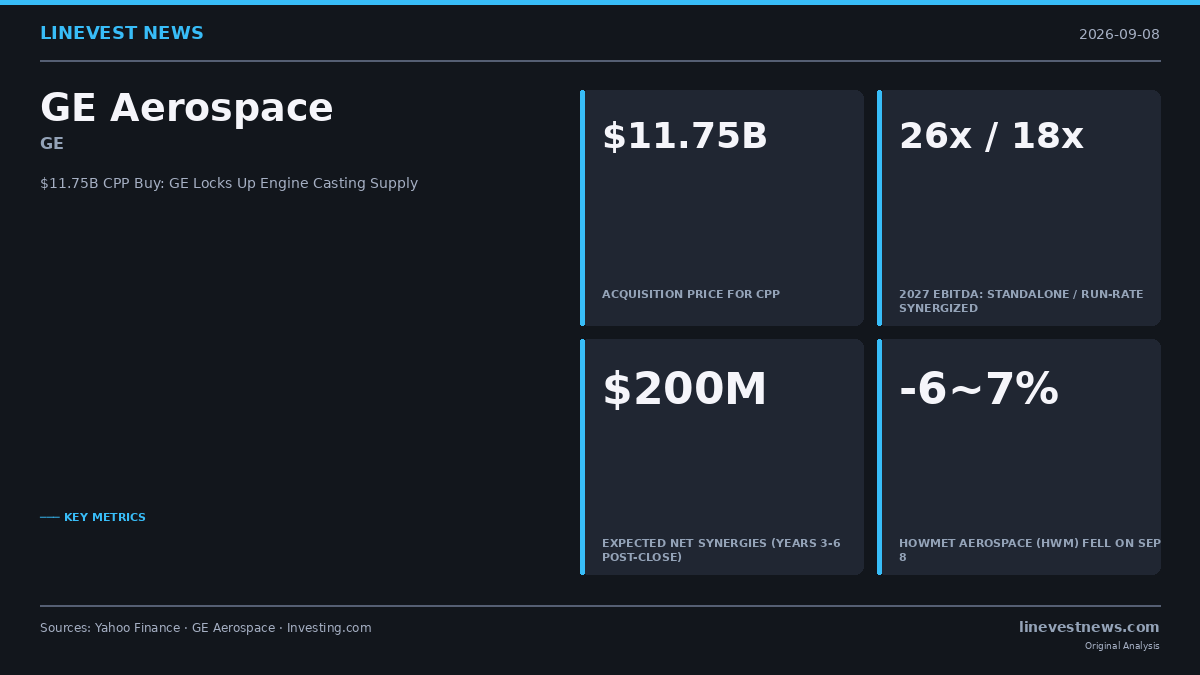
GE Aerospace Pays $11.75 Billion for CPP: Three Watch Points Before the H2 2027 Close
GE Aerospace acquires CPP for $11.75B ($7B cash + new debt). Howmet fell 6-7%. Watch: antitrust timeline, hawkish-rate debt cost, and HWM dual competitive overhang.
Go deeper than the headline
You just read what happened. Here's how to read what it means.
The day's reports, every morning — free
LineVest Daily lands in your inbox before the opening bell with the reports we published that day — what each company's latest 10-K or 10-Q actually says about the numbers, in plain English. Free, no card required.
This report, on any company you name
What you just read on GE Aerospace is the format. Name any U.S.-listed company and we do the same for it — its latest SEC filing read in full, financials under US GAAP, governance, and what it means for the stock. PDF in your inbox within 3 hours.
Which company should we read?
$15 · one-time · PDF within 3 hours
Pick a company to continueIndependent journalism based on primary SEC filings — not investment advice. No brokerage affiliation.