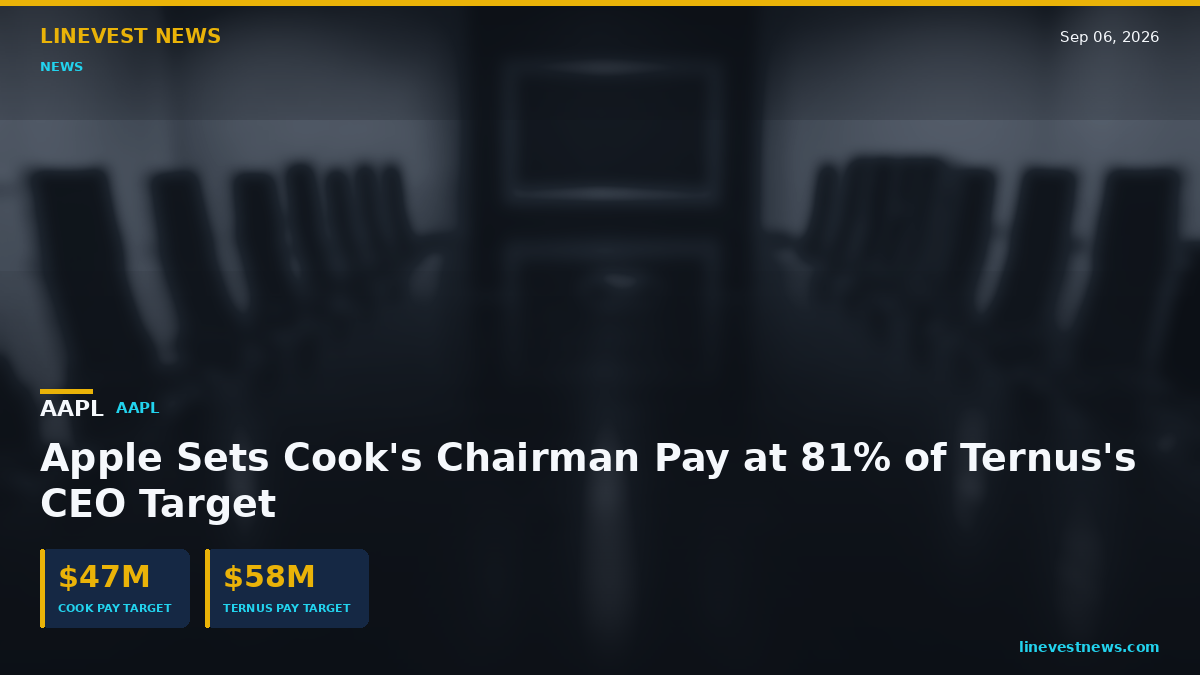
Apple (NASDAQ: AAPL) gave Tim Cook a pay target worth 81 cents for every dollar it gave the man who replaced him. That ratio appears in no press release. It falls out of an amended Form 8-K — the report a company files when something material happens between quarterly updates. Apple filed it with the SEC on Sept. 1, the day John Ternus became chief executive.
The transition itself was old news. Apple announced the plan back in April. What the filing added was the price.
What the filing actually says
The document is a Form 8-K/A. The "/A" marks it as an amendment to a filing Apple had already made.
The relevant section is Item 5.02. That item covers the departure and appointment of officers, along with the pay arrangements attached to them. It is where compensation for an incoming chief executive has to be spelled out.
The amendment updates an original filing dated April 20, 2026. That was the day Apple's newsroom announced the succession plan, and Fortune reported the same afternoon that Cook would hand over the job after 15 years. The April document named both men but left the pay blank, promising an update once the figures were settled.
Cook's terms are short. His salary becomes $2 million a year, effective Sept. 26, 2026.
He also receives an equity award with a target value of $45 million, to be granted in fiscal 2027. Add the two and his headline target is $47 million.
Ternus gets a $3 million salary, effective on the transition date. His fiscal 2027 equity award carries a target value of $55 million. Salary plus that grant puts his headline target at $58 million — the figure used for every comparison below.
Separately, and outside that $58 million, he receives a prorated award valued at $2.5 million for his fiscal 2026 service as chief executive.
Both awards arrive as restricted stock units, or RSUs. These are promises of company stock that convert into actual shares only after a waiting period. The holder must still be employed when that date arrives.
Why it matters: the split, not the total
Here the two packages stop looking alike.
A headline pay number tells you what a board was willing to spend. How that number is built tells you what the board actually wants in return. The two grants are assembled differently, and the difference is the story.
Three-quarters of Ternus's equity award is performance-based, the filing states. The remaining quarter is time-based. Cook's award splits evenly, half performance and half time.
The distinction is worth spelling out. Time-based shares arrive if the executive simply stays employed through the vesting dates. Performance-based shares arrive only if the company clears a target the board sets in advance. One rewards presence. The other rewards results.
Both men's performance shares hang on the same measure. The filing ties them to Apple's total shareholder return — the share price gain plus dividends — measured against the other companies in the S&P 500.
Now run the arithmetic the filing does not run for you. Cook's performance-linked slice comes to $22.5 million. That is 48% of his target.
Ternus's equivalent slice is $41.25 million, or 71% of his. The new chief executive's pay is about 23 percentage points more exposed to Apple's stock performance than the outgoing one's.
Turn that around and it reads more plainly. Roughly $24.5 million of Cook's target — the time-based half of the grant plus one year of salary — does not move with how Apple does against the index.
That difference is the quiet part of the document. A performance-heavy grant tells a chief executive that the board expects results and will not pay for effort alone. A more evenly split grant tells a chairman something else: stay, be available, and the money is largely there regardless. Boards do not draft these ratios by accident. They are among the clearest written statements of what each man is being asked to do.
The sentence that says he is not leaving
One clause does more work than any number in the document.
"In the event of Mr. Cook's termination due to retirement on or after the first anniversary of the grant date, Mr. Cook's equity award will vest, subject to performance for the performance-based RSUs, but will continue to settle on the originally scheduled vesting dates," the filing states.
Read it plainly. Retire after that first anniversary and the award survives. Retire before it and that protection is not written down. For both men, the time-based shares release in equal installments every six months across four years.
Bloomberg's technology newsletter reached the same theme on Sept. 6. It called the arrangement a "CEO-like" Cook pay package and said it "shows he's going nowhere." The retirement clause is the machinery underneath that headline.
Why an executive chairman rarely costs this much
Executive chairman is not a standard job description. It sits somewhere between a board seat and an operating role, and companies use the title for very different purposes. Sometimes it is a dignified exit ramp for a long-serving chief. Sometimes it is a supervisor installed above a new one. The title by itself cannot tell you which.
Pay usually can. A chair who has genuinely stepped back draws a director's retainer. A chair the board still wants working draws an operating executive's equity grant. Apple wrote the second kind of document, and it wrote it on the same day the handover took effect.
The timing is worth pausing on. Apple is heading into a product cycle it has been building toward for years. It is also heading into a political environment where its supply chain and its trade exposure get decided as much in Washington and Beijing as in Cupertino. Those relationships took a decade and a half to build. They do not transfer with a title. A board looking at that calendar has an obvious reason to hold on to continuity. Paying to keep it costs less than losing it.
The money is not the point
Set against Apple's size, both packages are rounding error. Apple's market capitalization stood at $4.67 trillion at the Sept. 4 close, with the stock at $319.97, according to stockanalysis.com.
The two targets together come to roughly $105 million. That is about 0.002% of the company's market value.
Nobody is reading this filing for the cost. They are reading it for what the board was willing to pay to keep one particular person inside the building.
For Cook the figure is still a step down. Apple's proxy statement, filed in January 2026, put his fiscal 2025 total compensation at $74,294,811.
That followed $74.6 million the year before, per the same proxy filing. A proxy statement is the disclosure a company sends shareholders ahead of its annual meeting, and executive pay is one of the things it must contain.
Measured against the new target, he gave up the job and roughly 37% of the pay along with it — though that comparison sets a fiscal 2027 target against a fiscal 2025 reported total, and the two are not built the same way. It is still a real cut by any reading, and far more than a company pays someone it expects to fade into the background.
Korean market angle: supply chain continuity
Apple's component supply chain runs through South Korea at scale. Samsung Display — a Samsung Electronics affiliate — supplies OLED panels for iPhone. Samsung Electronics and SK Hynix are Apple's primary memory suppliers. Both parent groups rank among the largest constituents of the KOSPI index, and their earnings move in part on Apple component volumes.
Cook's stated mandate — managing Apple's relationships with Washington and Beijing, per 9to5Mac — runs through Seoul as well. South Korea occupies a central position in the semiconductor and display supply chain that trade policy on both sides of the Pacific is actively reshaping. The exposure Apple is navigating is, in substantial part, South Korean supply-chain exposure.
The Form 8-K/A names no Korean company. But read from the KOSPI, the board's decision to pay $47 million to keep Cook inside the building is a decision to retain the executive who built Apple's supplier relationships during the supply-chain cycle where continuity carries most value. For investors in Samsung Electronics and SK Hynix, the relevant fact is not the dollar amount Apple paid Cook — it is that Apple paid to hold him.
A precedent worth holding in mind
Disney moved Bob Iger to executive chairman in February 2020 and handed the chief executive title to Bob Chapek. Iger stayed on directing the company's creative work until December 2021. In November 2022, Disney's board removed Chapek and returned Iger to the chief executive role, effective immediately, CNBC reported.
Nothing in Apple's filing suggests Cook plans anything similar. The precedent is not a prediction, but it is instructive. It shows that a well-paid executive chairman is a position a board can act from, rather than one an executive simply retires into.
What we wrote last week
LineVest covered the handover on the day it happened. We described Cook's new role then as an oversight seat. It would keep him engaged on "policy and regulatory matters," we wrote, "while removing him from day-to-day operations." The filing released that same day does not contradict that account of his duties. What it does is price them well above what an oversight seat normally pays.
Reporting since has sharpened the job description further. 9to5Mac says Cook's focus as executive chairman will be managing Apple's relationships with President Trump and the Chinese government. That is not a ceremonial brief. It is one of the largest external risks the company carries.
Now set three facts from the filing beside each other. The board gave Cook a target worth 81% of the chief executive's. It made his award less performance-linked than the chief executive's. And it wrote a clause that shields the award only after he has served a year. Those are the terms of a retention agreement rather than a farewell.
Where this reading could be wrong
This is a transition-year grant, and transition years are not normal years. Boards routinely pay more to hold a departing chief executive through a handover, then let the number fall once the new one is established. If Apple's next proxy statement shows Cook's fiscal 2028 target dropping toward ordinary director pay, then this year's figure was a bridge and not a second center of power. That counter-evidence would be visible, dated and easy to check.
What settles it
Two dates do most of the work.
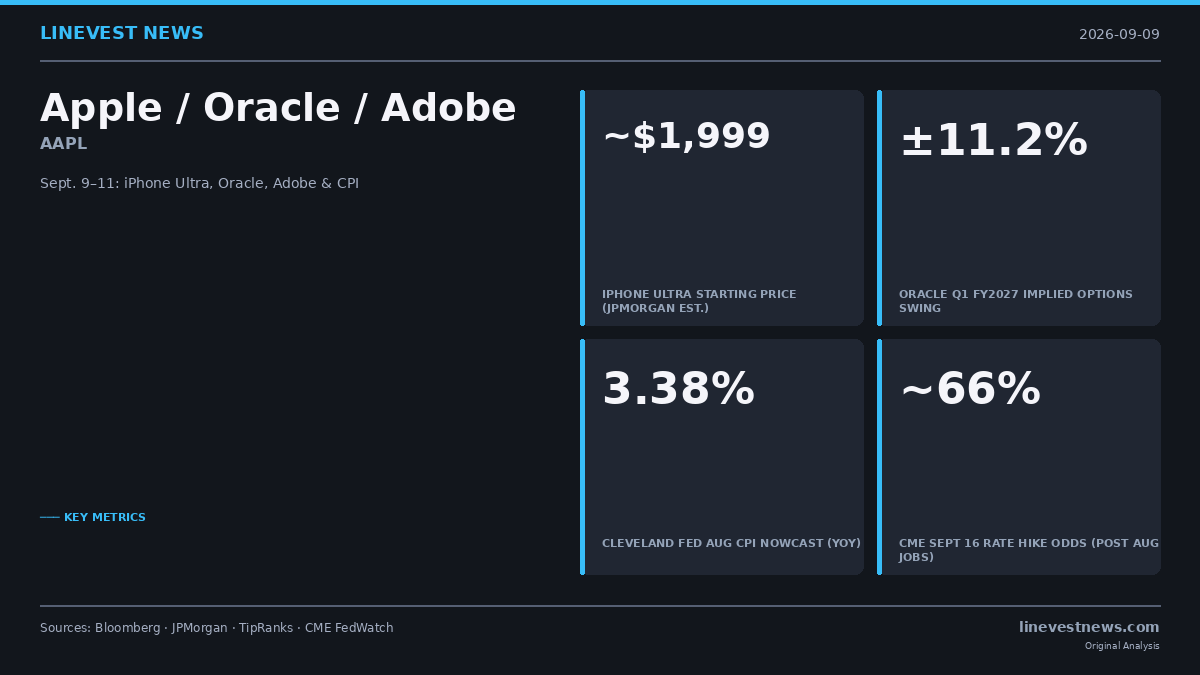
The first is Sept. 9. Apple holds its "Surprise and shine" keynote at Apple Park at 10 a.m. Pacific, where a new iPhone lineup — reportedly including Apple's first foldable model — and new Apple Watches are expected. It is Ternus's first keynote as chief executive. Whether Cook appears on that stage, and in what capacity, is a governance signal that costs nothing to watch.
The second is Ternus's first earnings call, expected in late October. Calls are where authority becomes audible. Who fields the hard question on China, and who fields the hard question on Siri, will say more about the real division of authority between the two men than anything written in the filing.