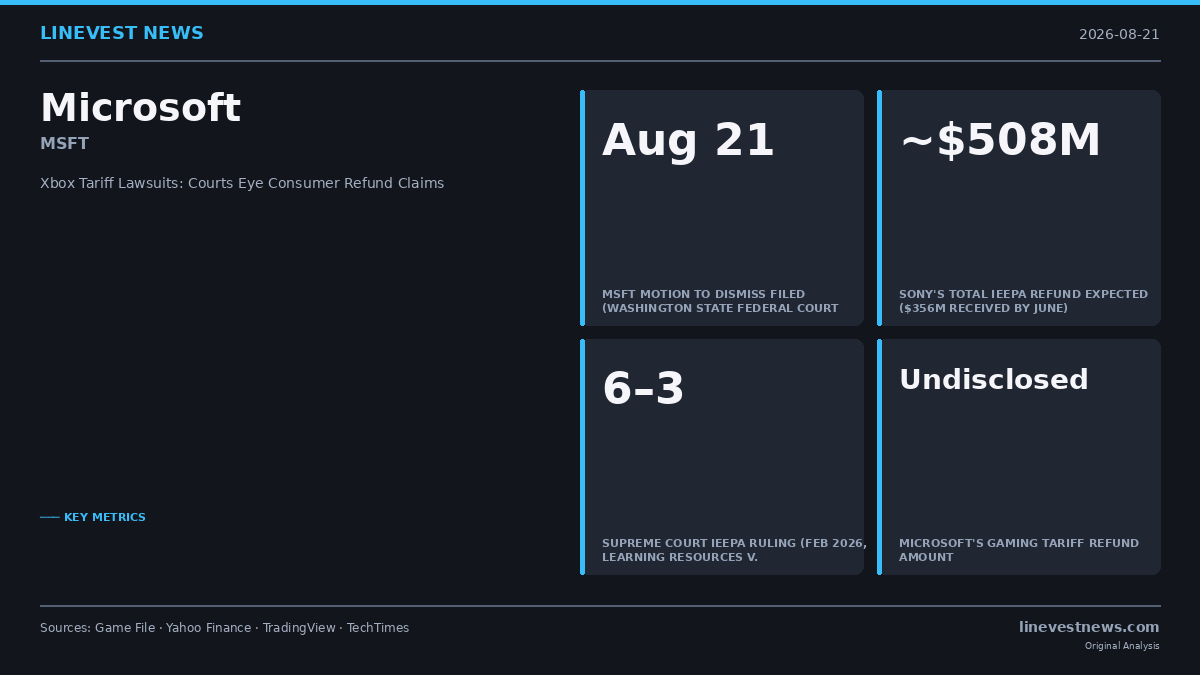
TL;DR - Microsoft (MSFT) filed a motion to dismiss a consumer class action in the Western District of Washington federal court on August 21, 2026, arguing Xbox buyers have no legal claim to tariff refunds. - Sony (NYSE: SONY) filed a parallel dismissal motion in California's Northern District (specific date not publicly confirmed); Nintendo filed comparable arguments in late July. - Sony expects approximately $508 million in U.S. government IEEPA tariff refunds, with $356 million already received in Q1 FY2026 (April–June 2026). Microsoft has not disclosed its refund amount. - The underlying legal trigger: the U.S. Supreme Court ruled 6–3 in February 2026 in Learning Resources v. Trump that IEEPA does not authorize presidential tariff authority — making the 2025 tariffs illegal retroactively. - No federal court has yet ruled on the motions to dismiss. Three investor watch points: lawsuit outcome risk, balance sheet accounting of refunds, and what the IEEPA ruling means for Microsoft's hardware pricing going forward.
Background: The Supreme Court Ruling That Started It All
In February 2026, the U.S. Supreme Court issued a 6–3 ruling in Learning Resources, Inc. v. Trump, holding that the International Emergency Economic Powers Act does not grant the executive branch authority to impose import tariffs. The decision invalidated the broad sweeping tariffs the Trump administration imposed beginning in early 2025. Importers seeking refunds must pursue them through U.S. Customs and Border Protection protest and liquidation-reopening procedures — the refunds are not automatic, and individual claims remain subject to CBP review.
Consumer electronics companies were among the largest tariff payers. Gaming hardware — PlayStation consoles and Xbox consoles — was predominantly manufactured in China. Nintendo Switch assembly had largely shifted to Vietnam and Cambodia prior to the tariff period specifically to avoid tariff exposure and subject to effective tariff rates that ranged into the double digits. In response to those costs, major console makers raised prices:
- Microsoft raised Xbox prices in May 2025.
- Sony raised PlayStation 5 prices in August 2025.
- Nintendo raised Switch prices around the same period.
After the SCOTUS ruling, U.S. Customs and Border Protection began processing refunds to importers. Sony disclosed it expects to receive approximately $508 million across Sony Group, with most of that flowing to its gaming division; $356 million was received in the April–June 2026 quarter (Q1 FY2026 for Sony). Microsoft has not disclosed a comparable figure. However, given that Xbox has a smaller global hardware footprint than PlayStation, Microsoft's gaming-division refund is likely smaller in absolute terms than Sony's — though the exact amount has not been publicly disclosed by either Microsoft or independent analysts.
Consumers who paid higher prices during the tariff period then filed class-action lawsuits arguing the companies should pass those refunds on to buyers.
Watch Point 1: The Lawsuits — What Happens if Dismissal Is Denied?
Microsoft and Sony's legal strategy is consistent and coordinated. Both have asked federal courts to dismiss consumer suits at the pleadings stage, before discovery begins.
Microsoft's argument, filed in the Western District of Washington federal court on August 21, 2026: "There is nothing unjust about Plaintiff purchasing an Xbox at an advertised price and getting exactly what he paid for — regardless of whatever theory he devised months later about Microsoft's cost structure." Sony filed nearly identical language in California's Northern District: "Paying fair market price for voluntarily purchased consumer goods is not a legally cognizable injury in fact."
Both companies also argue that tariffs cannot be proven as the sole cause of price increases — inflation, component costs, and foreign exchange effects all contributed to higher hardware prices during 2025.
These arguments are legally defensible but not guaranteed to succeed. The plaintiffs are likely asserting unjust enrichment and consumer protection claims, not a tort requiring proof of direct causation. If the courts deny the motions to dismiss — a meaningful possibility — litigation would proceed to class certification and discovery, materially increasing Microsoft's and Sony's legal costs and settlement risk.
For context: Nintendo filed comparable arguments in late July and has received no ruling either.
Investor lens: Watch for court orders on the motions to dismiss in the Western District of Washington (Microsoft) and California's Northern District (Sony). An adverse ruling in either jurisdiction before year-end would create settlement pressure and could establish a precedent that applies across the gaming hardware industry.
Watch Point 2: Balance Sheet Accounting — How Does Microsoft Book the Windfall?
Sony's disclosure provides the clearest public template: $508 million in expected IEEPA refunds, $356 million received in Q1 FY2026 (April–June 2026 — Sony's fiscal year runs April–March, named for the starting year). The question for Microsoft investors is how a comparable receipt — size unspecified — flows through the income statement.
U.S. GAAP does not prescribe a single line item for tariff refunds. Companies have latitude to recognize them as reductions in cost of goods sold (improving gross margin), as other income, or as a separate non-recurring item. Sony has signaled the refunds are recognized in the period they are received or become realizable — standard period-of-receipt treatment (Sony Group reports under IFRS) — which means the April–June quarter absorbed a one-time benefit, not a retroactive restatement of prior periods.
For Microsoft, whose gaming segment (Xbox hardware plus Activision Blizzard content) generates roughly $5–6 billion in revenue per quarter, a tariff refund of even $150–300 million would represent approximately 2.5–6% of a single quarter's segment revenue (150/6000 = 2.5%; 300/5000 = 6.0%) — meaningful but unlikely to be a primary topic on a Microsoft earnings call, given it is not a recurring item. Microsoft's fiscal Q4 2026 earnings (reported July 2026) did not highlight a significant gaming tariff line item in public reporting, suggesting the amount may be smaller than Sony's relative to Microsoft's gaming scale, or that it has not yet been fully processed.
Investor lens: Check Microsoft's fiscal Q1 FY2027 earnings (expected late October 2026) for any disclosure of tariff refund recognition in the gaming or total company results. A surprise benefit here could provide a margin tailwind that consensus estimates have not modeled.
Watch Point 3: IEEPA Ruling Implications — What's Left of the Tariff Regime?
The Learning Resources v. Trump ruling struck down IEEPA as a tariff authority, but it did not eliminate all U.S. import tariffs. Section 232 (national security) tariffs on steel and aluminum, and Section 301 (unfair trade practices) tariffs on Chinese goods — both of which pre-date the IEEPA tariff orders — remain on statutory footing that the Supreme Court did not disturb.
For Microsoft's hardware supply chain, this creates a nuanced picture:
- Xbox consoles: Primarily manufactured in China. Section 301 tariffs on Chinese electronics remain in effect, subject to product-specific exclusions.
- Surface devices: Similarly China-sourced in part, with some manufacturing in Taiwan and other countries.
- Server hardware (Azure): Broadly exempt from consumer tariff considerations but exposed to component-level duties.
None of this disappears because of the IEEPA ruling. What the ruling did eliminate was the executive branch's ability to unilaterally impose new broad tariff packages without Congressional authority — a structural constraint on tariff escalation risk going forward.
One notable data point: Sony raised PlayStation 5 prices again in spring 2026, after the Supreme Court ruling. The company cited ongoing component costs, weaker yen effects, and demand dynamics — not tariffs. This suggests hardware price inflation for the gaming sector is multi-factorial and is unlikely to reverse even as the IEEPA overhang clears.
Investor lens: Microsoft's hardware gross margins should see some relief from the IEEPA refund, but ongoing Section 301 tariffs and manufacturing cost inflation limit the magnitude of structural improvement. The IEEPA ruling is a one-time benefit, not a sustained tailwind.
Snapshot
| Data Point | Value |
|---|---|
| Supreme Court IEEPA ruling | February 2026, 6–3, Learning Resources v. Trump |
| Microsoft motion to dismiss filed | August 21, 2026 (Western District of Washington) |
| Sony motion to dismiss filed | Date not publicly confirmed, N.D. California |
| Court rulings on motions | None yet |
| Sony total IEEPA tariff refund (expected) | ~$508M |
| Sony refund received (April–June 2026) | ~$356M |
| Microsoft gaming tariff refund | Not publicly disclosed |
| Microsoft Gaming segment revenue (per quarter) | ~$5–6B (est.) |
| Xbox price increase date | May 2025 |
| PS5 price increase dates | August 2025; again Spring 2026 |
The Bottom Line
Microsoft and Sony's legal position is defensible but untested in court. Investors who hold MSFT primarily for its cloud and enterprise business will likely treat the gaming tariff litigation as a rounding error — but the precedent the courts set matters for the hardware sector broadly. The IEEPA ruling is a net positive for Microsoft's supply chain risk profile (less executive tariff unilateralism going forward), while a potential tariff refund — if and when Microsoft discloses and recognizes it — could provide a one-time earnings benefit that consensus estimates may not have modeled. The more significant unknown is whether a federal judge decides consumers have a valid cause of action — and the gaming world is watching Panic (the Playdate maker), which voluntarily refunded customers, as the counter-example of how companies can handle the windfall differently.
Sources: - Sony and Microsoft say they're not obligated to pass U.S. tariff refunds to consumers — Game File - Sony Got $356 Million in Tariff Refunds. PS5 Owners Won't See a Cent — Yahoo Finance - Sony, Microsoft seek to dismiss lawsuits over withheld PS5/Xbox tariff refunds — TradingView - Sony and Microsoft Move to Kill Tariff Refund Lawsuits While Playdate Maker Pays Customers Back — TechTimes - Video game makers really don't want to give their customers tariff refunds — Yahoo Finance - KPMG Report: Supreme Court IEEPA Decision — Refund Opportunities
This article is for informational purposes only and does not constitute investment advice or a recommendation to buy or sell any security. LineVest is not a registered investment adviser.