
MicrosoftMSFT
About Microsoft
Microsoft Corporation designs, builds, and licenses software, cloud services, devices, and gaming content, and reports its business in three segments: Productivity and Business Processes, Intelligent Cloud, and More Personal Computing. Productivity and Business Processes houses Microsoft 365 (Office applications, Exchange, Teams, SharePoint), Dynamics 365 enterprise applications, and LinkedIn. Intelligent Cloud is anchored by Azure public cloud infrastructure and platform services, alongside server products such as SQL Server and Windows Server, and enterprise support. More Personal Computing covers Windows OEM and commercial licensing, Surface devices, Xbox content and services, and search and news advertising. Commercial cloud offerings sold to enterprises and governments, dominated by Azure and Microsoft 365, typically drive the bulk of operating profit.
Investors track Azure growth relative to Amazon Web Services and Google Cloud, capital expenditure required to build AI training and inference capacity, and the depreciation cadence flowing from that build-out. The commercial relationship with OpenAI, in which Microsoft holds a large economic interest and hosts model workloads on Azure, is a structural exposure worth monitoring for both revenue attach and competitive dynamics. Regulatory scrutiny spans antitrust reviews of cloud bundling in Europe, gaming consolidation reviewed by the FTC and CMA, and evolving AI governance regimes. Governance features include a lead independent director framework, routine dividends and buybacks, a large index weight in the S&P 500 and Nasdaq-100, and exposure to enterprise IT budget cycles.
Microsoft was founded in 1975 by Bill Gates and Paul Allen to sell a BASIC interpreter for the Altair, then transformed the industry after licensing MS-DOS to IBM in 1980 and shipping Windows in 1985. The company went public in 1986, launched Office, and by the 1990s dominated desktop computing, drawing landmark U.S. and EU antitrust cases. Under Steve Ballmer the firm expanded into servers, Xbox, and enterprise software; Satya Nadella, chief executive since 2014, refocused the company on cloud and cross-platform services. Major acquisitions include Skype (2011), Nokia's devices business (2014, later written down), LinkedIn (2016), GitHub (2018), Nuance (2022), and Activision Blizzard (2023). Headquarters remain in Redmond, Washington.
Customers span consumers buying Windows PCs, Xbox consoles, and Microsoft 365 subscriptions; small and medium businesses on cloud plans through partners; and large enterprises and public-sector bodies on multi-year Enterprise Agreements negotiated directly or through resellers and system integrators. Azure is metered by consumption of compute, storage, networking, and higher-level services, while Microsoft 365 and Dynamics are priced per seat per month. Competitive position rests on a deep enterprise sales force, a global partner channel, identity and productivity lock-in through Active Directory and Office file formats, and scale in data-center capacity. Principal rivals are Amazon Web Services, Google, Apple, Salesforce, Oracle, and Sony, with roughly half of revenue generated outside the United States.
Company profile by LineVest editorial. Journalism, not investment advice.
Order a report on Microsoft — $15Microsoft coverage
2 articles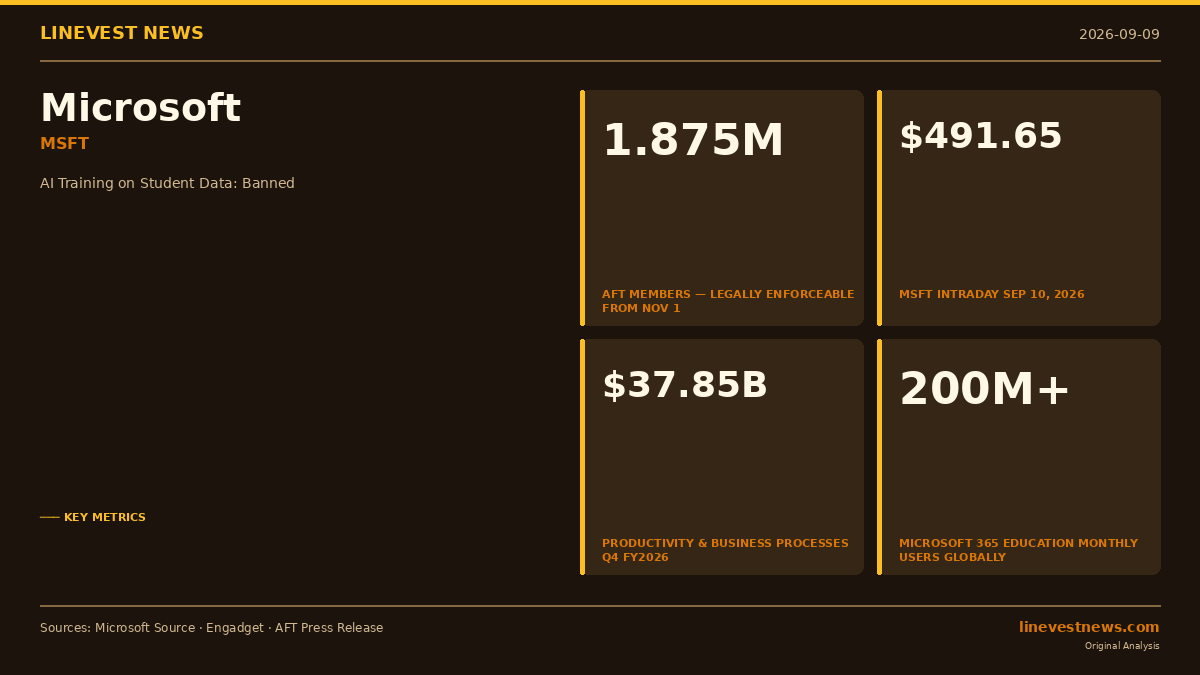
Microsoft-AFT AI Privacy Pact Bars Student Data From Training: Three Watch Points for MSFT Investors
Microsoft and AFT (1.875 million members) agreed to bar student data from AI training pipelines. Districts can sue if violated; effective November 1, 2026.
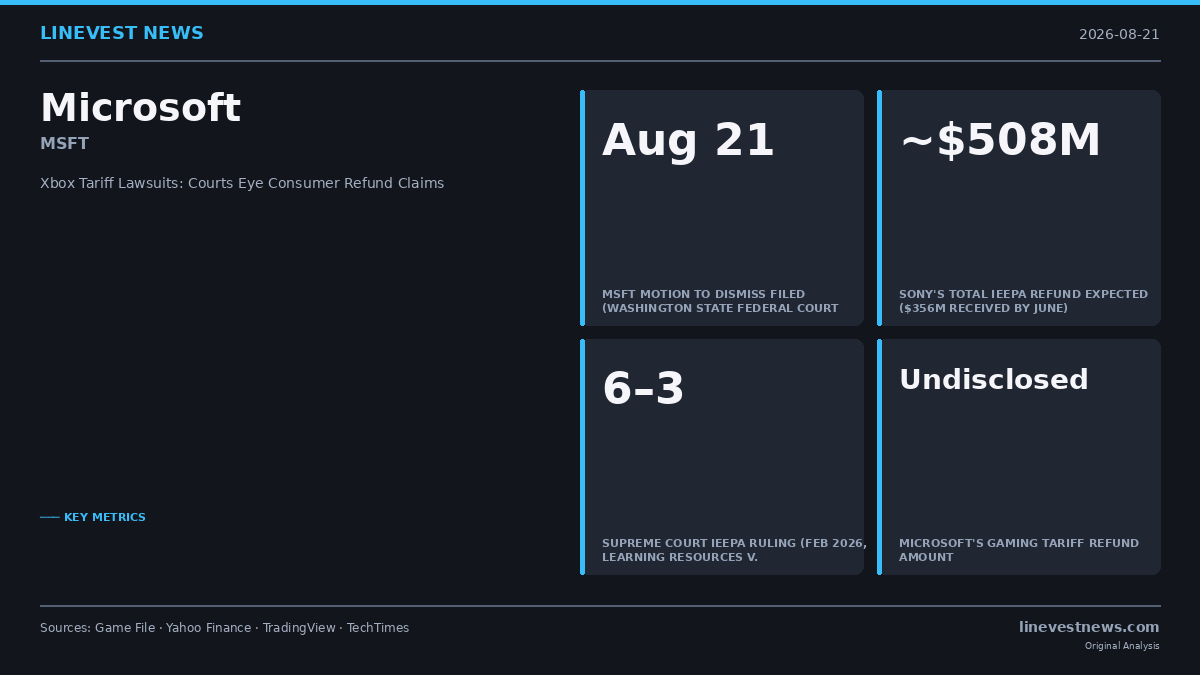
Microsoft (MSFT) Files to Dismiss Xbox Tariff Consumer Lawsuit — Three Watch Points on the IEEPA Refund Battle
Microsoft filed to dismiss an Xbox tariff class action on Aug. 21. Sony expects $508M in IEEPA refunds. No court has ruled on any of the three pending motions.
Go deeper than the headline
You just read what happened. Here's how to read what it means.
The day's reports, every morning — free
LineVest Daily lands in your inbox before the opening bell with the reports we published that day — what each company's latest 10-K or 10-Q actually says about the numbers, in plain English. Free, no card required.
This report, on any company you name
What you just read on Microsoft is the format. Name any U.S.-listed company and we do the same for it — its latest SEC filing read in full, financials under US GAAP, governance, and what it means for the stock. PDF in your inbox within 3 hours.
Which company should we read?
$15 · one-time · PDF within 3 hours
Pick a company to continueIndependent journalism based on primary SEC filings — not investment advice. No brokerage affiliation.