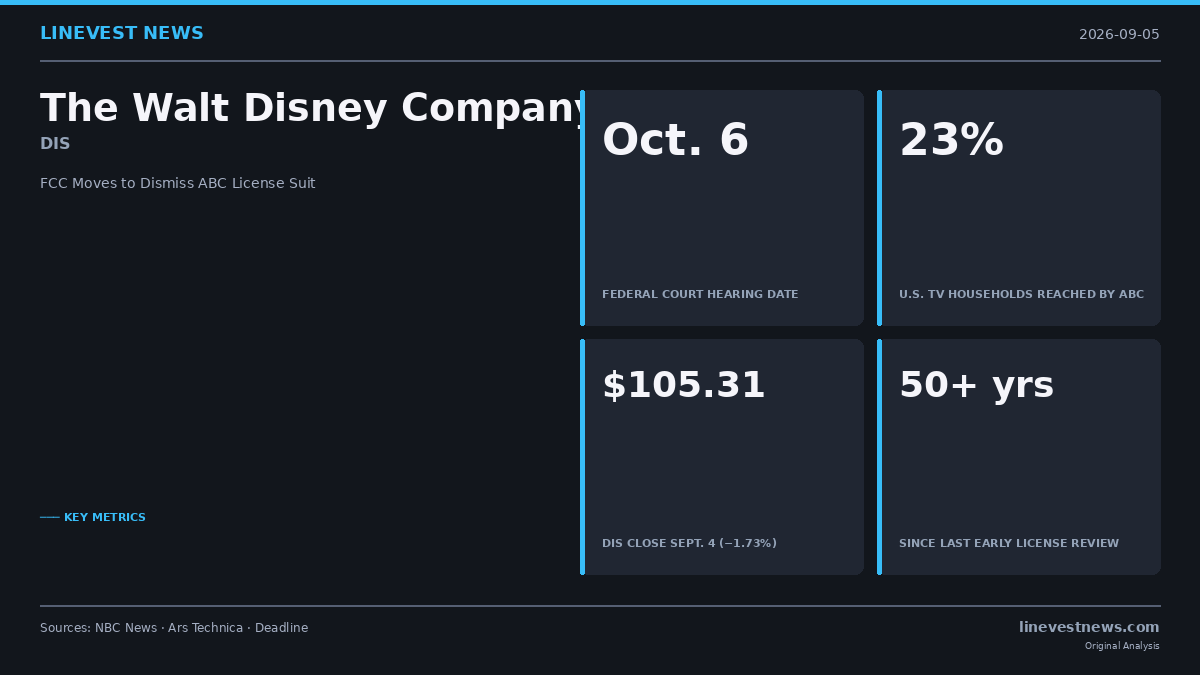
TL;DR - The FCC on Sept. 4 asked a federal court to dismiss Disney's lawsuit over the early license review of eight ABC-owned TV stations, calling the suit "premature" because no licenses have been removed yet - FCC Chair Brendan Carr called Disney's challenge "a meritless case"; the agency told the court it remains "open-minded" about whether ABC should ultimately lose its licenses - U.S. District Judge Loren AliKhan has set an October 6 hearing on the merits of Disney's First Amendment claims — the first major judicial test of whether license-review threats can be used to shape broadcaster editorial decisions - Disney's ABC News settled a separate Trump lawsuit in December 2024 for $15 million; Paramount paid $16 million in a CBS settlement linked to FCC merger approval — watchdog groups are warning Disney not to follow the same path - DIS closed at $105.31 on Sept. 4 (−1.73%); Q3 FY2026 showed revenue of $25.2B (+7%) and adjusted EPS of $2.06 (+28%), with the Entertainment segment generating $11.35B in revenue
Part A: From "Fire Kimmel" to Federal Court
The dispute traces to a social media post. In April 2026, the day after President Trump publicly called for ABC to fire late-night host Jimmy Kimmel, FCC Chair Brendan Carr ordered ABC's eight owned-and-operated television stations to file their broadcast license renewals years ahead of schedule — the first such early-renewal mandate in more than 50 years. The eight stations, located in New York, Los Angeles, Chicago, Philadelphia, Houston, San Francisco, Raleigh-Durham, and Fresno, collectively reach roughly 23% of U.S. television households. Their licenses were not scheduled for renewal until October 2028.
The FCC simultaneously opened a probe into ABC's program The View and a separate investigation into Disney's diversity, equity, and inclusion (DEI) practices. Disney complied with the April order, submitting renewal applications on May 28.
On August 18, Disney escalated by filing suit in U.S. District Court for the District of Columbia. The complaint described the FCC's actions as an "extraordinary assault on free speech" and an "existential threat," alleging the Trump administration was waging "a retaliatory campaign against ABC for a single reason: it disapproves of what ABC broadcasts." Disney sought an emergency temporary restraining order to halt the proceedings.
Judge AliKhan rejected Disney's request for an expedited hearing on August 21. She did extract one concession: the FCC agreed to provide at least 48 hours' notice before issuing any order to formally refer ABC's licenses to a public-hearing process — the administrative step that would begin an actual revocation proceeding.
FCC Files to Dismiss (Sept. 4)
On September 4, the FCC filed a motion asking Judge AliKhan to dismiss the case. The agency's central argument is ripeness: because no license has been removed and no revocation order has been issued, Disney's challenge is not yet mature for federal court review. The FCC wrote that allowing the case to proceed would "only hobble the Commission's efforts to investigate and resolve serious allegations that Disney has engaged in unlawful discrimination."
The filing included an unusual disclosure: the FCC stated it remains "open-minded" about whether ABC's stations should lose their licenses — language that media-law observers noted goes beyond a standard procedural brief. Chair Carr summed up the government's position bluntly: "All broadcasters have a legal obligation to operate in the public interest — even Disney."
Timeline
| Date | Event |
|---|---|
| April 2026 | FCC orders early renewal of 8 ABC stations, the day after Trump calls for Kimmel firing |
| May 28, 2026 | Disney files required renewal applications |
| August 18, 2026 | Disney sues FCC in D.C. District Court; seeks emergency TRO |
| August 21, 2026 | Judge AliKhan rejects expedited hearing; FCC agrees to 48h notice rule |
| September 4, 2026 | FCC files motion to dismiss Disney's lawsuit |
| October 6, 2026 | Next hearing before Judge Loren AliKhan |
Part B: Three Watch Points for DIS Investors
1. Settlement Risk Before October 6
Disney has already demonstrated willingness to settle Trump-related litigation. In December 2024, ABC News settled a separate Trump defamation lawsuit by donating $15 million to the future Trump Presidential Library — without admitting fault. That precedent was followed by Paramount Global, which paid $16 million in mid-2025 to settle President Trump's lawsuit over a CBS News interview of then-candidate Kamala Harris. Media analysts widely linked Paramount's settlement to its desire for FCC approval of Skydance Media's $8 billion acquisition of Paramount, which the FCC subsequently approved.
Watchdog organizations and media-law scholars are now explicitly urging Disney not to follow the same playbook. Their concern is not primarily financial — $15–16 million is a rounding error for a company of Disney's scale — but strategic: any settlement that includes "content commitments" or modifications to Disney's DEI programs would set an editorial precedent that could constrain the company's programming decisions well beyond a single administration.
The FCC's 48-hour notice requirement before a formal license-referral order limits the agency's tactical flexibility, but it also signals that the administrative clock is ticking. If Disney settles before October 6, investors should scrutinize the settlement language for any operational commitments beyond a cash payment.
2. What Each Judicial Outcome Means
If Judge AliKhan grants the FCC's motion to dismiss on ripeness grounds, the license-review process continues through FCC administrative channels. The next step would be a formal Adjudicatory Hearing — a lengthy proceeding that could extend well beyond 2026. Broadcast license revocations through contested proceedings are extraordinarily rare in the modern era; while historical precedents exist — WHDH-TV in Boston and RKO General's WNAC-TV both lost licenses through contested proceedings in the 1970s and 1980s — no major broadcast network affiliate has lost its licenses through this route in recent decades. The practical risk for Disney in the near term is not license loss but a prolonged regulatory overhang and chilling-effect pressure on programming decisions.
If Judge AliKhan denies the motion and allows Disney's suit to proceed to full merits arguments, it would signal only that Disney's First Amendment claims are justiciable — that a federal court will examine whether using license reviews as editorial leverage is constitutionally permissible. Whether that conduct ultimately violates the First Amendment would be determined in later proceedings on the merits. Still, the ruling would extend meaningful constitutional scrutiny to the FCC's conduct and would create precedent relevant to other broadcasters under similar scrutiny, including Comcast's NBCUniversal, which the FCC has separately flagged for a DEI investigation.
3. ABC's Place in the DIS Portfolio
Disney's Q3 FY2026 results, reported August 5, underscore how central the broadcast networks remain to the company's near-term performance. Total revenue reached $25.2 billion (+7% year-over-year), with adjusted earnings per share of $2.06 — a 28% gain from $1.61 in the prior-year quarter. The Entertainment segment, which encompasses ABC and other linear networks alongside Disney+ and Hulu, generated $11.35 billion in revenue (+6%) and $1.68 billion in operating income, up 65% from $1.02 billion a year earlier.
On the live-sports front, ABC and ESPN's coverage of the NBA Finals drew the highest viewership in 28 years, according to Disney's Q3 FY2026 investor call — a reminder that live sports remain a structural advantage for broadcast television even as streaming grows. Sports-rights contracts at Disney typically bundle ABC and ESPN together, meaning any impairment to ABC's broadcast status would have downstream effects on ESPN's carriage and renewal negotiations.
| DIS Financial Snapshot | Value |
|---|---|
| Q3 FY2026 Revenue | $25.2B (+7% YoY) |
| Q3 FY2026 Adj. EPS | $2.06 (+28% YoY) |
| Entertainment Segment Revenue | $11.35B (+6% YoY) |
| Entertainment Operating Income | $1.68B (vs. $1.02B prior year) |
| DIS Close (Sept. 4, 2026) | $105.31 (−1.73%) |
| 52-Week Range | $92.19 – $119.78 |
The FCC dispute does not yet appear in Disney's segment financials, but a protracted license fight — or a settlement with editorial strings attached — would likely prompt analysts to revisit the risk-adjusted value of ABC's contribution to the portfolio.
Bottom line for DIS investors: The October 6 hearing will determine whether Disney's First Amendment challenge survives to full merits arguments in federal court. If Judge AliKhan denies the dismissal motion, the lawsuit proceeds in court — but the FCC's administrative license-review process would likely continue in parallel, meaning neither outcome fully resolves the underlying dispute. The more immediate investor risk is the settlement calculus: a cash-only deal is financially manageable, but any agreement that includes programming or editorial commitments would introduce structural uncertainties that the market has not yet priced.
This article is journalism, not investment advice. LineVest News is not a registered investment adviser. Readers should conduct their own due diligence before making investment decisions.
Sources
- FCC Asks Court to Reject Disney Lawsuit — NBC News
- Disney and ABC Sue FCC — NBC News
- FCC Seeks Dismissal of ABC Lawsuit — Deadline
- FCC Asks Court to Dismiss Disney Challenge — Variety
- Trump Admin Fights ABC Lawsuit — Ars Technica
- Paramount CBS Settlement — PBS NewsHour
- Disney Q3 FY2026 Earnings — Yahoo Finance
- Disney ABC License Fight — ts2.space