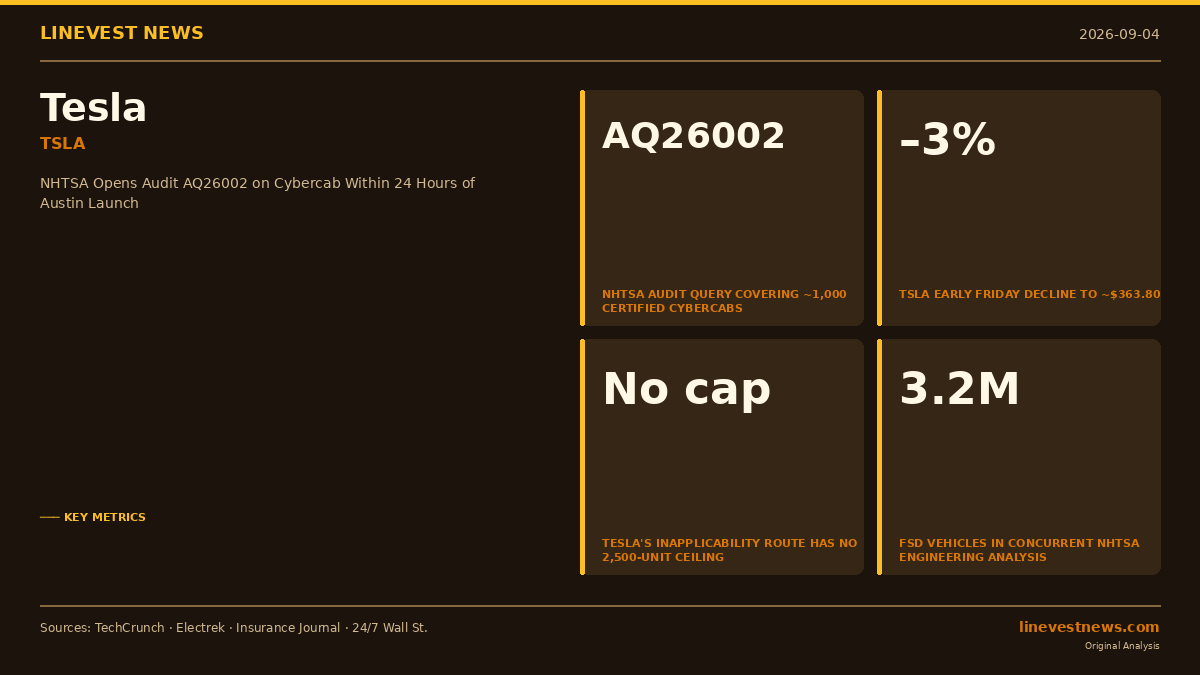
TL;DR - NHTSA's Office of Defects Investigation opened Audit Query AQ26002 covering approximately 1,000 Cybercab units within the audit's certification scope — within 24 hours of Thursday's Austin commercial launch - Tesla self-certified FMVSS compliance by declaring steering-wheel, pedal, and mirror rules "inapplicable" to a vehicle with no human controls — bypassing the formal exemption petition route - TSLA closed Thursday approximately 5.4% higher at $376.37; fell approximately 3.3% in early Friday trading to around $363.80, per 24/7 Wall St. - Three watch points: (1) NHTSA rejects Tesla's inapplicability arguments, (2) DOT rulemaking pace, (3) Tesla's concurrent Engineering Analysis covering 3.2 million FSD-equipped vehicles
Part A: The NHTSA Audit
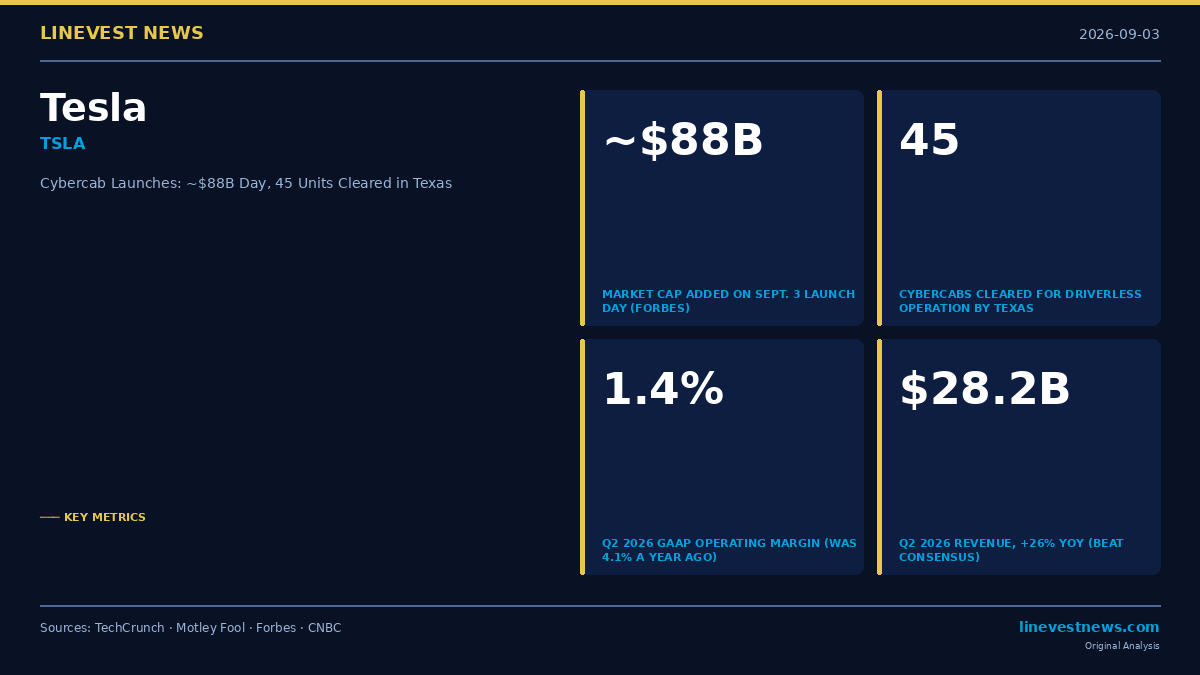
NHTSA's Office of Defects Investigation opened Audit Query AQ26002 covering approximately 1,000 Cybercab units — the vehicles within the scope of Tesla's self-certification filing. To be clear on scale: Tesla initially deployed a small number of Cybercabs commercially in Austin on September 3, 2026; the ~1,000 figure in AQ26002 represents the broader population of certified units, not all vehicles currently in paid service.
The agency stated it will examine "the process and technical data on which Tesla relied when certifying the Cybercab" — specifically "the extent to which Tesla's certification depended on determinations that certain FMVSS are inapplicable."
An audit query is a distinct investigative tool used by NHTSA's Office of Defects Investigation to examine a manufacturer's certification or recall conduct. It is separate from the standard defect-investigation sequence (Preliminary Evaluation → Engineering Analysis, which precedes any recall request). At this stage, NHTSA typically requests documentation and reviews the certification basis before deciding any next steps.
Why Tesla's Self-Certification Is Under Scrutiny
U.S. automakers self-certify compliance with Federal Motor Vehicle Safety Standards (FMVSS). The core issue: the Cybercab has no steering wheel, brake pedal, accelerator pedal, or side mirrors. Dozens of FMVSS regulations were written assuming those components exist.
Rather than petition NHTSA for an explicit exemption from specific standards — a process subject to a statutory cap of 2,500 vehicles per manufacturer annually — Tesla declared that many of those rules simply do not apply to a vehicle designed never to be operated by a human driver. NHTSA is now scrutinizing whether those inapplicability determinations hold up.
The certification path comparison:
| Route | Process | Annual Deployment Cap |
|---|---|---|
| FMVSS Exemption Petition | Formal application, agency review | 2,500 vehicles per manufacturer |
| Self-Certification via Inapplicability | Self-declare standards non-applicable | No cap (if NHTSA accepts the argument) |
The 2,500-vehicle annual cap applies to manufacturers that petition for exemption from specific FMVSS requirements. By arguing inapplicability — rather than seeking an exemption — Tesla structured its certification path without that ceiling. That approach is now what AQ26002 is examining.
Regulatory Backdrop: Rules in Motion
In June 2026, NHTSA proposed removing the brake-pedal requirement for vehicles "designed exclusively for autonomous operation" — a direct change to FMVSS that would remove one of the contested requirements from future Cybercab certifications. NHTSA Administrator Jonathan Morrison has also said the agency would "absolutely" consider ending the steering wheel requirement for fully driverless cars, though no formal proposed rule on steering wheels has been issued as of this writing.
A prospective final rule on brake pedals would apply to future vehicles and would not retroactively close AQ26002, which examines Tesla's certification basis for units already built. However, finalizing that rule would remove one contested requirement from future production certifications, easing the path for broader fleet expansion.
Concurrent Engineering Analysis: 3.2 Million FSD Vehicles
AQ26002 is not Tesla's only active NHTSA matter. In March 2026, NHTSA upgraded a separate investigation into Tesla Full Self-Driving software to an Engineering Analysis — the stage immediately preceding a potential recall — covering approximately 3.2 million FSD-equipped vehicles. That Engineering Analysis focuses on visibility-related crashes, including at least one fatality.
An Engineering Analysis is a more advanced stage than an audit query. The Cybercab probe (AQ26002) and the FSD Engineering Analysis are distinct investigations covering different vehicle populations and different issues.
Part B: Three Watch Points for TSLA Investors
Stock Reaction: Launch Momentum Meets Regulatory Friction
TSLA closed Thursday (September 3) approximately 5.4% higher at $376.37, per 24/7 Wall St., as commercial Cybercab service began in Austin and investors priced in early robotaxi validation. In early Friday trading, shares fell approximately 3.3% to around $363.80, per 24/7 Wall St., as NHTSA opened AQ26002 and unresolved deployment-scale questions weighed on sentiment.
Watch Point 1: Can NHTSA Reject Tesla's Inapplicability Arguments?
This is the primary regulatory risk for the Cybercab commercial trajectory. If NHTSA concludes Tesla improperly determined that certain FMVSS rules do not apply, potential agency responses include:
- Requiring Tesla to seek formal FMVSS exemptions going forward, effectively imposing the 2,500-vehicle annual cap
- Requesting changes to units within the audit scope
- Referring the certification findings to the standard defect-investigation process
A recall would be the low-probability tail risk. More likely near-term scenarios involve a documentation review lasting several months, during which Austin operations continue while NHTSA evaluates Tesla's technical arguments.
Watch Point 2: The DOT Rulemaking Calendar
The June 2026 brake-pedal NPRM, if finalized, would remove one of the contested FMVSS requirements from future Cybercab certifications. Administrator Morrison's public statements suggest additional rule changes on manual controls may follow, though proposals on steering wheels and mirrors have not yet been issued.
For investors, the rulemaking calendar matters most for the long-term Cybercab scale-up. Finalizing brake-pedal and, eventually, steering wheel rules would reduce the contested FMVSS landscape for future production. Until then, the inapplicability framework remains Tesla's primary certification path — with NHTSA's stance on that framework currently under active scrutiny.
Note that NHTSA NPRMs customarily include a 60-day public comment period before a final rule can be issued, and final rules at DOT routinely face delays.
Watch Point 3: Two Simultaneous Investigations and the Narrative Problem
Tesla's current valuation incorporates significant expectations for robotaxi economics. Two simultaneous NHTSA matters — an Engineering Analysis covering approximately 3.2 million FSD vehicles and Audit Query AQ26002 — create a compounding regulatory narrative. The FSD Engineering Analysis is at a more advanced stage: it is one step from a potential recall determination. AQ26002 is at an earlier investigative stage.
Taken together, the two investigations create a regulatory headline risk for a stock whose multiple is built on the premise of autonomous vehicle commercialization. Even favorable individual resolutions would require NHTSA to clear Tesla's certification methodology — a process with an uncertain timeline.
Scenario Framework
| Scenario | TSLA Impact |
|---|---|
| AQ26002 closes without enforcement; brake-pedal (and eventual steering-wheel) rules finalized | Bullish: certification path for future units resolved; uncapped Cybercab scaling possible |
| AQ26002 closes; DOT rulemaking extends into 2028 | Neutral: Austin pilot continues, broader ramp constrained by ongoing inapplicability uncertainty |
| NHTSA requires formal exemption petition going forward | Moderately bearish: 2,500-unit cap effectively imposed during transition |
| AQ26002 escalates to Preliminary Evaluation or higher | Bearish: possible pause, multiple compression |
The Bottom Line
Audit Query AQ26002 is not a recall, and Tesla's Cybercabs are operating in Austin. But the probe signals that NHTSA intends to formally evaluate whether Tesla's fastest-possible certification path — designed to sidestep the 2,500-vehicle annual cap — has a sound technical and legal basis.
Combined with the concurrent FSD Engineering Analysis (3.2 million vehicles, one step from a potential recall determination), investors long TSLA on the robotaxi thesis face a regulatory environment that is active, multi-front, and at different stages of severity. Monitoring AQ26002 status, the FMVSS rulemaking calendar, and the pace of Austin fleet expansion will be essential in the months ahead.
This article is for informational purposes only and does not constitute investment advice. Consult a qualified financial professional before making investment decisions.
Sources - Feds launch investigation into Tesla's Cybercab deployment — TechCrunch - Tesla Cybercab is already under NHTSA investigation after launch — Electrek - NHTSA Opens Probe Into Nearly 1,000 Tesla Cybercabs — Insurance Journal - Federal Regulators Open Investigation After Tesla Launches Car With No Steering Wheel — 24/7 Wall St. - Tesla Falls 3% as Cybercab Launch Leaves Deployment Questions Unanswered — 24/7 Wall St. - Trump administration proposes axing brake-pedal requirement for AVs — TechCrunch - NHTSA Considers Ending Steering Wheel Requirement for Autonomous Vehicles — Gurufocus - NHTSA Upgrades Probe into 3.2M Teslas Over Self-Driving Crashes — Insurance Journal