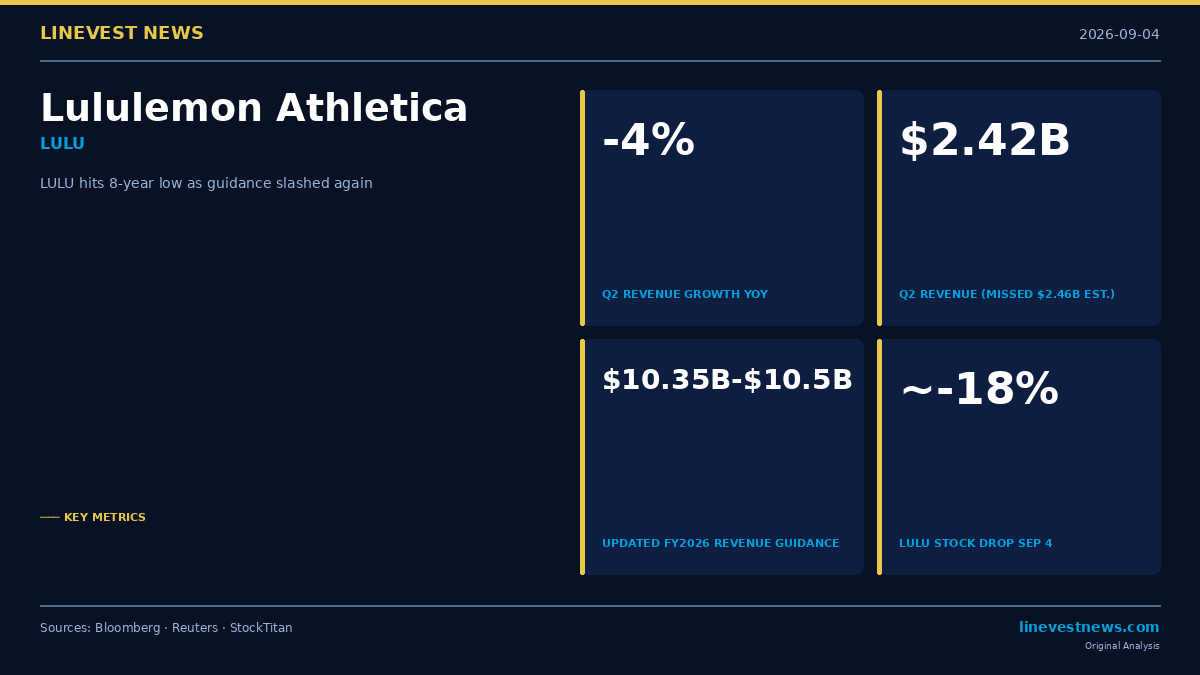
Lululemon Athletica (NASDAQ: LULU) reported fiscal second-quarter results after the market close on September 3, 2026, missing revenue estimates and cutting its full-year outlook for the second consecutive time this fiscal year. Shares tumbled approximately 18% on September 4 to around $100 — below the prior 52-week low of $104.44 and the lowest level in eight years.
TL;DR - Q2 revenue $2.42B (−4% YoY, −5% constant currency), missed $2.46B consensus - Comparable sales −9% overall; Americas −12%, International −3% - EPS of $2.92 included $0.86/share from $134.5M tariff refunds — a one-time boost - Full-year revenue guidance slashed to $10.35B–$10.5B (from $11.0B–$11.15B), per company guidance a 5%–7% decline vs. FY2025 - Q3 guidance $2.29B–$2.32B vs. $2.53B analyst estimate — the deceleration continues - Heidi O'Neill (26-year Nike veteran) starts as CEO September 8 with urgent mandate
Part A — What Lululemon Reported
Q2 FY2026 Results
| Metric | Q2 FY2026 | Q2 FY2025 | Change |
|---|---|---|---|
| Net Revenue | $2.42B | ~$2.52B | −4% YoY (−5% cc) |
| Americas Revenue | — | — | −8% YoY |
| International Revenue | — | — | +4% YoY (+2% cc) |
| Comparable Sales | −9% | — | −10% cc |
| Gross Margin | 60.5% | ~58.5% | +200 bps (incl. $134.5M tariff refund) |
| Diluted EPS | $2.92 | $3.10 | −6% YoY |
cc = constant currency. Gross margin benefited from a $134.5M IEEPA tariff refund recognized in the quarter. An additional $4.1M in associated interest was separately recognized below the gross profit line.
The headline EPS of $2.92 beat the analyst consensus of $1.82 by $1.10 per share. However, $0.86 per share after tax came directly from the tariff refund. Excluding this item, underlying EPS was approximately $2.06 — still above the $1.82 consensus, but by a narrower margin, and well below the prior-year $3.10.
Guidance Revised Sharply Lower
| Prior FY2026 Guidance | New FY2026 Guidance | |
|---|---|---|
| Revenue | $11.0B–$11.15B | $10.35B–$10.5B |
| Revenue Change vs. FY2025 | Flat to −1% (per company) | −5% to −7% (per company) |
| Diluted EPS | $10.95–$11.15 | $9.48–$9.73 |
Q3 FY2026 revenue is guided to $2.29B–$2.32B versus the $2.53B analyst consensus — implying the revenue decline has not yet stabilized.
Regional and Product Performance
The Americas — Lululemon's core market — posted −8% revenue and −12% comparable sales, a sharp reversal from +1% revenue growth in Q2 FY2025. International revenue grew +4% in reported currency, but China weakened significantly: from +24% constant-currency growth a year ago to −2% constant currency in Q2 FY2026.
Leggings — the category that defined Lululemon's brand — declined approximately 20%, indicating product relevance issues in the company's most important category. Interim co-CEO and CFO Meghan Frank stated: "We expected a better response. We know there is significant work ahead."
Management also cited social media negative commentary as a headwind to brand momentum.
Part B — What This Means for LULU Investors
1. The Tariff Refund Obscures a Sharp Underlying Deterioration
The $134.5M IEEPA tariff refund accounted for approximately 556 basis points of revenue — meaning that without it, gross margin would have been roughly 55%, representing a decline of about 350 basis points from the prior-year ~58.5%. The reported 60.5% gross margin inverts what the underlying business delivered.
Q3 FY2026 revenue guidance of $2.29B–$2.32B — roughly 9% below the $2.53B analyst consensus — arrives without any tariff refund tailwind, and at a scale that makes margin recovery harder. Investors modeling forward results should use adjusted gross margins in the mid-50s as the working baseline, not 60.5%.
2. What Heidi O'Neill Inherits on Day One
O'Neill spent 26 years at Nike in various senior leadership roles, most recently as President of Consumer, Product & Brand, overseeing product pipeline, brand voice, and athlete relationships. These are directly applicable skills for Lululemon's current challenges.
Her mandate on September 8:
- Product execution: Reviving core women's categories, particularly leggings, against intensifying competition from Alo Yoga and Vuori
- Brand reset: Rebuilding North American brand momentum after social media headwinds and inconsistent product launches
- Americas stabilization: Reversing a −12% comparable sales decline in the region that generates the majority of revenue
- China recovery: Reigniting a market that had been among the fastest-growing in the portfolio just one year ago
O'Neill arrives, however, at a brand with fundamentally different DNA than Nike. Lululemon's premium positioning and community-driven retail model require a distinct approach from Nike's mass-market and athlete-sponsorship playbook. Whether her skills translate to Lululemon's narrower, premium niche is the central investment question.
Interim co-CEOs Meghan Frank and Andre Maestrini will resume their prior senior leadership roles once O'Neill joins.
3. Three Watch Points for LULU Investors
i. Q3 as a Diagnostic Quarter
Q3 guidance of $2.29B–$2.32B signals continued deterioration. If O'Neill can stabilize or beat Q3 guidance in the November earnings report — her first full quarter in the role — it would be the first concrete evidence that the turnaround has begun. A third consecutive guidance cut in November would signal deeper structural damage.
ii. Leggings Innovation Cadence
A roughly 20% decline in leggings represents a brand and product relevance problem, not purely a macro issue. Any recovery in this SKU family would be the clearest proof of product re-relevance. Watch fall 2026 product launches, new fabrication introductions, and any commentary on leggings design refresh in the Q3 earnings call.
iii. China Trajectory
China reversed from +24% constant-currency growth to −2% in a single year. This could reflect premium positioning under pressure from domestic competitors or broader consumption caution. The China trajectory will determine how much international revenue can offset Americas weakness. A return to positive China comps in H1 FY2027 would be a meaningful positive signal.
Analyst Backdrop
Across 34 analysts covering LULU, the average rating is Hold with a 12-month average price target of approximately $127 — implying roughly 27% upside from the post-earnings ~$100 level. Estimate revisions following the steeper-than-expected guidance cut are likely to push consensus lower in the days ahead.
LULU entered September 4 trading near $100, below its prior 52-week low of $104.44, marking an eight-year low for the company. The stock has declined approximately 53% over the past twelve months.
This article is for informational purposes only and does not constitute investment advice or a recommendation to buy or sell any security.