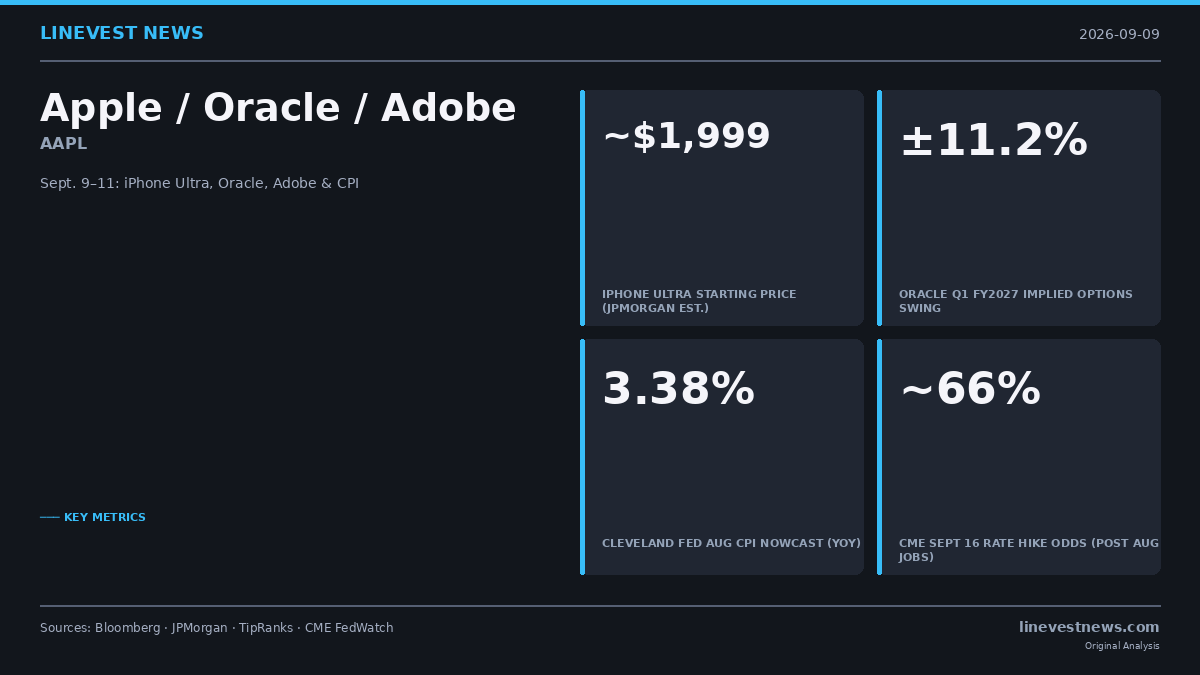
TL;DR - US markets reopen Tuesday September 8 after Labor Day. Apple's "Surprise and Shine" event follows Wednesday September 9 — CEO John Ternus's first major product launch, centered on the iPhone Ultra, Apple's first foldable device, priced from approximately $1,999 per JPMorgan. - Oracle and Adobe both report after the close Thursday September 10; options are pricing an 11.2% implied move for Oracle around its $638 billion remaining performance obligation; Adobe's call with CEO Narayen doubles as investors' first gauge of strategic continuity ahead of the December 1 handoff to incoming CEO Anil Chakravarthy. - August CPI releases Friday September 11 at 8:30 AM ET; the Cleveland Fed's nowcast stands at 3.38% year-over-year, consistent with July's confirmed 3.4%; a print at or above 3.5% would raise September 16 rate-hike odds to approximately 85% or higher. - With the Fed in blackout since September 5, these four trading days represent the most closely watched data the FOMC will receive ahead of the September 16 vote; CME FedWatch assigns approximately 66% odds of a hike following August's blowout 162,000 payrolls.
Part A: The Calendar — Four Trading Days, Four Catalysts
| Date | Day | Event | Timing | Key Metric |
|---|---|---|---|---|
| Sept 7 | Mon | US markets closed — Labor Day | — | — |
| Sept 8 | Tue | US markets reopen | — | — |
| Sept 9 | Wed | Apple "Surprise and Shine" event | 10 AM PT / 1 PM ET | iPhone Ultra pricing and supply |
| Sept 10 | Thu | Oracle Q1 FY2027 earnings | After close | Revenue vs. $19.1B–$19.5B consensus |
| Sept 10 | Thu | Adobe Q3 FY2026 earnings | After close (2 PM PT call) | Revenue vs. $6.67B–$6.72B guidance |
| Sept 11 | Fri | August CPI — BLS release | 8:30 AM ET | YoY rate vs. July's 3.4% baseline |
| Sept 15–16 | — | FOMC meeting; rate decision September 16 | 2 PM ET (Sept 16) | 25 bps hike or hold |
The four trading days are unusual in their density. Apple absorbs investor attention mid-week on Wednesday; Oracle and Adobe both report Thursday evening; the macro verdict arrives Friday morning at 8:30 AM ET, five days before the Fed votes September 16. A hot CPI on Friday will immediately lift two-year Treasury yields and push the FOMC decision closer to certainty; a soft Oracle cloud print can pull down AI infrastructure sentiment even before CPI lands.
Part B: Investor Analysis — How the Four Catalysts Interact
1. Apple September 9: The Ternus Era's First Product Test
Apple enters the week at a pre-Labor-Day close of $319.97, up approximately 18% year-to-date against the S&P 500's 12.75% gain — outperforming the index by more than 5 percentage points. The September 9 event — titled "Surprise and Shine" — will be CEO John Ternus's debut presentation after succeeding Tim Cook on September 1, 2026.
iPhone Ultra (foldable): Apple's first-ever foldable smartphone is expected to carry a starting price of approximately $1,999 per JPMorgan, with analyst Ming-Chi Kuo forecasting a range of $2,000–$2,500 and Fubon Research at approximately $2,399. Analyst supply estimates diverge significantly: Kuo projects 3–5 million units shipping across calendar year 2026, while Morgan Stanley — which is more bullish on demand — projects 7–8 million units shipping in the second half of 2026 alone, with the majority of those expected in the October–December quarter. Morgan Stanley's higher supply and ASP assumptions underpin its estimate that the iPhone Ultra could contribute approximately $14 billion to Apple's December quarter revenue.
The standard iPhone 18 has been delayed to spring 2027 alongside the iPhone 18e and iPhone Air 2, concentrating September's unit economics at the premium tier.
| Product | Starting Price Estimate | 2026 Supply Outlook |
|---|---|---|
| iPhone Ultra (foldable) | $1,999–$2,500 | 3–5M CY2026 (Kuo, conservative) |
| iPhone Ultra (foldable) | same as above | 7–8M H2 2026 (Morgan Stanley, bullish) |
| iPhone 18 Pro / Pro Max | Expected at prior Pro tier pricing | High volume |
| iPhone 18 (standard) | Delayed to spring 2027 | — |
| Home Hub (AI display) | TBA | — |
Investor read-through: The iPhone Ultra's demand signal at $1,999 and above is the most-watched variable. A strong pre-order indication would validate Apple's premium-tier thesis. Apple's more than 5 percentage point year-to-date outperformance relative to the S&P 500 leaves limited margin for disappointment.
Three questions for Wednesday: 1. Does Apple price the iPhone Ultra at exactly $1,999, or push the entry point above that level? 2. Does the Home Hub include a subscription service announcement that expands services annual recurring revenue? 3. Does Ternus signal October or November availability for iPhone Ultra's initial shipments?
2. Oracle September 10: The $638B RPO Conversion Test
Oracle (ORCL) reports its first quarter of fiscal year 2027 after the close Thursday September 10. The consensus expects approximately $19.1–$19.5 billion in revenue — implying approximately 28–31% year-over-year growth depending on where in the range revenue lands — and non-GAAP EPS of approximately $1.73–$1.77; Oracle's own guidance was $1.72–$1.76.
The options market is pricing an 11.2% move in either direction, one of the larger implied swings for Oracle in recent memory. The reason is structural: Oracle ended fiscal year 2026 with $638 billion in remaining performance obligation, of which $75 billion was pre-funded by hyperscaler customers. Investors want to know whether that backlog is converting into recognized revenue at the pace needed to sustain 58–64% blended cloud growth. Per analyst estimates, achieving that blended target requires Oracle Cloud Infrastructure (OCI) to sustain triple-digit growth — estimates suggest approximately 110% or higher is required, depending on the OCI-SaaS revenue mix — to compensate for the slower growth of the larger SaaS business.
| Oracle Q1 FY2027 | Estimate |
|---|---|
| Revenue consensus | $19.1B–$19.5B |
| Implied YoY growth | ~28–31% |
| Oracle non-GAAP EPS guidance | $1.72–$1.76 |
| Analyst non-GAAP EPS consensus | ~$1.73–$1.77 |
| Remaining performance obligation | $638B |
| Options implied move | ±11.2% |
Investor read-through: A revenue beat above $19.5 billion would confirm that Oracle's aggressive data center investment is translating to recognized revenue. A miss below the $19.1 billion consensus floor would raise questions about the gap between $638 billion in backlog and actual conversion pace. For investors in adjacent AI infrastructure names — data center REITs, power utilities serving hyperscalers — an Oracle beat provides indirect validation of the broader AI buildout thesis.
3. Adobe September 10: CEO Succession Under the Spotlight
Adobe (ADBE) reports Q3 FY2026 after the close Thursday September 10, with an investor call starting at 2 PM Pacific. Adobe's own guidance for Q3 calls for revenue of $6.67–$6.72 billion. The consensus non-GAAP EPS estimate is approximately $6.08. This follows Q2's record revenue of $6.62 billion.
The harder question for Adobe is organizational. Adobe named Anil Chakravarthy as incoming CEO effective December 1, replacing Shantanu Narayen after 19 years as chief executive; Narayen transitions to Executive Chair. Because the Q4 FY2026 report is expected in mid-December — after the December 1 leadership handoff — the September 10 call will be Narayen's final earnings call as CEO. Investors will parse his language on AI monetization — Firefly ARR, Creative Cloud attach rates, Document Cloud trends — for signals about strategic continuity under Chakravarthy. Adobe's stock has fallen approximately 18% year-to-date, partly reflecting uncertainty about whether Firefly and AI-first products can offset slower growth in traditional subscriptions.
| Adobe Q3 FY2026 | Estimate |
|---|---|
| Company revenue guidance | $6.67B–$6.72B |
| Consensus non-GAAP EPS | ~$6.08 |
| Preceding Q2 actual revenue | $6.62B (record) |
Investor read-through: Beat and raise validates the AI monetization thesis and could re-rate the stock toward broader market performance. In-line with no guidance raise may lead the market to interpret the CEO transition as a strategic reset rather than a confidence signal. Listen to the Q&A for how Narayen frames the Chakravarthy handoff — language about "continuity" versus "evolution" will matter as much as the revenue line.
4. August CPI September 11: The Most Closely Watched Print Before September 16
The Bureau of Labor Statistics releases August CPI on Friday September 11 at 8:30 AM ET — five days before the FOMC votes September 16, and the most closely watched inflation reading ahead of that decision.
Baseline: July 2026 CPI came in at 3.4% year-over-year. The Cleveland Fed's inflation nowcast for August stands at 3.38% year-over-year, consistent with an essentially flat reading relative to July. Wall Street consensus clusters around 3.4%.
With the Federal Reserve in blackout since September 5, no public FOMC statements will precede the September 16 decision. August's payroll report — 162,000 jobs against a 53,000 consensus — has already pushed the implied probability of a September hike to approximately 66% per CME FedWatch.
| CPI Scenario | YoY Band | Implied FOMC Action | Approximate Hike Probability |
|---|---|---|---|
| A — Hot | ≥ 3.5% | Near-certain hike | ~85% or higher |
| B — In Line | 3.3%–3.4% | Approximately near current level | ~55%–70% |
| C — Cool | ≤ 3.2% | Hold likely | ~10%–25% |
Current CME FedWatch hike probability: approximately 66%. Consensus CPI is 3.4%, placing an in-line print at the upper bound of Scenario B. A 3.2% reading would mark a meaningful 0.2 percentage point deceleration from July, shifting the narrative from steady inflation to a potential cooling trend and pushing hike odds toward the Scenario C range.
Asset class implications:
- Scenario A (hot print): Two-year Treasury yields rise (bond prices fall); the US dollar strengthens; growth and technology equities face multiple compression; consumer staples and energy stocks offer relative defensiveness, while rate-sensitive sectors including utilities and REITs compress alongside growth.
- Scenario B (in-line print): Limited immediate reaction on the number itself; attention shifts to FOMC statement language and any signals on the October or December path.
- Scenario C (cool print): Rate-sensitive sectors — homebuilders, REITs, small caps — rally; long-duration bonds catch a bid; technology broadly benefits from lower discount rates.
The Cross-Asset Connection: Sequencing Creates Double Exposure
The week's distinctive feature is that the three major technology events — Apple Wednesday, Oracle and Adobe Thursday — occur before the macro verdict arrives Friday morning. This sequencing creates an unusual risk dynamic.
If Apple's iPhone Ultra receives a strong initial response Wednesday and Oracle beats Thursday night, equity sentiment enters Friday's CPI in an optimistic posture. A hot CPI in that environment is more destabilizing than usual: investors must simultaneously process "tech fundamentals are solid" and "the Fed is almost certainly hiking in five days." Historically, that combination compresses multiples for high-valuation technology names even when earnings remain solid, because rising rates reduce the present value of future cash flows.
Conversely, if Apple disappoints Wednesday or Oracle misses Thursday, the CPI arrives into already-weak technology sentiment. A cool CPI in that scenario could be disproportionately powerful as a relief rally catalyst, removing the rate-hike overhang at precisely the moment tech sentiment is most vulnerable.
For practical portfolio management, the sequencing matters more than any single data point this week. Sizing decisions made Wednesday after the Apple event should account for Thursday's earnings volatility and Friday's macro risk — with the FOMC vote seven days away.
Sources
- Apple "Surprise and Shine" event preview — Bloomberg
- JPMorgan: iPhone Ultra starting at $1,999 — Tweaktown
- Morgan Stanley: iPhone Ultra $14B December quarter — MacDailyNews
- iPhone Ultra supply forecasts — PhoneArena
- Oracle Q1 FY2027 11.2% implied move — TipRanks
- Adobe Q3 FY2026 earnings date — BusinessWire
- CPI and September rate hike analysis — Seeking Alpha
- Warsh and September rate hike debate — CNBC
- Catalyst watch: Apple, Oracle, CPI week — Seeking Alpha
This article is for informational purposes only. LineVest News is not a registered investment adviser. Nothing herein constitutes investment advice or a recommendation to buy or sell any security.