
OracleORCL
About Oracle
Oracle Corporation is a global enterprise software and cloud infrastructure company whose business rests on three interlocking pillars: cloud services and license support, cloud license and on-premise license, and hardware and services. The cloud and license support line, which bundles maintenance for Oracle's database and applications with subscription access to its cloud offerings, generates the bulk of both revenue and profit and is the segment that anchors the company's economics. Oracle's flagship products remain its relational database and the Fusion and NetSuite suites of enterprise applications covering ERP, HCM, and CX, alongside Oracle Cloud Infrastructure, its hyperscale compute and storage platform. Industry-specific software, notably Cerner-branded electronic health records, rounds out the portfolio.
Holders track several structural questions. Capital intensity has risen sharply as Oracle builds out data centers to support OCI and large AI-training contracts, which shifts the free cash flow profile and raises supplier concentration around Nvidia. Customer concentration in remaining performance obligations, disclosed in filings, has grown with a handful of very large multi-year AI compute deals. Governance features include the continued influence of founder Larry Ellison as chairman and chief technology officer and his substantial ownership stake. Other durable considerations include competitive positioning against hyperscalers, exposure to U.S. federal and healthcare procurement cycles, foreign currency translation given roughly half of revenue from outside the Americas, and a long-standing policy of returning capital through buybacks and a modest dividend.
Oracle was founded in 1977 by Larry Ellison, Bob Miner, and Ed Oates as Software Development Laboratories, renamed Relational Software Inc., and finally Oracle in 1982. The commercial launch of a SQL-based relational database ahead of IBM established the franchise that still defines the company. Oracle went public in 1986. A wave of acquisitions from the mid-2000s transformed it into an applications company, most consequentially PeopleSoft in 2005, Siebel in 2006, BEA Systems in 2008, Sun Microsystems in 2010, and NetSuite in 2016. The 2022 acquisition of Cerner extended Oracle into healthcare records. The company is Delaware-incorporated and headquartered in Austin, Texas after relocating from Redwood City, California in 2020.
Oracle sells primarily to large enterprises, governments, and, increasingly, cloud-native customers training AI models. License and cloud contracts are typically multi-year, negotiated by a direct sales force and complemented by resellers and system integrators, with support renewals producing highly recurring revenue at very high gross margin. The competitive moat rests on the entrenched Oracle Database inside mission-critical workloads, the switching costs of Fusion and NetSuite applications, and multi-cloud interconnects that place Oracle Database inside rival hyperscaler data centers. Principal competitors include SAP in applications, Microsoft, Amazon Web Services, and Google Cloud in infrastructure, Salesforce and Workday in SaaS, and Epic in health records. The Americas generate roughly half of revenue, with EMEA and Asia-Pacific supplying the balance.
Company profile by LineVest editorial. Journalism, not investment advice.
Order a report on Oracle — $15Oracle coverage
4 articles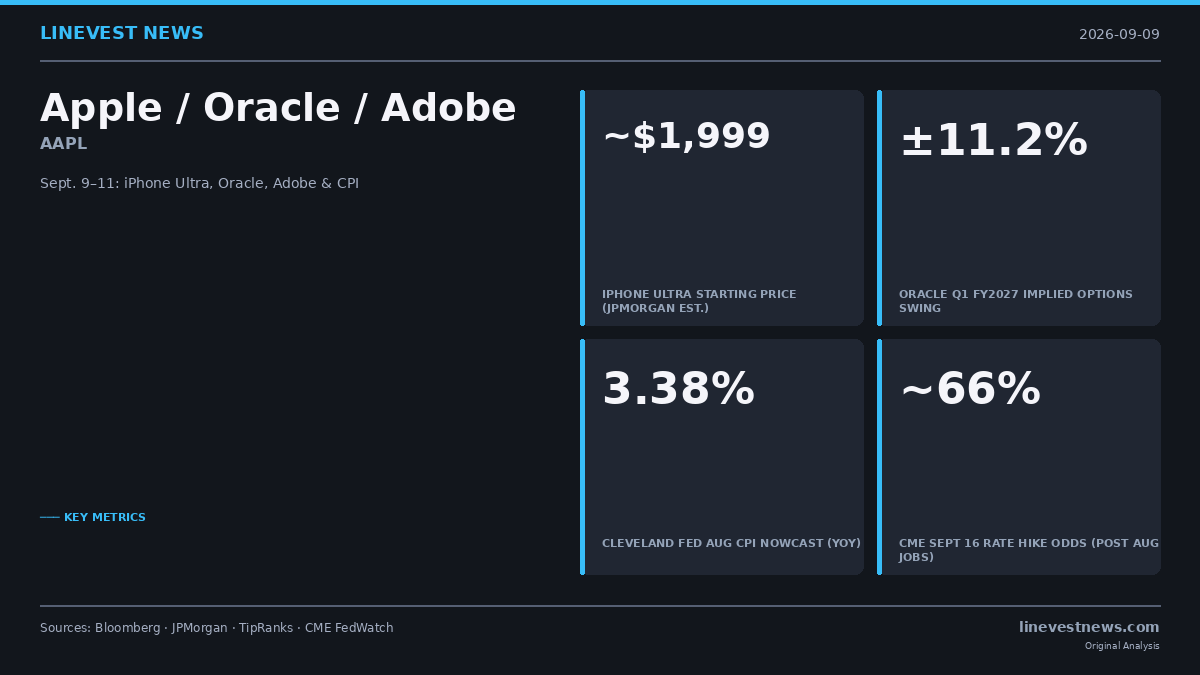
September 8–11 Investor Playbook: iPhone Ultra, Oracle, Adobe, and the CPI That Decides the Rate Decision
iPhone Ultra, Oracle cloud earnings, Adobe CEO handoff, and Friday CPI converge in four trading days ahead of the September 16 rate decision.
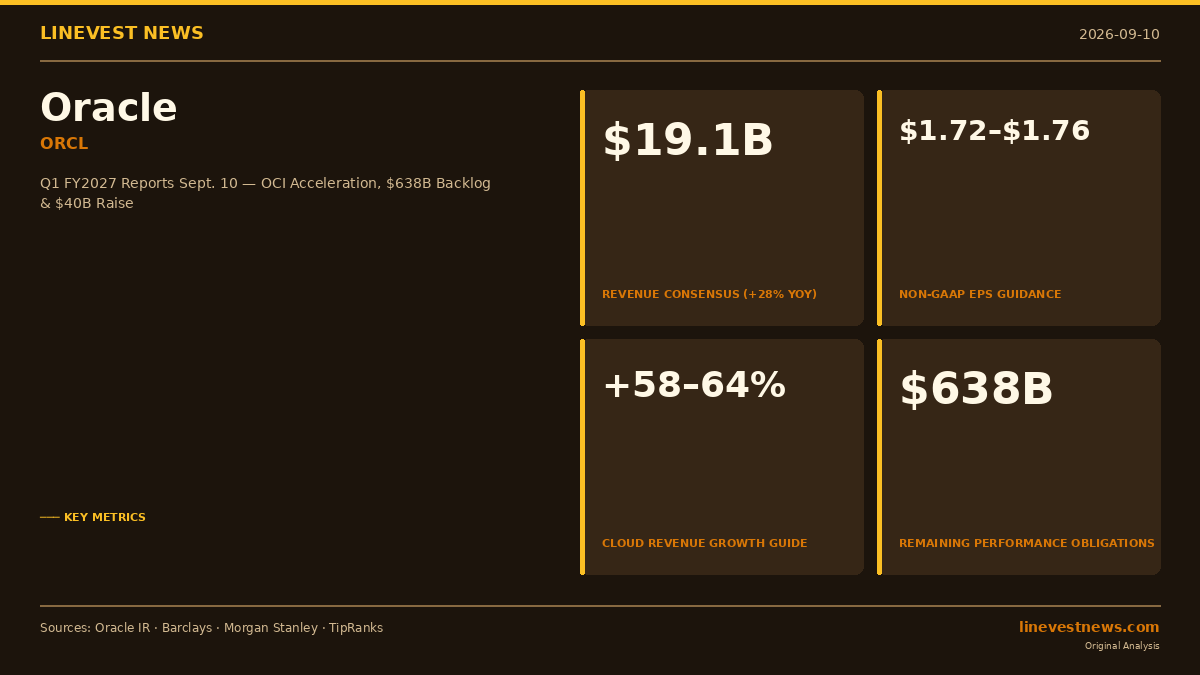
Oracle (ORCL) Q1 FY2027 Earnings Preview: Three Watch Points for the September 10 Report
Oracle reports Q1 FY2027 on Sept. 10 after close. Consensus: $19.1B revenue (+28%). Guide: non-GAAP EPS $1.72–$1.76, cloud +58–64% YoY.
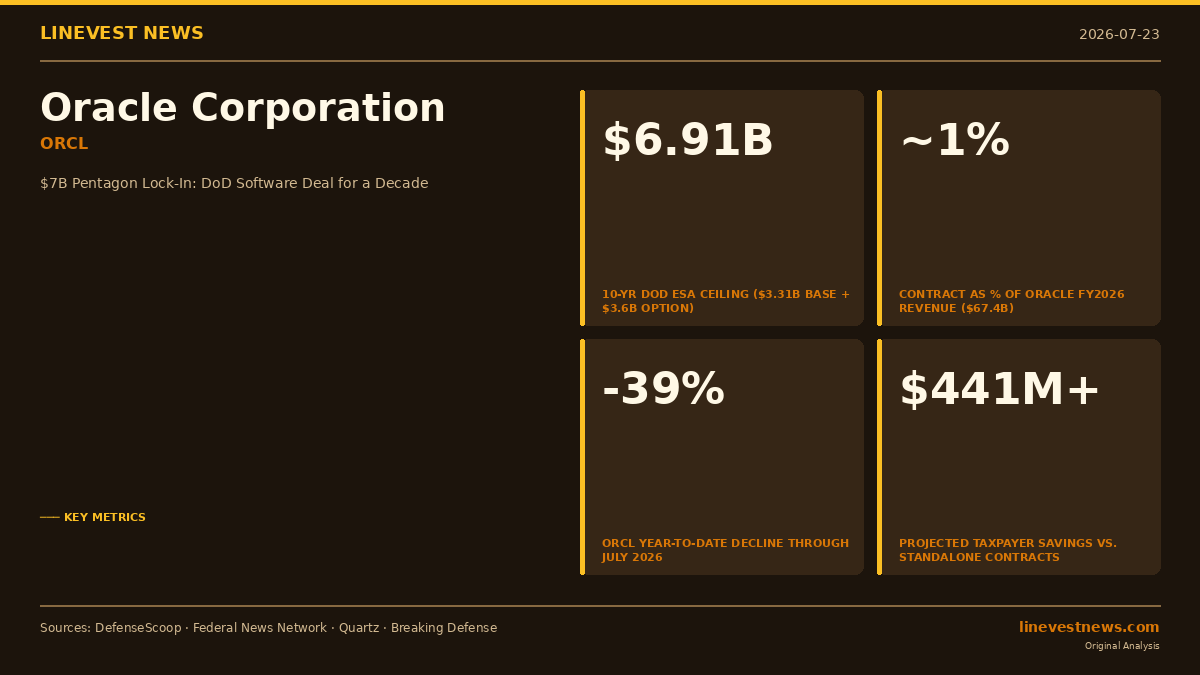
Oracle (ORCL) Locks Pentagon Into $7 Billion, 10-Year Software Deal—What U.S. Investors Need to Know
Oracle (ORCL) won a $7B, 10-year DoD Enterprise Software Agreement on July 23, 2026. The deal saves $441M in taxpayer costs but represents ~1% of Oracle's annual revenue.
Oracle FY2026 Annual Report: USD 638B Backlog and Negative Free Cash Flow of USD 23.7B Signal Infrastructure Pivot
Oracle FY2026: Revenue USD 67.4B (+17.3%), RPO backlog USD 638B, CapEx USD 55.7B (+162%), free cash flow -USD 23.7B. OCI cloud infrastructure revenue surged 77% as Oracle's infrastructure pivot accelerates.
Go deeper than the headline
You just read what happened. Here's how to read what it means.
The day's reports, every morning — free
LineVest Daily lands in your inbox before the opening bell with the reports we published that day — what each company's latest 10-K or 10-Q actually says about the numbers, in plain English. Free, no card required.
This report, on any company you name
What you just read on Oracle is the format. Name any U.S.-listed company and we do the same for it — its latest SEC filing read in full, financials under US GAAP, governance, and what it means for the stock. PDF in your inbox within 3 hours.
Which company should we read?
$15 · one-time · PDF within 3 hours
Pick a company to continueIndependent journalism based on primary SEC filings — not investment advice. No brokerage affiliation.