TL;DR
- Oracle (ORCL, NYSE) secured a 10-year, up-to-$7 billion Enterprise Software Agreement (ESA) with the U.S. Department of Defense on July 23, 2026, covering the full DoD plus intelligence agencies and the U.S. Coast Guard.
- The deal consolidates fragmented Oracle software procurement across the Pentagon, projecting at least $441 million in taxpayer savings versus separate license purchases.
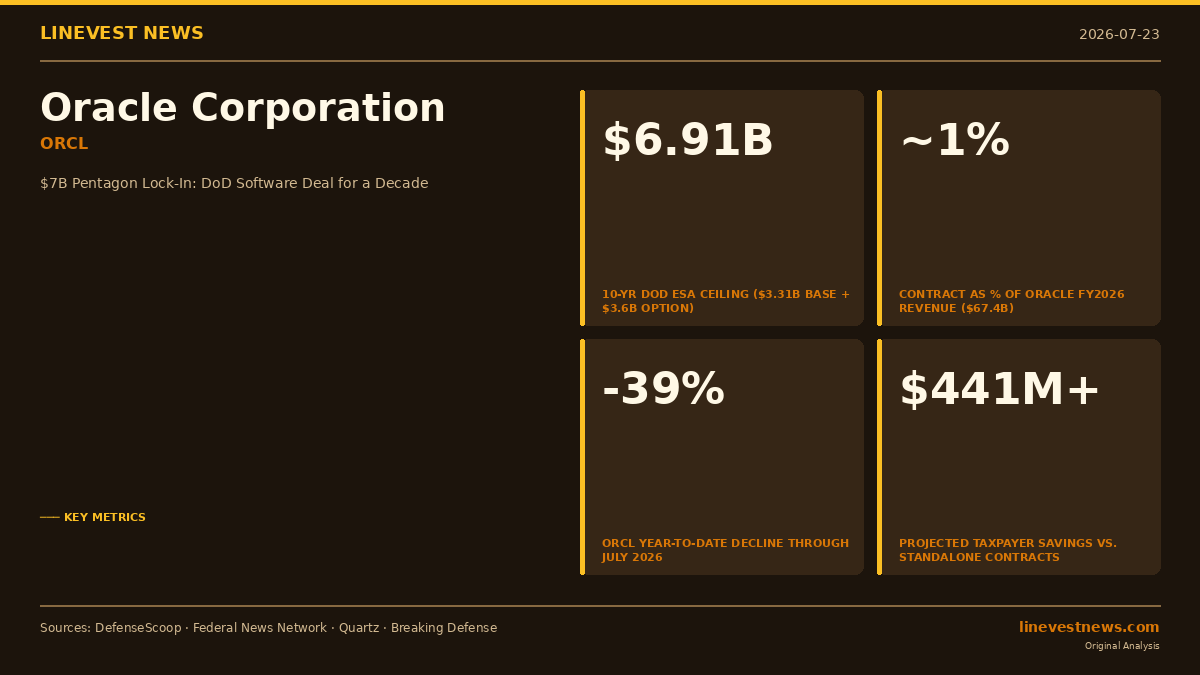
- At approximately $699 million per year, the contract represents roughly 1% of Oracle's fiscal 2026 revenue of $67.4 billion—a meaningful government anchor, but analysts characterize it as a "marginal boost" against Oracle's larger AI-cloud challenges.
- ORCL shares rose 2–3% on the announcement but remain approximately 39% below their 2026 opening price, trading near $124. Analyst consensus: the stock faces resistance at $135 until Oracle shows evidence of accelerating cloud and AI revenue conversion.
Part A: The Contract — Structure and Scope
What Oracle Won
The U.S. Department of Defense, acting through the Department of the Navy, awarded Oracle an Indefinite Delivery/Indefinite Quantity (IDIQ) enterprise software agreement on July 23, 2026. The vehicle is structured in two periods:
| Period | Duration | Ceiling Value |
|---|---|---|
| Base period | 5 years | $3.31 billion |
| Option period | 5 years | $3.60 billion |
| Total ceiling | 10 years | $6.91 billion (~$7 billion) |
The agreement is not a new funding commitment but rather a single consolidated procurement vehicle that replaces dozens of fragmented Oracle software contracts across military branches, intelligence agencies, and the Coast Guard. Agencies still need to issue individual delivery orders against the ceiling—so the $6.91 billion is a maximum, not guaranteed annual spend.
What Is Covered
The ESA covers: - On-premises software licenses (perpetual and subscription-based) - Software maintenance and support - Consulting services - Software-as-a-Service (SaaS) offerings - A migration pathway to Oracle Cloud Infrastructure and AI-enabled tools
A live example: the Defense Manpower Data Center is using the agreement to migrate human-resources systems—including personnel records, benefits eligibility, and military ID management—onto Oracle platforms.
The Pentagon's Rationale
DoD CIO Kirsten Davies stated: "By fundamentally improving how we procure on-premises Oracle capabilities, we are driving at least $441 million in taxpayer savings while rapidly and effectively serving our warfighters."
Navy CIO Barry Tanner added that consolidation "reduces cybersecurity risk, and helps us focus resources on resilient capabilities that can scale, integrate, and endure in contested conditions."
This mirrors a trend of DoD consolidating enterprise software under single vendors. In May 2026, the Pentagon awarded Dell Federal Systems a $9.7 billion Core Enterprise Technology Agreement for Microsoft services—establishing the same unified-procurement model, just for a different vendor ecosystem.
Part B: What It Means for ORCL Investors
1. Revenue Contribution Is Modest Relative to Oracle's Scale
Oracle closed fiscal year 2026 (ended May 31, 2026) with revenue of approximately $67.4 billion. The DoD agreement's annualized ceiling of ~$699 million represents roughly 1.04% of FY2026 revenue.
| Metric | Value |
|---|---|
| Oracle FY2026 revenue | $67.4B |
| DoD ESA annualized ceiling | ~$699M |
| Contract as % of FY2026 rev | ~1.0% |
| Projected taxpayer savings vs. standalone | $441M+ |
| ORCL stock reaction (July 24) | +2–3% |
The contract delivers revenue predictability—not a step-change in growth. For context, Oracle's FY2026 total cloud revenue was already in the $25–30 billion range. A $700M/yr government anchor is meaningful but not transformative on its own.
Bottom line: The ESA is accretive to Oracle's government-segment stability but not a catalyst large enough to reverse ORCL's 39% YTD decline by itself.
2. The Strategic Prize: A Cloud and AI On-Ramp
The ESA's true long-term value lies in the transition pathway it creates. Oracle's EVP for Government, Defense, and Intelligence, Kim Lynch, described the agreement as creating "a more standardized and efficient path to Oracle cloud and AI technology tuned to support mission-critical scenarios."
This is Oracle's playbook: land on-premises license consolidation, then migrate workloads to Oracle Cloud Infrastructure (OCI). The Pentagon's 10-year lock-in gives Oracle a decade to convert legacy on-premises DoD customers into OCI cloud customers—a revenue-multiplier if it succeeds.
Oracle is separately pursuing a $88 million Air Force contract to deploy AI tools on classified military networks, providing another proof point that the company is building an AI-cloud presence inside the DoD ecosystem beyond traditional database licensing.
3. Competition With Microsoft, Amazon, and Google
The DoD's cloud landscape is contested. The same Pentagon that awarded Oracle $7 billion in software also awarded: - Microsoft (via Dell Federal): $9.7 billion CETA for consolidated Microsoft Services (May 2026) - Amazon Web Services: JEDI/JWCC infrastructure contracts remain live - Google Cloud: Expanding defense contracts for AI workloads
Oracle's ESA is primarily an on-premises software consolidation deal, not a head-to-head cloud infrastructure award. The risk for investors: if DoD agencies use the ESA's SaaS provisions to migrate workloads to AWS, Azure, or GCP rather than OCI, Oracle captures license revenue in the near term but cedes the cloud margin opportunity to competitors.
4. ORCL Stock Context: A 39% YTD Drawdown
Oracle entered 2026 as a consensus AI-cloud beneficiary—data centers, GPU cluster leasing, and enterprise SaaS. By the time the DoD contract was announced on July 23, ORCL had fallen approximately 39% year-to-date, trading near $124 against resistance at $135.
The drawdown reflects multiple headwinds: - CapEx acceleration: Oracle committed to massive data-center spending, raising leverage concerns in a high-interest-rate environment. - AI revenue lag: The market began questioning the timeline for AI cloud investments to convert into reportable revenue. - Competition from hyperscalers: Microsoft, Amazon, and Google command larger installed bases for AI workloads.
The DoD ESA prompted a 2–3% single-day rally in ORCL—notable given the stock's recent weakness—but analysts caution that a sustained rebound requires "substantial evidence of accelerated AI cloud revenue" before the $135 resistance zone becomes support.
5. The Investment Risk / Reward Framework
Bull case: The $7B ESA is a 10-year revenue floor. Combined with the AI-cloud migration pathway and Oracle's growing hyperscaler-level data-center footprint, ORCL at $124—trading below its five-year average price-to-sales multiple—represents a value entry into one of the few pure-play enterprise cloud companies with demonstrated government traction.
Bear case: The ESA is a legacy on-premises consolidation deal at thin margins. If Oracle's $70 billion FY2027 capital expenditure guidance fails to generate commensurate cloud revenue, the company faces a margin compression cycle while MSFT, AMZN, and GOOGL extend their AI leads. The $441 million in government savings largely accrues to the DoD, not Oracle's income statement.
| Risk Factor | Severity | Investor Signal to Watch |
|---|---|---|
| ESA delivery order pace | Medium | Quarterly revenue from U.S. Public Sector segment |
| OCI vs. hyperscaler cloud migration rate | High | OCI revenue growth in FY2027 Q1–Q2 |
| CapEx-to-cloud-revenue conversion | High | FY2027 free cash flow margin |
| Government IT budget sequestration | Low | Continuing resolution / NDAA cycle |
Key Takeaway for U.S. Investors
The Oracle–Pentagon ESA is a strategically important deal that provides Oracle with a 10-year government software beachhead and a migration pathway toward OCI cloud contracts. Revenue impact is modest (~1% of annual revenue at ceiling), but the lock-in reduces churn risk in Oracle's government segment and positions the company for incremental AI-cloud workloads as DoD modernization accelerates.
For investors in ORCL—already down 39% in 2026—the contract is a positive datapoint but not sufficient, on its own, to justify a re-rating. The critical variables remain: FY2027 OCI revenue growth, the pace of CapEx monetization, and Oracle's ability to win AI workloads inside the classified DoD environment where the $88M Air Force AI contract provides an early signal.
This article reflects editorial analysis as of August 3, 2026. Oracle's actual quarterly revenue contributions from the DoD ESA will be disclosed in future earnings reports. This is not investment advice. LineVest is an independent financial news publisher and does not hold positions in any securities mentioned.
Sources - DefenseScoop — Pentagon Awards Oracle $7B Software Licenses (July 23, 2026): https://defensescoop.com/2026/07/23/pentagon-awards-oracle-7b-dollar-software-licenses/ - Federal News Network — DoD Awards Oracle Software Deal Worth Up to $7 Billion: https://federalnewsnetwork.com/contracting/2026/07/dod-awards-oracle-software-deal-worth-up-to-7-billion/ - Quartz — Oracle Wins $7 Billion Pentagon Software Contract: https://qz.com/oracle-pentagon-software-contract-dow-esi-072426 - Breaking Defense — Oracle Inks $7 Billion Deal to Consolidate Pentagon Software Purchases: https://breakingdefense.com/2026/07/oracle-inks-7-billion-deal-to-consolidate-pentagon-software-purchases/ - TradingKey — Oracle ORCL: $7B DoD Contract Amid Stock Struggles: https://www.tradingkey.com/analysis/stocks/us-stocks/262052506-stock-oracle-orcl-price-ai-dod-msft-amzn-goog-tradingkey - Yahoo Finance — Oracle Inks 10-Year, $7 Billion Contract With DoD: https://finance.yahoo.com/markets/stocks/articles/oracle-inks-10-7-billion-112700892.html