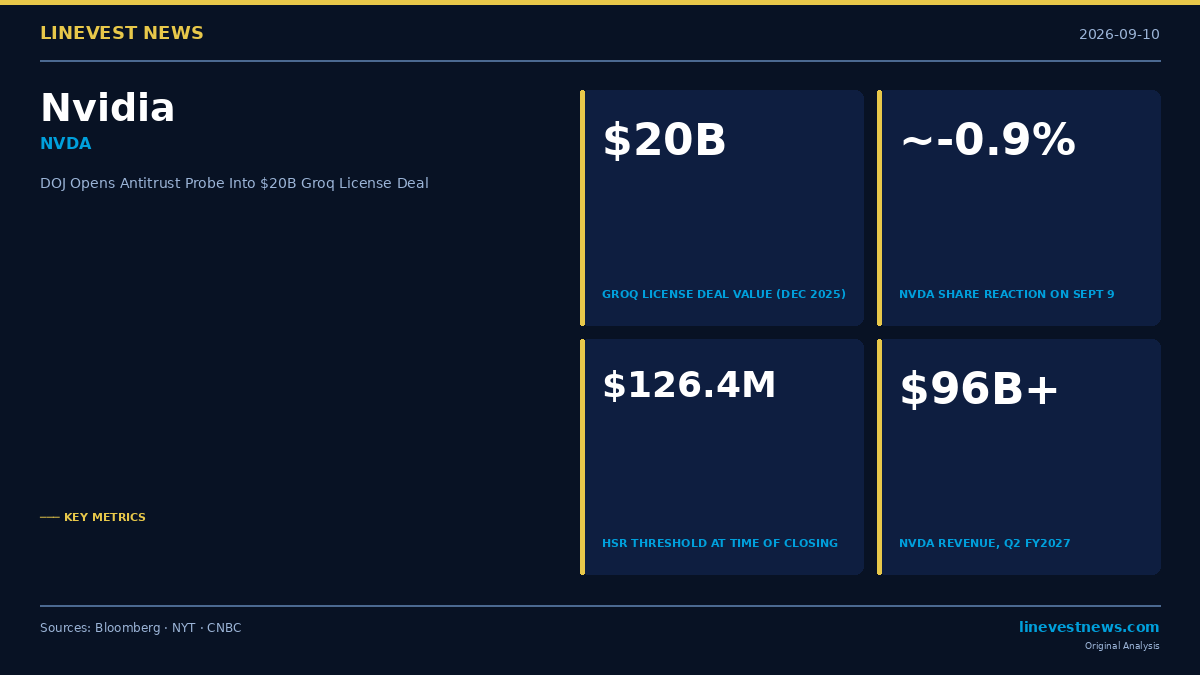
TL;DR - The Justice Department is investigating Nvidia's ~$20 billion license deal with AI inference chip startup Groq, announced December 2025 - Core concern: Nvidia may have structured the arrangement as a "license" to sidestep Hart-Scott-Rodino (HSR) pre-merger filing requirements; CNBC reported the deal as an asset purchase of most of Groq's assets, while the companies described it as a license - Groq co-founder and CEO Jonathan Ross and COO Sunny Madra joined Nvidia; Groq continues independently under new CEO Simon Edwards - Investigation could close without action; if enforcement occurs, a fine is the most likely outcome — DOJ officials do not expect the deal to be unwound - NVDA shares fell approximately 0.9% on September 9 after NYT first reported the probe; Bloomberg confirmed on September 10
Part A: The Deal and the Probe
The December 2025 Arrangement
In late December 2025, Nvidia and Groq Inc. — a Mountain View-based AI chip startup — announced a licensing agreement covering Groq's inference chip technology. CNBC reported the deal as Nvidia acquiring most of Groq's assets (everything except the GroqCloud inference API business) for roughly $20 billion — nearly three times Groq's most recent $6.9 billion private valuation; the companies officially described it as a non-exclusive licensing arrangement. This is the core conflict: CNBC reported the transaction as an asset purchase; Nvidia and Groq described it as a license. The DOJ is now asking which characterization is legally correct.
As part of the deal, Groq co-founder and CEO Jonathan Ross (a co-inventor of Google's Tensor Processing Unit) and COO Sunny Madra, along with several senior engineers, joined Nvidia. Groq's CFO Simon Edwards stepped up as the new CEO, and the company continued operating GroqCloud — its commercial inference API — as an independent entity.
The DOJ Investigation
On September 9, 2026, The New York Times reported that the Justice Department had opened an antitrust investigation into the arrangement — one that began shortly after the December announcement and had since included a formal demand for information sent to Nvidia. Bloomberg confirmed the probe on September 10.
The central question: Did Nvidia deliberately structure the transaction as a "license" to avoid triggering HSR pre-merger notification? Under HSR, acquisitions above the $126.4 million threshold that applied to transactions closing in late 2025 must be reported to regulators before closing. Licensing agreements do not automatically require filing — but regulators can probe whether an arrangement is economically equivalent to an acquisition. Senators Elizabeth Warren and Richard Blumenthal raised the same concern in a March 2026 letter to Nvidia, written after the DOJ probe had already begun.
Part B: Three Watch Points for NVDA Investors
1. The HSR Evasion Theory — How Strong Is the Government's Case?
Regulators' core argument rests on whether the Groq deal is an acquisition in substance despite being labeled a license:
| Factor | Points Toward Acquisition | Points Toward License |
|---|---|---|
| Deal description | CNBC: Nvidia bought all Groq assets except GroqCloud | Companies: non-exclusive license |
| Technology access | Nvidia gets Groq LPU IP under broad terms | Non-exclusive — Groq can license to others |
| Talent transfer | Co-founder Ross + COO Madra joined Nvidia | Groq remains independent with new CEO |
| Market competition | Groq lost its co-founder and COO to Nvidia | GroqCloud continues to operate |
| HSR filing | Not filed | — |
The FTC and DOJ began scrutinizing AI "acqui-hire" structures in 2024, questioning whether arrangements that transfer talent, IP, and competitive assets require antitrust review even without a formal corporate transaction. The Nvidia-Groq deal is a scaled-up version of that same question, now formalized as a federal probe.
Investor implication: If DOJ recharacterizes the deal, Nvidia could face a "hold-separate" requirement that constrains integration of the Groq team's work — a meaningful disruption to a development effort now more than eight months in progress.
2. Penalty Scenarios — What Is the Real Cost?
DOJ officials have told Bloomberg they do not currently expect to seek an unwind of the transaction. Unwinding a licensing arrangement and talent migration after eight-plus months would be operationally unprecedented.
The range of outcomes, roughly in order of likelihood:
| Outcome | Likelihood | NVDA Impact |
|---|---|---|
| Investigation closes without enforcement action | High | None |
| Monetary fine for HSR non-compliance | Moderate | Immaterial: HSR civil penalties accrue per day and would represent a fraction of one percent of a single quarter's revenue |
| Behavioral remedy — compulsory licensing terms or exclusivity limits on future products | Lower | Moderate: constrains ability to differentiate on Groq-derived technology |
| Constraint on talent or IP integration (hold-separate order) | Low | Significant: limits Jonathan Ross's contribution and inference roadmap lead |
Nvidia reported approximately $96 billion in revenue for the quarter ended July 2026 (Q2 FY2027). HSR daily civil penalties, even across the entire period since closing, would represent a rounding error by comparison. The probe's investor weight comes from strategic risk, not legal cost.
3. What the Probe Reveals About Nvidia's Inference Anxiety
The most important investor read isn't legal exposure — it's what management considered worth $20 billion.
Nvidia's GPU supremacy in AI training is uncontested. But inference — running trained models in production at scale — rewards latency, power efficiency, and per-token cost over raw FLOPS. Groq's deterministic single-stream LPU architecture is optimized for latency: independent benchmark data, including data from Artificial Analysis, showed Groq's LPU achieving faster time-to-first-token latency and per-query output speed than Nvidia's H100 on certain inference workloads, before the December 2025 deal. (The LPU trades aggregate batched throughput for per-user latency — the axis that matters in real-time consumer and enterprise deployments.) That competitive advantage is what Nvidia's management moved to pre-empt.
By securing Groq's IP and leadership team, Nvidia simultaneously: 1. Absorbed a credible inference rival's technical leadership, reducing near-term competitive pressure even though Groq's GroqCloud continues to operate independently 2. Extended its inference roadmap beyond its current GPU and NVLink rack-scale system portfolio
The DOJ probe now requires Nvidia to defend that inference strategy in regulatory proceedings. For investors watching the inference hardware space — Etched, Tenstorrent, Cerebras, and AMD's inference-optimized MI series are still competing — any constraint on Groq integration is a modest tailwind for those rivals.
The bottom line: Nvidia paid $20 billion to absorb a competitor's technical core and secure optionality on post-GPU inference architectures. Even if that cost rises by fine and compliance friction, the strategic calculus remains largely intact. The probe is a regulatory headline, not an existential threat — but it confirms that Nvidia's own management judged the inference market threatening enough to warrant a $20 billion pre-emptive response.
Sources
- Bloomberg: "DOJ Probes Nvidia's $20 Billion License Deal With Groq on Antitrust Concerns" (September 10, 2026)
- NYT via Reuters/Investing.com: "US DOJ probes Nvidia's licensing deal with AI startup Groq" (September 9, 2026)
- CNBC: "Nvidia buying AI chip startup Groq's assets for about $20 billion" (December 24, 2025)
- Groq Official: "Groq and Nvidia Enter Non-Exclusive Inference Technology Licensing Agreement" (December 2025)
- Senators Warren & Blumenthal: letter to Nvidia on Groq deal (March 2026)
- Bloomberg: "AI Chip Startup Groq Raises $750 Million at $6.9 Billion Valuation" (September 2025)
- Fortune: "Nvidia doubles Q2 revenue to $96 billion" (August 26, 2026)
This article is for informational purposes only and does not constitute investment advice. LineVest News is an independent journalism outlet and does not hold positions in any securities mentioned.