TL;DR
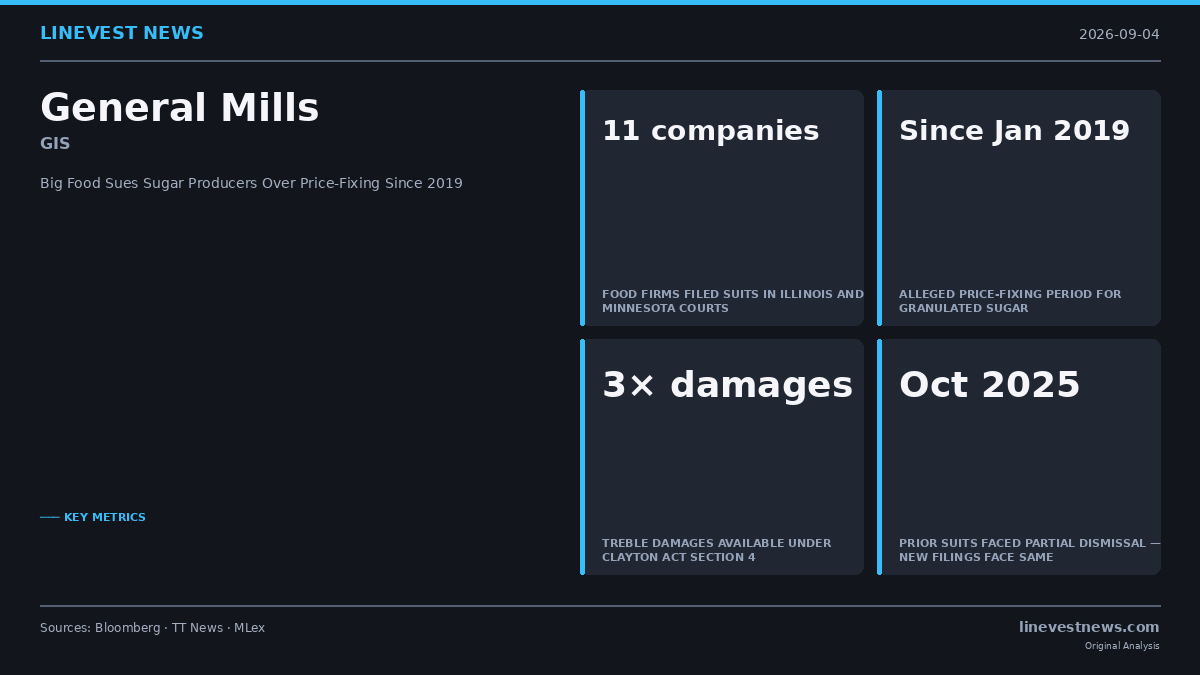
- General Mills (GIS), Mars, and McKee Foods filed suit on Friday, September 4 in Chicago federal court (Case 26-cv-10777), accusing ASR Group and United Sugars Corporation of coordinating prices through a shared data intermediary since 2019.
- A broader July 24 direct purchaser lawsuit in Minnesota names Nestlé USA, Hershey (HSY), Kraft Heinz (KHC), Mondelēz (MDLZ), WK Kellogg (now a Ferrero subsidiary), JM Smucker (SJM), Frito-Lay, Grupo Bimbo, General Mills, and Mars as plaintiffs.
- The alleged mechanism: Commodity Information Inc. (CII) collected and re-distributed non-public pricing and sales data among sugar producers, creating what plaintiffs call a "shared, real-time understanding" of each competitor's strategy.
- In October 2025, a federal court granted several defendants' motions to dismiss in an earlier consolidated case, finding insufficient allegations under the Twombly plausibility standard — the new filings face the same pleading threshold.
The New Wave of Sugar Lawsuits
On Friday, September 4, 2026, General Mills, Inc. (GIS), Mars, Inc., and McKee Foods Corp. filed a complaint in the U.S. District Court for the Northern District of Illinois (Chicago), Case No. 26-cv-10777, against ASR Group International — the parent of Domino Foods and one of the country’s largest sugar refiners — and United Sugars Corporation, a Minnesota-based sugar marketing cooperative that markets refined sugar on behalf of member producers including American Crystal Sugar and Minn-Dak Farmers Cooperative.
The complaint also names Commodity Information, Inc. (CII) and its principal Richard Wistisen as additional defendants. According to the filing, CII collected non-public pricing, volume, and sales data from the sugar producers and then published a consolidated intelligence report to subscribers within the same industry — creating, the plaintiffs argue, a "shared, real-time understanding of each other's pricing, sold positions and forward strategies."
This Chicago filing follows a July 24, 2026 direct purchaser lawsuit in the U.S. District Court for the District of Minnesota, which named a broader plaintiff group: Nestlé USA, Hershey (HSY), Kraft Heinz (KHC), Mondelēz International (MDLZ), WK Kellogg (a Ferrero subsidiary since September 2025), JM Smucker (SJM), Frito-Lay (a PepsiCo subsidiary), Grupo Bimbo, General Mills, and Mars. Both waves name ASR Group and United Sugars Corporation as primary defendants and allege the information-sharing scheme inflated refined sugar prices since January 1, 2019.
ASR Group responded by calling the allegations "baseless," characterizing the September 4 filing as a repackaging of claims already pending in Minnesota.
Why U.S. Sugar Prices Are Structurally Elevated
American food manufacturers face an inherent cost disadvantage in sugar procurement. The U.S. sugar program — a combination of tariff-rate quotas, USDA loan programs that create effective price floors, and marketing allotments — has long shielded domestic producers from lower-cost international supply. Per the plaintiffs' complaint and industry participants cited in the litigation, domestic refined sugar prices have been maintained well above globally traded benchmark levels, a gap widened by the import quota system.
What the lawsuits argue is that the defendants compounded this structural premium through a private, horizontal information-sharing arrangement. The alleged scheme mirrors a pattern that antitrust regulators and courts have examined in other industries: price transparency systems, in which competitors share data through a common intermediary, can suppress rivalry even absent an explicit agreement — if the practical effect is to reduce competitive uncertainty among producers.
Companies in the Litigation
Eleven distinct companies appear as plaintiffs across the two suits. The table below covers publicly traded U.S.-listed companies and their parent-level tickers where the named plaintiff is a subsidiary.
| Company / Entity | Ticker | Exchange | Role |
|---|---|---|---|
| General Mills | GIS | NYSE | Plaintiff — both suits |
| Hershey | HSY | NYSE | Plaintiff — Minnesota |
| Kraft Heinz | KHC | NASDAQ | Plaintiff — Minnesota |
| Mondelēz International | MDLZ | NASDAQ | Plaintiff — Minnesota |
| JM Smucker | SJM | NYSE | Plaintiff — Minnesota |
| Frito-Lay, N.A. (PepsiCo/PEP) | PEP* | NASDAQ* | Plaintiff — Minnesota |
*Frito-Lay, N.A. is a wholly owned subsidiary of PepsiCo, Inc. (PEP/NASDAQ). The named plaintiff in the complaint is Frito-Lay, N.A., not PepsiCo.
Additional plaintiffs not listed on U.S. exchanges: Mars, Inc. (private), McKee Foods Corp. (private), Nestlé USA (subsidiary of SIX Swiss Exchange-listed Nestlé S.A.), WK Kellogg (spun off from Kellogg Company in October 2023; taken private by Ferrero in September 2025, approximately ten months before the July 2026 filing), and Grupo Bimbo (Mexico SE: BIMBOA).
Defendants:
| Party | Status |
|---|---|
| ASR Group International (Domino Foods) | Private company |
| United Sugars Corporation | Private cooperative |
| Commodity Information Inc. | Private company |
| Richard Wistisen (principal of CII) | Individual defendant |
Three Watch Points for Investors
1. Can the New Filings Clear the Pleading Bar Set by the October 2025 Dismissal?
In October 2025, a federal court granted several defendants' motions to dismiss in an earlier consolidated sugar antitrust case, per Food Institute and industry legal reporting. The court found that the plaintiffs had not alleged facts sufficient to render a price-fixing agreement plausible under the Twombly standard — information-sharing through a third-party intermediary, without additional allegations pointing to coordinated commitment, did not satisfy that threshold.
The September 4 Chicago filing and the July Minnesota lawsuit must therefore go further. Courts evaluating antitrust conspiracy claims at the pleading stage look for "plus factors" that distinguish parallel conduct from active coordination — such as direct communications among competitors, pricing moves inconsistent with each party's independent self-interest, or structural market features that make unilateral action implausible. The new filings will need to plead such factors with sufficient particularity to survive a renewed motion to dismiss.
Watch for: Whether the court consolidates the Chicago case into the Minnesota proceedings, and whether a motion to dismiss is filed in early 2027. The court's ruling on that motion will be the first concrete signal of whether these suits have legal staying power.
2. How Significant Are the Potential Overcharges?
Sugar is a significant input for several of the plaintiff companies, particularly those in confectionery, cereal, and baked goods. Hershey relies on granulated and refined sugar across its confectionery lines; Kraft Heinz and Mondelēz use it in condiments, biscuits, and snack categories; General Mills incorporates it into cereals, snack bars, and baking products.
USDA data puts U.S. refined sugar deliveries for food use at roughly 12–12.6 million short tons per year — approximately 24–25.2 billion pounds annually. The plaintiff group collectively spans cereal, confectionery, condiments, baked goods, snack, and grocery categories, and the alleged conspiracy period covers approximately 7.7 years (January 2019 through September 2026).
If plaintiffs ultimately prevail, U.S. antitrust law provides for treble damages under Clayton Act Section 4 — every dollar of overcharge could be recoverable at three times the actual amount. The complaints do not specify a dollar figure; the ultimate recovery would depend on proving the exact overcharge margin above what a competitive market would have produced.
Watch for: Any management commentary on sugar-specific litigation exposure or potential recovery in upcoming earnings calls. General Mills' Q1 FY2027 report (due September 2026) would be the earliest opportunity, followed by Hershey's Q3 FY2026 report (due October 2026).
3. The Structural Policy Backdrop — Antitrust Meets Import Restrictions
The deeper context extends beyond the courtroom. U.S. sugar trade policy has long elevated domestic prices by restricting foreign competition. If the plaintiffs ultimately demonstrate that domestic producers also suppressed competition among themselves, it would mean American food manufacturers were facing a double squeeze: one imposed by statute, the other allegedly imposed by private coordination.
This matters for investors because any revision to U.S. sugar import policy — periodically proposed during Farm Bill negotiations — would structurally reduce the input cost disadvantage that U.S. food companies face relative to overseas competitors. The antitrust litigation brings renewed attention to just how much of that disadvantage is statutory versus behavioral.
Watch for: Whether the sugar litigation influences the 2027 Farm Bill debate, particularly discussions around sugar quota reform. Any bipartisan movement toward liberalizing domestic sugar access would be a structural positive for the gross margins of GIS, HSY, KHC, and MDLZ.
This article is for informational purposes only and does not constitute investment advice.
Sources
- Bloomberg: Major Food Companies Allege US Sugar Producers Colluded on Price
- TT News: General Mills, Mars, McKee allege sugar price collusion
- Food Institute: Sugar Shock — Suit Accuses Sugar Producers of Collusion
- MLex: Major food firms sue US sugar companies, allege information-sharing conspiracy
- MLex: Nestlé, Hershey, Kraft, others file US price-fixing claims against sugar companies
- Briefs.co: Major Food Makers Sue Sugar Producers Over Price Fixing
- Food Navigator: Ferrero completes acquisition of WK Kellogg Co
- D. Minnesota: Granulated Sugar Antitrust Litigation