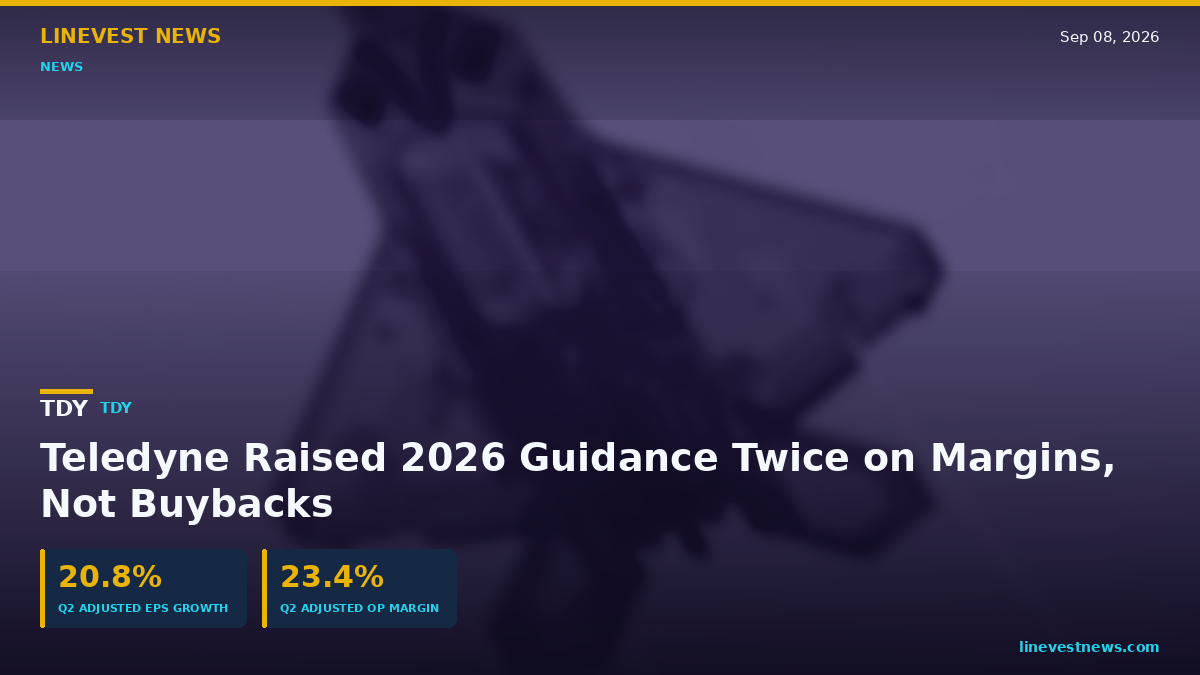
Teledyne Technologies (NYSE: TDY), a diversified maker of imaging sensors, test instruments and defense electronics, has raised its full-year adjusted earnings guidance twice this year, the last raise setting the midpoint at $24.55 per share. As of the September 4 close, the stock traded below where it sat on the morning the second raise landed. That raise is in a July 22 regulatory filing, not in this week's commentary. The same filing answers the question the summaries skipped: the gain in adjusted per-share profit came from wider margins, not from shrinking the share count. That distinction is the whole story, because a margin gain can be structural or it can be a one-off variance in shipment mix, and the two point in opposite directions from here.
The item circulating this week is not a fresh announcement. It is a Yahoo Finance piece relaying commentary from the Artisan Mid Cap Fund, a U.S. equity fund run by Artisan Partners. The fund cited "accelerating organic growth" — organic meaning growth from existing operations rather than from acquisitions. It also pointed to "continued strength in defense and improving demand across short-cycle industrial markets."
Short-cycle means products that ship weeks after an order, so they turn with the economy rather than with multi-year programs. The fund's reading is fair on the facts. But it summarizes a quarter reported back in July, which is why the filing itself is the better place to start.
What the July filing said
Teledyne reported second-quarter net sales of $1,662.5 million, up 9.8% from a year earlier. Adjusted diluted earnings reached $6.28 per share, a gain of 20.8%. Adjusted means the company's own non-GAAP measure, which leaves out certain acquisition-related and other items.
Both figures cleared what analysts expected. Estimates compiled by Investing.com had called for $5.79 per share on about $1.58 billion of sales. Executive Chairman Robert Mehrabian said the company ended the quarter with roughly $5.0 billion of funded backlog — booked orders for which the customer's funding has been committed.
Where the earnings growth came from
The 20.8% earnings gain is worth pulling apart. Sales grew 9.8%, so profit grew about twice as fast as revenue. The adjusted operating margin widened to 23.4% from 22.2%. That is operating leverage — the way profit moves faster than revenue when fixed costs stay put.
Share count did drift lower, to 46.9 million weighted average diluted shares from 47.4 million. Hold it at last year's level and adjusted earnings work out to about $6.21 per share, a rise of 19.5%. So roughly a point and a third of the reported gain came from having fewer shares. The rest came from the business, through wider operating margins and items below the operating line such as interest income and taxes.
Teledyne was also not buying much stock to get there. Its quarterly report shows $2.9 million spent on treasury stock, including excise tax, across the first half. First-half sales were $3,222.6 million. Whatever pushed the weighted average share count down — repurchases made in earlier periods still carry into this year's average — it was not this year's buying.
This is the opposite of the pattern that usually sits behind a double-digit earnings gain at a mature industrial company. Very often the per-share figure outruns profit because the denominator is being retired. Here the denominator barely moved and the numerator did the work.
That is a harder result to produce, and a harder one to repeat. A buyback can be authorized in an afternoon. A margin must be defended every quarter against pricing, freight and product mix.
Two raises, and how small they were
The July filing lifted full-year guidance for the second time this year.
| Full-year 2026 outlook | Reported (GAAP) EPS | Adjusted (non-GAAP) EPS |
|---|---|---|
| Initial outlook | $19.76 – $20.22 | $23.45 – $23.85 |
| Raised with Q1 (April) | $20.08 – $20.44 | $23.85 – $24.15 |
| Raised with Q2 (July 22) | $20.73 – $20.99 | $24.45 – $24.65 |
Stack the two raises together and the midpoint of the adjusted range has moved up 3.8% since the year began. That is a conservative upward revision relative to the quarterly performance it reflects.
The gap between those two figures is itself a signal. Guidance moved far less than the results did. Management is letting the outlook trail the performance rather than extrapolating from it, which leaves room for a third raise.
On the earnings call, Mehrabian put full-year revenue at about $6.53 billion. He said that is "$120 million greater than we forecast in April." Teledyne recorded $6,115.4 million last year, so the new target implies growth just under 7%.
Mehrabian said defense sales should grow at high single-digit rates for the year, with pockets of double-digit growth. He sized unmanned systems at roughly $575 million this year against about $500 million last year. Space, he said, should clear $400 million and possibly reach $450 million.
The commercial side carries the more interesting revision. Teledyne had been guiding to flat or low single-digit growth in its short-cycle businesses. Mehrabian said the company is now comfortable with mid-single-digit growth across the commercial portfolio.
Those are the lines that ship quickly and turn with industrial activity. An upgrade there is a statement about the economy as much as about Teledyne. Defense budgets were never the uncertain part of this outlook; the industrial order book was.
One segment did most of the work
Digital Imaging sales rose 12.7% to $868.7 million, just over half the company total. Operating income in that segment rose 42.3%, growing more than three times as fast as its sales.
That segment is where Teledyne put FLIR Systems. Teledyne and FLIR announced the deal jointly on January 4, 2021, in a statement filed with the SEC. Teledyne's own completion release, issued that May, put the aggregate consideration at roughly $8.2 billion including net debt. The acquired business was renamed Teledyne FLIR.
The precedent matters because it sets the clock on this kind of deal. The margin benefit management now points to did not arrive at closing. It followed years of re-pricing, re-tooling and steering the acquired lines toward defense customers the standalone business could not reach. The infrared and space sensing lines named as growth drivers today are largely that purchase, half a decade on.
Not every segment followed. Instrumentation sales grew 5.5% to $387.8 million, while its operating income slipped 0.2% to $101.4 million.
On the segment tables in the quarterly report, that was the only one of the four segments where profit failed to follow sales; the other three grew operating income faster than revenue. One soft quarter in one unit is not a trend. It matters because the margin story depends on the other segments continuing to carry it.
What changed after July 22
On August 10 Teledyne announced a definitive merger agreement to buy Varex Imaging (NASDAQ: VREX), a Salt Lake City maker of X-ray tubes and imaging detectors, for $18.90 a share in cash. The joint release put total transaction value near $1.1 billion including Varex's net debt. Closing is expected in early 2027, subject to regulatory clearances and a vote of Varex stockholders.
How Teledyne disclosed it is its own small data point. A Form 8-K is the short filing companies use to report major events between quarterly reports. The one Teledyne filed that day, reviewed on SEC EDGAR, reports only two items: Item 7.01, Regulation FD Disclosure, and Item 9.01, exhibits. The exhibit is the joint press release. Item 1.01, Entry into a Material Definitive Agreement, does not appear, and the merger agreement is not attached.
The distinction is not cosmetic. Item 1.01 is the item a company uses when it signs a contract material to its business, and it normally carries the agreement as an exhibit. Filing under Regulation FD instead is consistent with a buyer treating the deal as news to be shared rather than as a contract that changes what the company is — though the filing itself gives no reason for the choice.
The arithmetic supports that reading. The total transaction value — an enterprise-value figure that includes Varex's net debt — is about 3.9% of Teledyne's roughly $28.3 billion equity market capitalization, and under a fifth of a single year's guided sales. FLIR was a company-changing transaction by comparison.
The backlog gives the outlook its floor. At roughly $5.0 billion against about $6.53 billion of guided sales, booked orders cover more than nine months of revenue. Free cash flow — the operating cash left after capital spending — was $284.7 million in the quarter alone. That combination is why a raise in July could be made with confidence.
LineVest covered the Varex agreement on August 12, and the contrast with this quarter lies in what the guidance does not include. That article described a company filling a product gap it could not fill internally, with closing set for early 2027. The outlook raised on July 22 was set before the merger agreement existed.
Every dollar of this year's improvement therefore comes from the existing business. Varex changes 2027 and beyond. It does not touch a single number in the current outlook.
The price declined in the weeks that followed
Teledyne traded at $652.16 in premarket hours on the morning of the raise, according to Investing.com's coverage of the call. It closed at $610.65 on September 4, per the Yahoo Finance item — about 6% lower, though one figure is a premarket quote and the other a closing price.
The same Yahoo item recorded a decline of 11.53% over the prior month, a market value of $28.31 billion and a 52-week high of $697.67.
The decline began after the raise, not before it, and it overlaps the Varex announcement. That timing is suggestive rather than conclusive. Defense and industrial shares moved as a group over the same weeks, and a stock can give back a post-earnings gain for reasons no filing will ever record.
What can be said is narrower. The operating news in the period was good, the guidance moved up, the stock initially rose, and the price declined in the weeks that followed.
Here is what would make this reading wrong. If Instrumentation's flat profit spreads to the other segments, the margin story that lifted guidance twice would face its first serious test. Three of four segments expanded operating income faster than revenue in the quarter. If that ratio shifts toward the Instrumentation pattern, the operating-leverage argument weakens.
A second risk sits in the commercial revision. Mehrabian's upgrade from flat to mid-single-digit growth in short-cycle markets is an economic call as much as a company-specific one. Industrial order rates can turn faster than guidance can be updated, and the commercial portfolio is where the current outlook made its most optimistic move.
Neither condition is present in the current numbers. What the July 22 filing recorded was a business where margins did the work, the backlog provides more than nine months of revenue cover, and quarterly free cash flow of $284.7 million — an annualized pace that approaches the full Varex transaction value — signals the cash generation capacity to support an acquisition of that scale without straining the balance sheet. Whether those three conditions hold through the back half is the only open question the filing left unanswered.
Sources
- Artisan Mid Cap Fund commentary on Teledyne, Yahoo Finance
- Teledyne Q2 2026 Earnings Release, SEC EDGAR (8-K Item 2.02)
- Teledyne 8-K filed July 22, 2026, SEC EDGAR
- Teledyne Q1 2026 Earnings Release, SEC EDGAR
- Teledyne 10-Q for Q2 2026, SEC EDGAR
- Teledyne 8-K (Varex acquisition), SEC EDGAR
- Teledyne Completes Acquisition of FLIR Systems, teledyne.com
- FLIR acquisition announcement, SEC EDGAR (January 2021)
- Teledyne to Acquire Varex Imaging Corporation, teledyne.com