
NVIDIANVDA
About NVIDIA
NVIDIA designs graphics processing units and full-stack accelerated-computing platforms rather than manufacturing them, outsourcing wafer fabrication primarily to TSMC. Revenue is reported in two segments, Compute & Networking and Graphics, but the company also discusses end markets: Data Center, Gaming, Professional Visualization, Automotive, and OEM. Data Center — comprising Hopper- and Blackwell-class GPUs, NVLink switches, and the Mellanox-derived InfiniBand and Ethernet networking stack sold largely as HGX baseboards and DGX systems — has become the dominant contributor to both revenue and operating profit. Gaming, built on the GeForce RTX line, remains a substantial but structurally smaller business. Professional Visualization (RTX workstation cards) and Automotive (DRIVE platform) are meaningful strategic footholds but modest in scale.
Investors track customer concentration acutely: a handful of U.S. hyperscalers and a small set of large AI-native buyers account for a disproportionate share of Data Center sales, and disclosures periodically flag single customers exceeding ten percent of revenue. Supplier concentration is equally structural, with TSMC as the sole leading-edge foundry and SK hynix, Micron, and Samsung supplying HBM. Export controls on advanced accelerators to China and other jurisdictions are a recurring regulatory variable, as are antitrust reviews of AI infrastructure. Index weight in the S&P 500 and Nasdaq-100 is large enough that flows matter. Capital allocation leans heavily on buybacks and a token dividend, and Jensen Huang's founder-CEO status shapes governance.
NVIDIA was founded in 1993 by Jensen Huang, Chris Malachowsky, and Curtis Priem to build graphics accelerators for the emerging PC gaming market, and listed on Nasdaq in 1999, the same year it introduced the GeForce 256 and coined the term GPU. CUDA, released in 2006, opened the GPU to general-purpose parallel computing and seeded the eventual data-center franchise. Acquisitions of PortalPlayer, Icera, and later Mellanox in 2020 extended the platform into networking; a proposed acquisition of Arm was abandoned in 2022 amid regulatory opposition. The company remains a single Delaware-incorporated entity headquartered in Santa Clara, California, with no operating subsidiaries of comparable scale.
Sales run through two channels: direct engagements with hyperscalers, sovereign AI programs, and large enterprises for Data Center systems, and a distribution and OEM channel through partners such as Dell, HPE, Supermicro, Lenovo, ASUS, and Gigabyte, plus consumer add-in-board partners for GeForce. Contracts are typically purchase-order based rather than long-dated take-or-pay, though allocation of scarce accelerators functions as de facto commitment. Competitive position rests on the CUDA software stack, the NVLink and networking fabric, and generational cadence in silicon, with AMD's Instinct line and hyperscaler in-house accelerators (Google TPU, AWS Trainium, Microsoft Maia) as principal rivals. A majority of revenue is billed to customers headquartered in or shipping to the United States, Taiwan, and other Asian markets.
Company profile by LineVest editorial. Journalism, not investment advice.
Order a report on NVIDIA — $15NVIDIA coverage
4 articles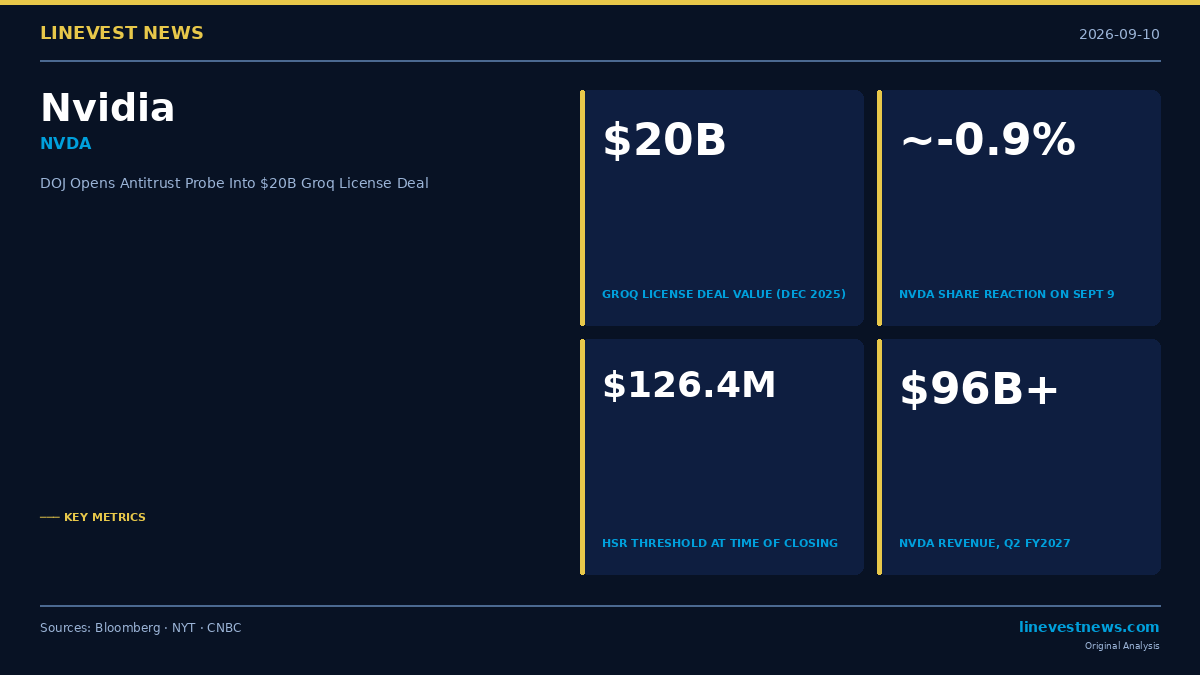
Nvidia's $20 Billion Groq License Under DOJ Scrutiny: Three Watch Points for NVDA Investors
DOJ is probing Nvidia's $20B Groq license deal, questioning whether it was structured to avoid antitrust review. NVDA fell ~0.9% on Sept 9 after NYT reported the probe.
NVIDIA (NVDA) Q1 FY27: $15.9B Investment Gains Lift EPS to $2.39, vs $1.87 Non-GAAP
Net income tripled, but the chip business did not. Of NVIDIA's $69,903 million in pre-tax income for the quarter ended April 26, 2026, $15,929 million — 22.8% —
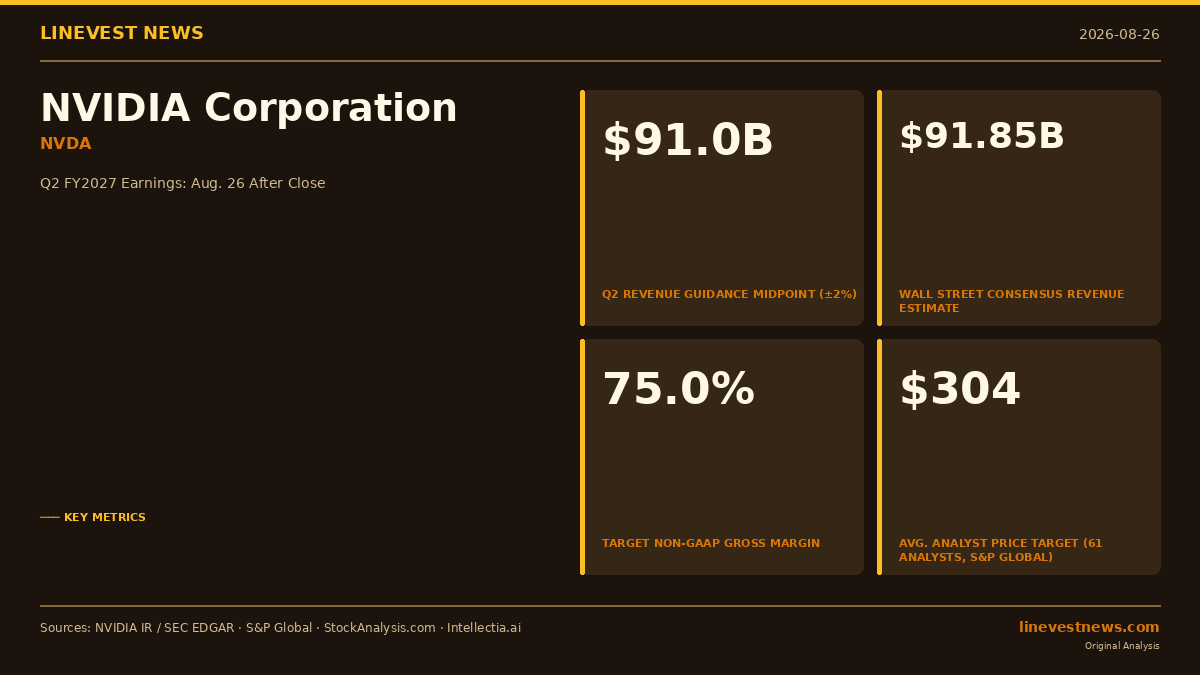
NVIDIA (NVDA) August 26 Earnings: $91B Revenue Target, 75% Gross Margin, and Blackwell Ultra Outlook
NVIDIA reports Q2 FY2027 on Aug. 26. Revenue guidance $91B; consensus $91.85B. Watch: revenue beat magnitude, gross margin at 75%, and Q3 guidance on Blackwell Ultra.
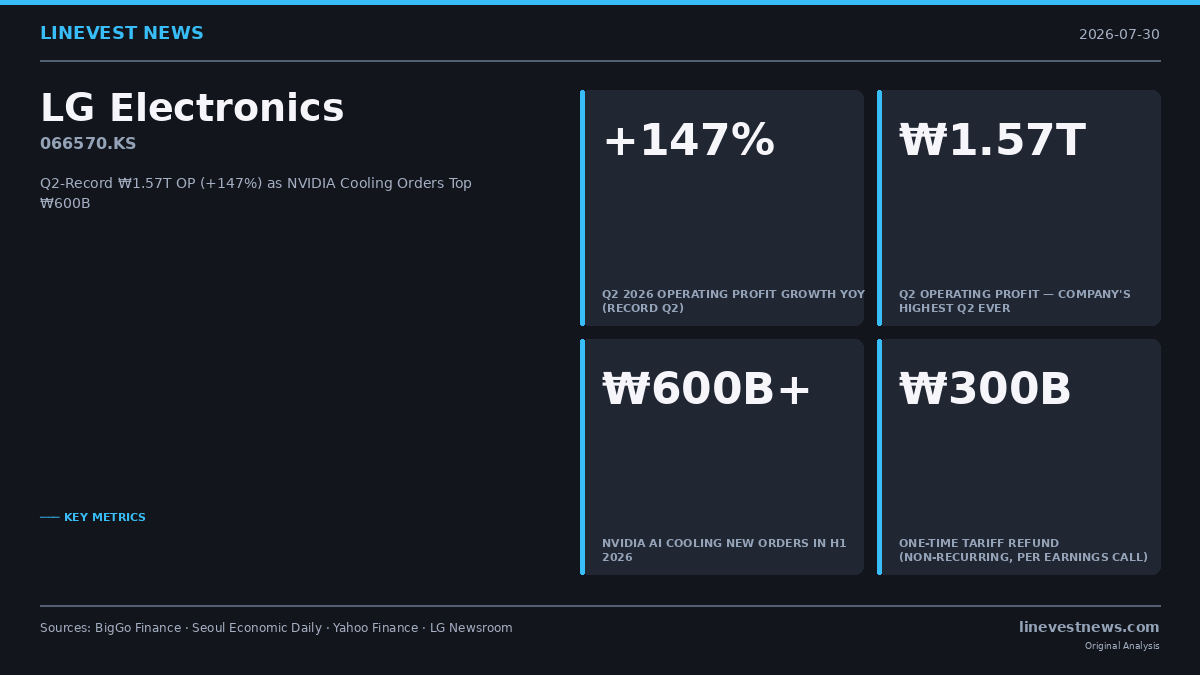
LG Electronics Q2 2026: Q2-Record ₩1.57T OP (+147%) — NVIDIA AI Cooling Orders Exceed ₩600B
LG Electronics Q2 2026: Record revenue ₩23.83T (+14.9%), OP ₩1.57T (+147%). NVIDIA AI cooling orders ₩600B+ H1. Stock -10% on H2 freight headwinds and one-time tariff refund.
Go deeper than the headline
You just read what happened. Here's how to read what it means.
The day's reports, every morning — free
LineVest Daily lands in your inbox before the opening bell with the reports we published that day — what each company's latest 10-K or 10-Q actually says about the numbers, in plain English. Free, no card required.
This report, on any company you name
What you just read on NVIDIA is the format. Name any U.S.-listed company and we do the same for it — its latest SEC filing read in full, financials under US GAAP, governance, and what it means for the stock. PDF in your inbox within 3 hours.
Which company should we read?
$15 · one-time · PDF within 3 hours
Pick a company to continueIndependent journalism based on primary SEC filings — not investment advice. No brokerage affiliation.