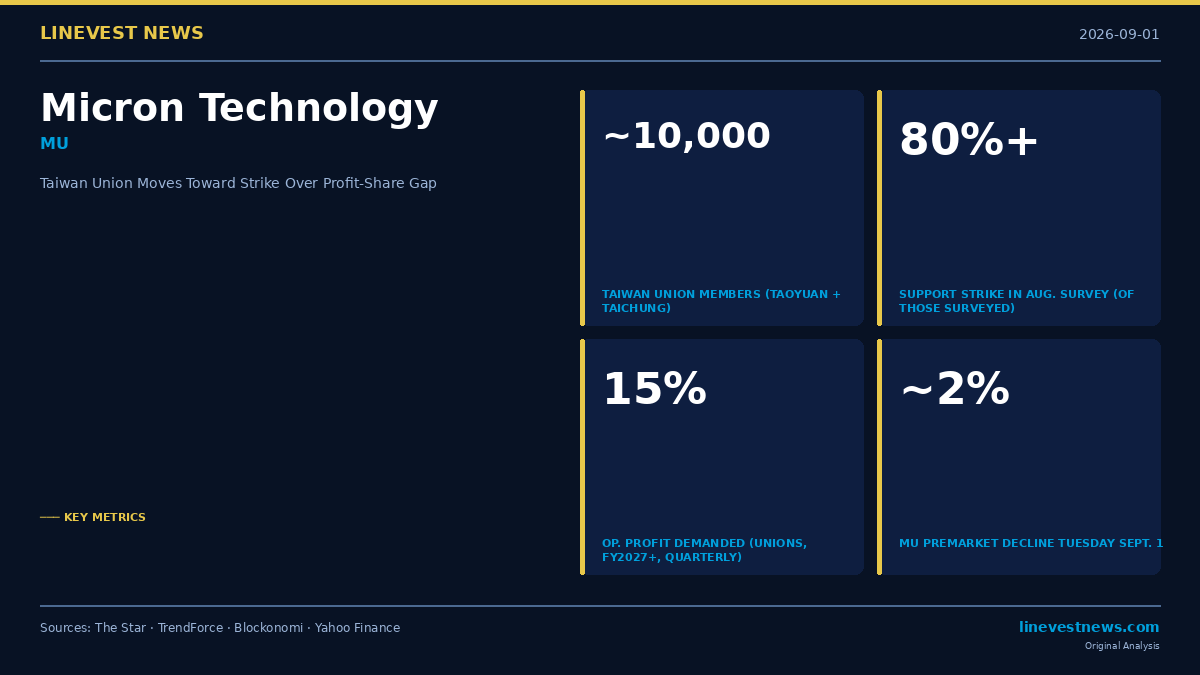
TL;DR - Micron's two Taiwan unions (~10,000 members in Taoyuan and Taichung) report that over 80% of surveyed workers backed strike action in an August preliminary poll — not a formal ballot; participation rate undisclosed - Unions want Micron's discretionary Incentive Pay Plan (IPP) replaced with a 15%-of-operating-profit formula paid quarterly from FY2027, modeled on SK hynix's and Samsung's profit-sharing structures - For FY2026, unions are demanding a one-time bonus equivalent to approximately 83 months of base salary per employee (~6.9 years of pay), per union officials - Micron says this year's payout will be "the highest in company history"; full details expected in October - Taiwan labor law requires mediation before any strike vote; TrendForce flagged that a ballot is possible as early as September 2026 - MU fell approximately 2% in premarket trading Tuesday alongside a broader technology sector sell-off
Part A — What's Happening
On Tuesday, September 1, Micron Technology's two major labor unions in Taiwan formally announced they are moving toward potential strike action unless the U.S. memory-chip maker overhauls its bonus system.
The unions represent employees across Micron's operations in Taoyuan and Taichung — two of Taiwan's main semiconductor manufacturing cities. The two unions count approximately 10,000 members, which per union officials represents the majority of Micron's roughly 15,000-person workforce in those two cities.
An internal online survey conducted in August showed more than 80% of participating members support a walkout if negotiations fail. The survey was a preliminary gauge of sentiment — not a formal, legally binding strike ballot — and the participation rate among the union membership was not publicly disclosed.
What the Unions Are Demanding
The dispute centers on Micron's Incentive Pay Plan (IPP), a performance-bonus system the unions argue does not adequately reflect the company's FY2026 profitability.
Under the current IPP, annual bonuses are capped at 200% of the target payout — equivalent to roughly five months of salary at the maximum. In practice, actual payouts have averaged 2.6 months of salary per the unions — at or near the target level, and roughly half the 5-month maximum the 200% cap permits.
The unions' proposal has two distinct components:
| Component | Period | Structure |
|---|---|---|
| One-time bonus | FY2026 | ~83 months of salary per employee (~6.9 years of pay), per union officials |
| Profit-sharing | FY2027 onward | 15% of operating profit, distributed quarterly |
The FY2026 one-time demand of approximately 83 months of base salary per employee is the figure unions say reflects the scale of Micron's record FY2026 profitability. The 83-month figure has drawn significant media attention given its magnitude — at 6.9 years of base pay, it represents roughly 32× the average annual IPP payout unions say employees have actually received.
How It Compares to Competitors
The unions point to SK hynix and Samsung as models for profit-linked compensation:
| Company | Employee Bonus Structure |
|---|---|
| SK hynix | ~10% of operating profit, distributed annually |
| Samsung (semiconductor) | ~10.5% effective rate via OPI (formula links to profits exceeding cost-of-capital threshold; max 50% of annual salary) |
| Micron (current IPP) | Cap at 200% of target (≈5 months max); actual avg. ≈2.6 months |
| Unions' demand (FY2027+) | 15% of operating profit, paid quarterly |
The unions' proposed 15% of operating profit is 1.5× SK hynix's 10% rate and above Samsung's approximate 10.5% effective rate. The added quarterly distribution cadence is another key feature: it replaces Micron's annual IPP cycle with a more frequent payout tied directly to current-period results.
Note that Samsung's OPI formula differs structurally — it links bonuses to profits above a cost-of-capital threshold rather than to total operating profit — making the 10.5% rate an approximation rather than a formula figure.
Company Response
Micron's Taiwan office confirmed it received the unions' communication and stated that "this year's performance-bonus payout will be the highest in the company's history." It did not address the structural FY2027 demand or quantify the planned payout. Full IPP details are expected to be communicated to employees in October 2026.
Part B — Investor Analysis
Why Taiwan Manufacturing Matters Here
Micron's Taiwan facilities are central to its most strategically important product line. Taoyuan and Taichung house Micron's primary front-end DRAM wafer fabrication capacity — including Fab 11 in Taoyuan (the former Inotera facility) and Fab 16 in Taichung (the former Rexchip facility) — as well as downstream HBM assembly and test operations.
HBM (High Bandwidth Memory) has been a primary driver of Micron's FY2026 revenue, with the category reaching record levels as AI GPU demand accelerated. A walkout at these fab sites would not immediately stop chip output — wafer fabrication runs over weeks-long cycles — but could halt new wafer starts and disrupt HBM assembly and qualification, potentially delaying deliveries to leading AI infrastructure customers.
The Cost Math of a 15% Formula
Micron has not disclosed the dollar impact of a 15%-of-operating-profit formula. At Micron's FY2026 record profitability levels, such a formula would represent a meaningful increase in labor costs. The self-regulating design — larger in boom years, smaller in down-cycles — is why the unions prefer it over a discretionary cap, and why Micron's management may be cautious about committing to an uncapped mechanism at a cyclical peak.
For comparison, SK hynix has sustained its ~10%-of-profit structure across multiple memory market cycles. The precedent is not inherently alarming for Micron shareholders — but the unions' 15% demand is materially above both the SK hynix (10%) and Samsung (~10.5%) benchmarks, and any structural settlement would likely involve negotiating that rate down.
What Taiwan Labor Law Requires
The path to a legal strike involves formal steps:
- Formal mediation: Both parties must participate in government-facilitated mediation before a strike vote can be called. TrendForce reported that mediation was expected in late August and mid-September.
- Strike ballot: If mediation fails, a union membership vote must pass before a walkout can begin.
TrendForce reported that a formal strike vote is possible as early as September 2026 if mediation fails quickly. The October IPP announcement is a potential de-escalation point — if it arrives before a ballot is called, a sufficiently generous payout could defuse the situation. If mediation collapses before October, the timeline compresses.
Three Questions Investors Should Track
1. What is the actual FY2026 IPP figure? The October announcement sets the negotiating baseline. A payout materially above prior years — even well short of the 83-month demand — is the most probable path to de-escalation.
2. Will Micron agree to a structural profit-share formula? A one-time higher payout buys peace for one year. A structural percentage-of-profit commitment permanently changes Micron's labor cost model. Management's Q4 FY2026 earnings call — expected in late September or early October — may offer early signals.
3. Is there downstream supply continuity risk? In a tight HBM market with few qualified front-end vendors, large AI customers have limited near-term sourcing alternatives. This reduces the probability of immediate contract switches, but also raises the stakes for both parties to reach a resolution before it affects wafer starts.
MU shares fell approximately 2% in premarket trading Tuesday, combining the Taiwan labor news with a broader technology sector sell-off. This is a new, company-specific overhang on the stock — not an immediate operational crisis, but a material risk to monitor through the October IPP window.
This article is based on union announcements, company statements, and publicly available financial disclosures. LineVest News is not a registered investment adviser. Nothing in this article constitutes investment advice.
Sources: - The Star: "Micron's Taiwan unions threaten strike over bonus dispute" (Sept. 1, 2026) - TrendForce: "Micron Taiwan Strike Vote Possible in Sept." (Aug. 28, 2026) - Blockonomi: "Micron (MU) Stock Dips as 10,000 Taiwan Employees Threaten Walkout" (Sept. 1, 2026) - Yahoo Finance: "Micron shares slide following Taiwan incentive pay report" (Sept. 1, 2026) - WCCFTech: "Micron Workers in Taiwan Move Toward Strike" (2026)