
Micron TechnologyMU
About Micron Technology
Micron Technology is one of the world's largest producers of memory and storage semiconductors, competing in a market long dominated by a handful of Asian and American players. Its business splits between DRAM, which typically generates the majority of revenue and the bulk of profit, and NAND flash, which contributes a smaller share and has historically been less profitable. The company sells into data center customers building AI training and inference infrastructure, PC and smartphone original equipment manufacturers, automotive and industrial embedded systems, and networking equipment vendors. High-bandwidth memory stacked for AI accelerators has emerged as a strategically important product line, sold to a concentrated set of GPU and custom silicon designers who integrate it beside their own logic dies.
Investors track memory pricing cycles closely, since DRAM and NAND revenue swings are amplified by the industry's oligopoly structure and the long lead times of new fab capacity. Customer concentration in the data center segment is meaningful, with a handful of hyperscale cloud operators and a small group of AI accelerator vendors accounting for a disproportionate share of high-bandwidth memory demand. Capital intensity is severe: leading-edge nodes require multibillion-dollar fab investments, and U.S. CHIPS Act awards, export controls affecting shipments to Chinese customers, and China's own regulatory measures against Micron products all shape the addressable market. Governance follows a conventional Delaware structure with a single share class.
Micron was founded in 1978 in Boise, Idaho, initially as a semiconductor design consultancy before it began producing its own DRAM chips in the early 1980s. The company survived successive downturns that eliminated most American memory makers, expanding through acquisitions including Texas Instruments' memory operations in 1998 and, most consequentially, the 2013 purchase of Japan's Elpida Memory, which brought significant DRAM capacity and a foothold in mobile memory. It also fully acquired its IM Flash NAND joint venture with Intel and later divested its 3D XPoint operations. Today Micron operates fabrication facilities across the United States, Japan, Taiwan, Singapore, Malaysia, and China, and remains headquartered in Boise.
Revenue is generated primarily through direct sales to original equipment manufacturers and cloud infrastructure buyers, supplemented by distribution channels serving smaller industrial and embedded customers. Pricing on commodity DRAM and NAND is largely spot- and contract-driven with short duration, though high-bandwidth memory and certain automotive parts increasingly involve longer-term qualification and supply agreements. Competitive position rests on manufacturing scale, process technology leadership at leading nodes, packaging capability for advanced memory stacks, and a broad product portfolio spanning DDR, LPDDR, GDDR, HBM, and NAND. Its principal rivals are Samsung Electronics and SK Hynix in DRAM and HBM, with additional NAND competition from Kioxia, Western Digital, and Chinese entrants. Asia-Pacific customers account for the majority of billings.
Company profile by LineVest editorial. Journalism, not investment advice.
Order a report on Micron Technology — $15Micron Technology coverage
2 articlesMicron (MU) Q3 FY2026: 80% Operating Margin as DRAM ASPs More Than Triple
Micron's third quarter is not a recovery quarter. It is the most profitable quarter in the company's history, and the margin sits roughly 31 percentage points above its own previous cycle peak.
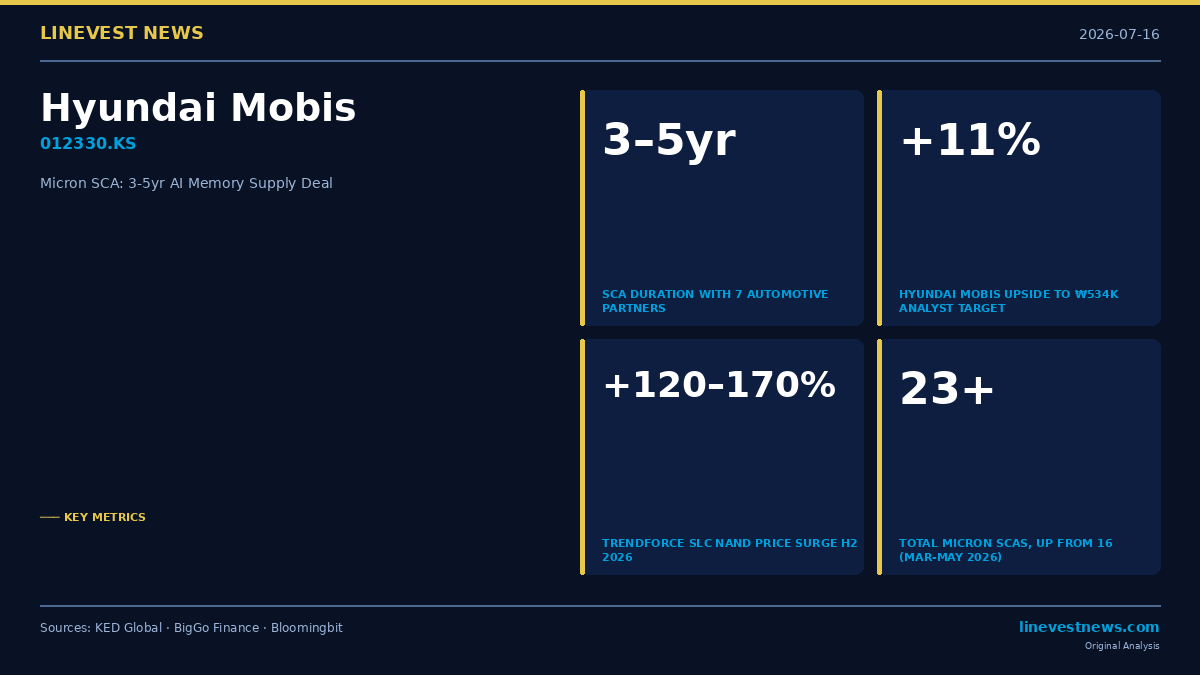
Micron Locks In 3-to-5-Year Automotive AI Memory Deals with Hyundai Mobis and Samsung Harman
Micron signed 3-5 year supply deals with Hyundai Mobis (012330.KS) and Samsung Harman for ADAS memory. TrendForce projects SLC NAND prices could surge 120-170% in H2 2026.
Go deeper than the headline
You just read what happened. Here's how to read what it means.
The day's reports, every morning — free
LineVest Daily lands in your inbox before the opening bell with the reports we published that day — what each company's latest 10-K or 10-Q actually says about the numbers, in plain English. Free, no card required.
This report, on any company you name
What you just read on Micron Technology is the format. Name any U.S.-listed company and we do the same for it — its latest SEC filing read in full, financials under US GAAP, governance, and what it means for the stock. PDF in your inbox within 3 hours.
Which company should we read?
$15 · one-time · PDF within 3 hours
Pick a company to continueIndependent journalism based on primary SEC filings — not investment advice. No brokerage affiliation.