TL;DR
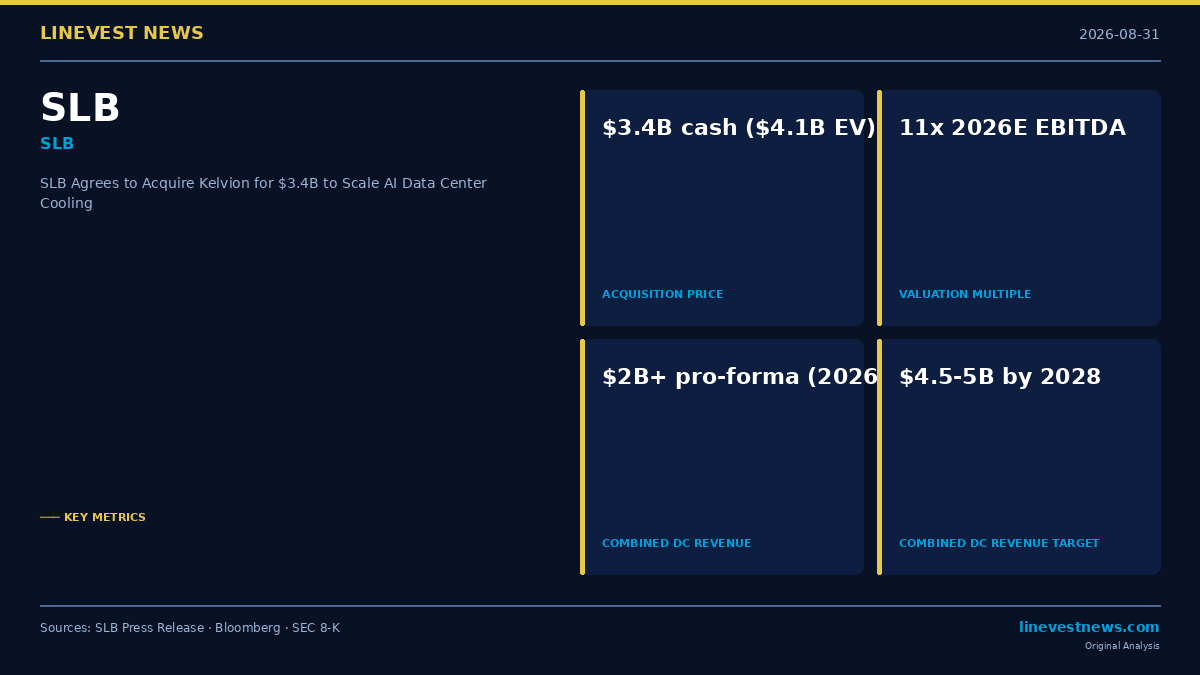
- SLB agreed Monday to acquire Kelvion for $3.4 billion in cash (total enterprise value ~$4.1 billion including $0.7 billion of assumed debt) from Apollo-managed funds and Triton-advised funds.
- Kelvion generates $2.3–2.4 billion in total 2026 revenue, with $1.2–1.3 billion from data center cooling — its largest and fastest-growing segment.
- Pro-forma combined data center revenue exceeds $2 billion in 2026; SLB targets $4.5–5 billion by 2028, a potential 125% increase in under two years.
- Expected $120 million in annual EBITDA synergies within three years, lowering the effective acquisition multiple from 11x to approximately 8.5x EBITDA.
- Transaction expected to close in the first half of 2027, subject to regulatory approvals.
Part A: The Deal
SLB (NYSE: SLB), the world's largest oilfield services company, said Monday it has signed a definitive agreement to acquire Kelvion, a global manufacturer of thermal management and heat exchange technologies. SLB agreed to buy 100% of Kelvion from Apollo-managed funds (majority owner) and Triton-advised funds (minority) for $3.4 billion in cash. SLB will also assume approximately $0.7 billion of Kelvion's existing debt, bringing the total enterprise value to roughly $4.1 billion.
Apollo had completed its investment in Kelvion in January 2026; Monday's announcement represents an exit roughly eight months later. The transaction is expected to close in the first half of 2027, pending customary regulatory approvals.
What Is Kelvion?
Founded more than a century ago and headquartered in Germany, Kelvion develops and manufactures heat exchangers and thermal management systems for industrial, energy, and data center markets. Its product lineup includes direct liquid cooling units, centralized coolant distribution systems, and large-scale air fin coolers for hyperscale campuses.
Kelvion has already delivered AI-scale projects. Among them: a $40-million-plus cooling deployment for the initial 200+ megawatt phase of a large-scale AI data center in the United States, including site-erected GigaBay Air Fin Coolers and Centralized Coolant Distribution Units.
Kelvion 2026 financial profile (management estimates):
| Metric | 2026 Estimate |
|---|---|
| Total Revenue | $2.3–2.4 billion |
| Data Center Revenue | $1.2–1.3 billion |
| Adjusted EBITDA | $350–400 million |
| EBITDA Margin | ~15–17% |
Data centers now represent Kelvion's largest and fastest-growing end market, accounting for roughly 52–55% of total revenue.
Valuation Check
At $4.1 billion enterprise value against $350–400 million in 2026 adjusted EBITDA (midpoint: $375 million), SLB is paying approximately 11x forward EBITDA before synergies ($4.1B ÷ $375M = 10.9x). Management expects ~$120 million in annual EBITDA synergies within three years. On a post-synergy basis, the effective multiple falls to roughly 8.5x ($4.1B ÷ $495M) — a meaningful discount to how pure-play data center cooling companies trade.
Part B: What This Means for SLB Investors
The Strategic Pivot Is Now Undeniable
CEO Olivier Le Peuch framed the deal in sweeping terms: "AI is driving the most significant infrastructure investment cycle in our lifetime. This transaction accelerates our ambition to become an industrial technology partner to the data center industry."
That language reflects an accelerating business reality. SLB's core oilfield operations face cyclical pressure. In Q2 2026, overall revenue grew 5% year-on-year to $8.97 billion, and adjusted EPS of $0.55 beat the consensus of $0.51 by approximately 8%. Yet GAAP EPS fell 30% year-on-year to $0.52, weighed down by ChampionX integration costs. International revenue outside North America declined 3% year-on-year, with Middle East disruptions ongoing and a recovery timeline that management described as "uncertain."
Against that backdrop, Data Center Solutions grew 80% year-on-year in Q2 2026, generating $186 million in quarterly revenue. Six-month 2026 data center revenue reached $327 million, up 63% year-on-year. Management said the unit is on track to exceed a $1 billion annualized run-rate by year-end 2026, with a target of $2 billion annualized exiting 2027.
Kelvion compresses that trajectory significantly.
Why Data Center Cooling Is a Structural Opportunity
The physics of AI compute are driving a thermal management crisis. NVIDIA's current Blackwell-generation GPUs operate at sustained power draws of 700–1,000 watts per chip. A single NVL72 AI rack can consume 120 kilowatts or more — three to four times the upper limit of what conventional air cooling can reliably handle.
That gap between heat output and cooling capacity is forcing hyperscalers and colocation operators to adopt liquid cooling at scale. Liquids carry roughly 1,200 times more heat per unit volume than air, making direct liquid cooling the only scalable option for the most power-intensive AI installations.
SLB already holds a position in this market through its engineering, modular manufacturing, and offsite construction capabilities — including selection as the delivery partner for Meta's 1-gigawatt data center project in Canada. Kelvion's heat exchangers and coolant distribution loops slot directly into that workflow, allowing SLB to quote a more complete per-gigawatt thermal management package. Management described the combination as potentially "doubling revenue potential per gigawatt" of capacity deployed.
Combined Data Center Revenue Trajectory
| Year | SLB DC Standalone | Kelvion DC | Combined DC (Pro-Forma) |
|---|---|---|---|
| 2026 | On track for >$1B annualized rate | $1.2–1.3B | $2B+ |
| 2028 (target) | — | — | $4.5–5.0B |
2028 combined target is management guidance disclosed Monday. SLB's 2026 standalone figure reflects management's public guidance of exceeding a $1B annualized run-rate by year-end.
Financing and Balance Sheet Implications
SLB held $4.071 billion in cash as of June 30, 2026, against net debt of $8.727 billion. The $3.4 billion cash payment will consume most of its liquid reserves; the $0.7 billion in assumed Kelvion debt adds to gross borrowings at close. Net debt is expected to rise by roughly $4 billion (the $3.4B cash outflow plus $0.7B assumed debt, before interim free cash flow), depending on earnings generated before the H1 2027 close.
SLB generated $716 million in free cash flow in Q2 2026 alone, suggesting an annualized rate above $2.5 billion. That cash generation — alongside existing credit facilities — provides a credible path to absorb a deal of this size without a dilutive equity raise. The quarterly dividend of $0.295 per share appears well-covered at current earnings levels.
SLB repurchased 12 million shares for $648 million in Q2. That buyback pace is likely to moderate while the deal is pending.
Competitive Positioning
The acquisition places SLB alongside a set of specialized data center infrastructure companies:
| Company | Core Cooling Exposure | Approx. 2026 Revenue |
|---|---|---|
| Vertiv Holdings (VRT) | High (thermal, power, UPS) | ~$10B |
| Carrier Global (CARR) | Medium (HVAC, data center cooling) | ~$26B |
| SLB + Kelvion (pro-forma) | Medium-High | ~$2B DC out of ~$11B total |
| Eaton (ETN) | Medium (power management) | ~$25B |
Vertiv, the pure-play benchmark, trades at roughly 15–18x EBITDA. By that measure, the 8.5x post-synergy multiple SLB is paying looks favorable — provided the combined unit sustains Kelvion's growth trajectory into 2028.
Key Risks for Investors to Monitor
Integration. Kelvion is an industrial-heritage European manufacturer; SLB's culture is oilfield engineering. Merging operational playbooks, sales forces, and supply chains across geographies will take time. The $120 million synergy target may prove optimistic in the early stages post-close.
Regulatory timeline. The H1 2027 close window is subject to antitrust review in multiple jurisdictions, given the cross-border nature of the deal. A second-request or extended review could push closing to H2 2027.
Core oilfield headwinds. If oilfield services revenue softens further — particularly in the Middle East — SLB may absorb margin pressure while simultaneously funding Kelvion integration, stretching both management attention and financial flexibility.
Thermal management commoditization. As liquid cooling becomes more standardized, hyperscalers with in-house engineering teams may internalize more cooling design work over time, eroding pricing power on heat exchangers and coolant distribution systems.
The Bottom Line
SLB's acquisition of Kelvion is one of the most consequential strategic bets the oilfield services industry has made on AI infrastructure. If the data center cooling market grows in line with AI capex budgets — and if integration proceeds smoothly — the combined unit could revalue SLB closer to an industrial technology multiple rather than a cyclical oilfield services multiple. If oilfield weakness persists and integration costs mount, the deal adds financial and operational complexity at a challenging moment.
For investors, the key metrics to track after Monday's announcement are: SLB's Q3 2026 Data Center Solutions revenue update (whether it stays on the $1B annualized trajectory), any commentary on deal financing at the next earnings call, and the pace of regulatory review as the transaction moves toward the projected H1 2027 close.
LineVest News does not hold positions in any securities mentioned. This article is based on SLB's official press release, the Apollo Funds GlobeNewsWire announcement, SLB's Q2 2026 SEC 8-K filing, and publicly available market data. This is journalism, not investment advice.
Sources