TL;DR
- When: Broadcom (AVGO) reports fiscal Q3 2026 results after the close on Wednesday, September 2.
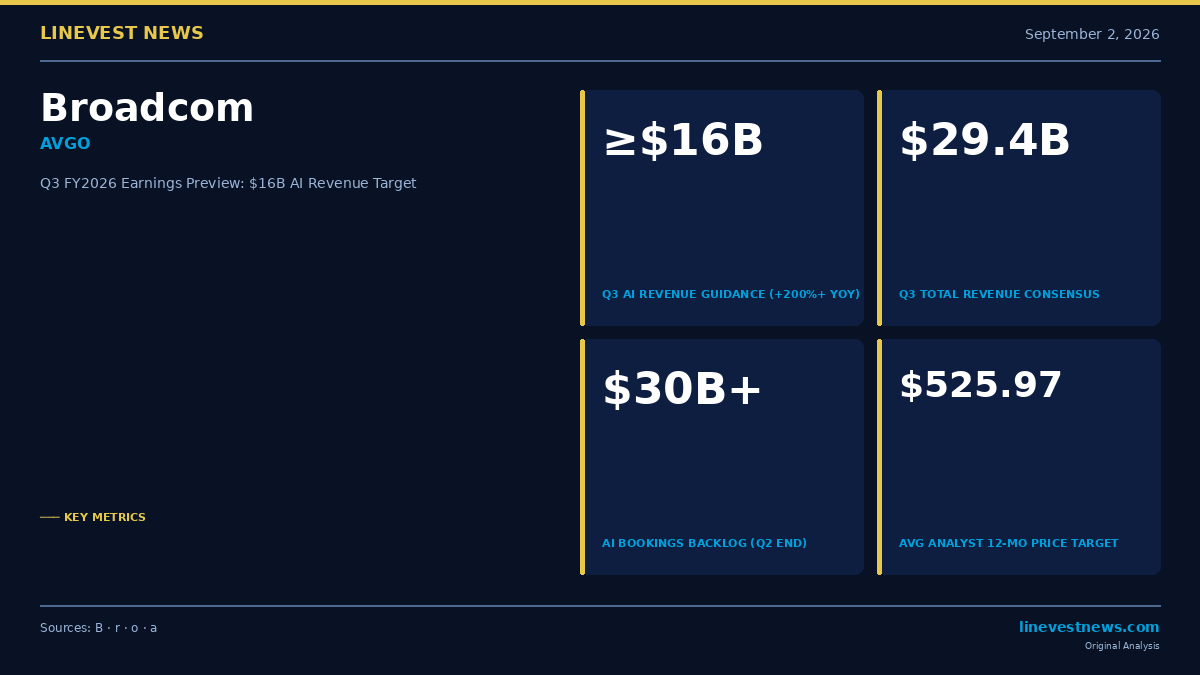
- Street view: Revenue consensus ~$29.4 billion (+84% YoY); non-GAAP EPS ~$3.24; AI semiconductor revenue consensus ≥$16 billion (+200%+ YoY).
- The bar is sky-high: Q2 results came in ahead of expectations yet AVGO fell roughly 12% in the weeks that followed — a "beat-and-drop" driven by disappointment in the VMware software segment.
- Hock Tan's own words set Q3's target: The CEO guided explicitly to $16 billion in AI semiconductor revenue during the Q2 call, making this the most closely watched line item on the income statement.
- Swing factor: Management has guided infrastructure software to ~$8.9 billion for Q3. Delivering that figure would signal VMware is finally re-accelerating — the missing ingredient from Q2.
- Analyst backdrop: Among 49 Wall Street analysts covering AVGO, the consensus rating is Strong Buy with an average 12-month price target of $525.97 — about 43% above Friday's close.
Earnings at a Glance
Broadcom is scheduled to release fiscal third-quarter 2026 results on September 2, 2026, after U.S. markets close. Shares ended Friday, August 28 at $368.79, giving the company a market capitalization of approximately $1.75 trillion.
| Metric | Q2 FY2026 Actual | Q3 FY2026 View |
|---|---|---|
| Total Revenue | $22.19B (+48% YoY) | ~$29.4B consensus (+84% YoY) |
| AI Semiconductor Revenue | $10.8B (+143% YoY) | ≥$16.0B mgmt guidance (+200%+ YoY) |
| Infrastructure Software | $7.18B (+9% YoY) | ~$8.9B mgmt guidance (+31% YoY) |
| Non-GAAP EPS | $2.44 | ~$3.24 consensus |
| GAAP EPS | — | ~$2.55 consensus |
Sources: Broadcom IR (Q2 actuals); Wall Street research (Q3 consensus); Broadcom management guidance for AI and software segments.
The revenue step-up from $22.2 billion in Q2 to roughly $29.4 billion in Q3 — a sequential increase of more than $7 billion in a single quarter — would be one of the steepest revenue ramps in the company's history.
Part A — What the Numbers Say
AI Revenue: From $10.8 Billion to $16 Billion in One Quarter
The headline number every investor will check first is AI semiconductor revenue. In Q2 FY2026, that figure came in at $10.8 billion, growing 143% year-over-year and representing roughly 49% of total company revenue. Broadcom CEO Hock Tan has guided explicitly to $16.0 billion for Q3 — a figure that would represent growth exceeding 200% year-over-year.
That guidance is underpinned by an extraordinary backlog. At the end of Q2, Broadcom reported more than $30 billion in cumulative AI bookings against the $10.8 billion shipped during the quarter — a backlog-to-quarterly-revenue ratio of roughly 2.8x, signaling committed customer demand extending well into fiscal 2027.
For the full fiscal year 2026, Broadcom has guided AI semiconductor revenue to $56 billion — approximately 180% growth over the prior year. On the Q2 call, CEO Hock Tan also projected that AI semiconductor revenue will exceed $100 billion in fiscal 2027.
The Custom XPU Playbook
Broadcom's AI revenue is not driven by off-the-shelf GPU sales. The company designs custom AI accelerator chips — called XPUs or ASICs — optimized for each customer's specific training and inference workloads.
Reported customers include hyperscalers Google and Meta, as well as AI model labs Anthropic and OpenAI, with two additional unnamed partners under long-term supply agreements extending through 2028. Broadcom also supplies the networking silicon that connects large XPU clusters at scale; the Tomahawk 6 switch ASIC offers a per-chip switching capacity of 102 terabits per second. Networking is expected to represent approximately 30% of total AI revenue over time.
This bespoke model insulates Broadcom from the commoditization pressures that affect merchant GPU vendors: a customer that has co-designed a chip with Broadcom over 18 to 24 months is unlikely to switch suppliers mid-cycle.
Infrastructure Software: The VMware Variable
Broadcom's second major segment — infrastructure software, which includes the VMware business acquired in late 2023 — generated $7.18 billion in Q2, growing 9% year-over-year. That growth rate disappointed investors who had expected VMware's transition from perpetual licenses to annual subscriptions to drive faster momentum.
For Q3, management has guided infrastructure software to approximately $8.9 billion — a figure that would represent 31% year-over-year growth. If Broadcom delivers at or above that level, it would mark a meaningful acceleration from Q2 and address the principal concern that weighed on the stock after the prior quarter's results.
The underlying thesis: as enterprises deepen their private cloud deployments, VMware Cloud Foundation becomes an increasingly essential platform, and the accumulated cohort of subscription conversions should begin to show up more prominently in reported revenue.
Part B — What It Means for Investors
The Beat-and-Drop Risk
Broadcom's post-earnings stock behavior in recent quarters has confounded investors who focus only on the top-line beat. When Q2 results arrived in early June 2026, total revenue of $22.19 billion exceeded the $22.13 billion consensus — yet shares fell approximately 12% in the weeks that followed.
The reason: the infrastructure software segment's 9% year-over-year growth fell short of expectations, and the stock had been bid up sharply into the print. Going into Q3, AVGO has recovered from those post-Q2 lows but still sits approximately 25% below its 52-week high of $495.00. The 52-week low of $287.17 illustrates the range of outcomes sentiment can produce.
| Scenario | What Would Drive It |
|---|---|
| Relief Rally | AI revenue at or above $16B + infrastructure software at or above $8.9B guidance |
| Flat/Mixed | AI revenue on target but software segment disappoints again |
| Selloff | Q4 or FY2027 guidance trails the $100B AI trajectory Tan outlined in Q2 |
The bar is not just whether Broadcom hits $16 billion in AI revenue — it is whether the VMware segment convincingly re-accelerates and whether Q4 guidance implies the full-year $56 billion AI target is on track.
Valuation Context
At $368.79, Broadcom carries a trailing price-to-earnings ratio of approximately 60x on net income of $29.32 billion for the trailing twelve months — a figure that grew 127% year-over-year on revenue of $75.47 billion. The annual dividend is $2.60 per share (approximately 0.71% yield at current prices).
The high trailing multiple reflects the market's expectation of rapid earnings growth ahead; analysts project non-GAAP EPS will step up substantially as AI revenue scales through fiscal 2027.
What the Street Thinks
Among 49 Wall Street analysts covering Broadcom, the consensus rating is Strong Buy. The average 12-month price target is $525.97, implying approximately 43% upside from Friday's close. The most bullish targets approach or exceed $600, while more cautious analysts are clustered around $400.
RBC Capital Markets carries a Sector Perform rating with a $400 price target, reflecting the view that a modest beat-and-raise is already embedded in current valuations.
What to Watch on September 2
Four numbers will determine how the stock trades in the sessions after the report:
- AI semiconductor revenue vs. ≥$16B guidance — Upside to the company's own target would be the clearest positive surprise.
- Infrastructure software revenue vs. ~$8.9B guidance — The VMware re-acceleration thesis lives or dies here.
- Q4 FY2026 guidance — The path to $56 billion in full-year AI revenue requires sustained Q4 momentum.
- FY2027 framing — Hock Tan's commentary on the $100 billion AI revenue target for fiscal 2027 will be closely parsed for conviction.
Broadcom reports after the close on Wednesday, September 2. Management will host a conference call the same evening.
This article is journalistic commentary and does not constitute investment advice. All financial figures cited are sourced from Broadcom's investor relations materials and publicly available analyst estimates. Past earnings reactions are not indicative of future performance.