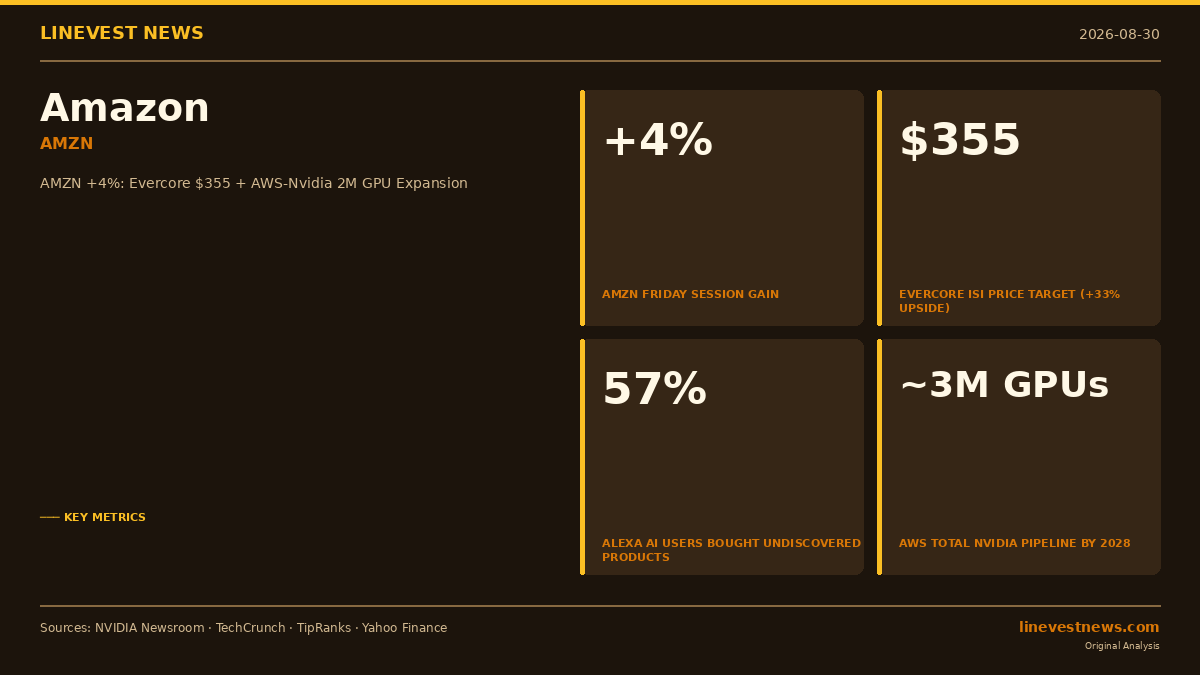
TL;DR - Amazon (AMZN) rose ~4% on Friday August 30 as two catalysts converged: Evercore ISI analyst Mark Mahaney lifted his price target to $355 from $315 after survey data proved agentic AI is adding incremental Amazon retail sales. - Separately, AWS and NVIDIA expanded their GPU partnership to include 2 million additional chips (Blackwell Ultra, Rubin, Rubin Ultra) for deployment in 2027–2028 — effectively tripling Amazon's original 1-million-GPU commitment made just five months ago. - The Evercore survey's headline finding: 57% of Alexa AI users reported buying a product they were not previously aware of — the first statistically robust evidence that Amazon's AI layer creates new demand rather than merely redirecting it. - Wall Street: 39 Buy / 1 Hold, average target $334. Evercore's $355 sits above consensus. Amazon crossed $3 trillion market cap on August 3 after strong Q2 results.
Part A — Two Catalysts in 48 Hours
Catalyst 1: Evercore's $355 Price Target (August 28, 2026)
Mark Mahaney of Evercore ISI raised his Amazon price target to $355 from $315, maintaining an Outperform rating, on the basis of the firm's 14th Annual U.S. Online Retail Survey. The number that matters most: 57% of Alexa AI users said they purchased a product they had not previously heard of.
That single data point answers a question Wall Street has debated for two years: is AI-powered shopping assistance additive (new demand) or substitutive (redirected demand)? The survey says additive.
Supporting findings from the same survey:
| Metric | Reading |
|---|---|
| Alexa AI users who bought previously unknown product | 57% |
| Users who increased total shopping volume after AI Alexa | 36% |
| U.S. shopper penetration (Amazon) | 92% |
| Lead over Walmart (second-place) | +34 percentage points |
| Same-day delivery regular users | 49% |
| Prime-member same-day spend vs. non-Prime | 3.1× |
| Customer satisfaction rate | 76% |
| Prime members willing to absorb $20/year fee hike | 60% |
Mahaney's track record on AMZN: 84% success rate on ratings, 21.81% average one-year return. His thesis is that agentic AI converts Alexa from a cost center into a demand-creation engine — and the survey now provides empirical footing for that thesis.
Catalyst 2: AWS Commits to 2 Million More NVIDIA GPUs (August 26, 2026)
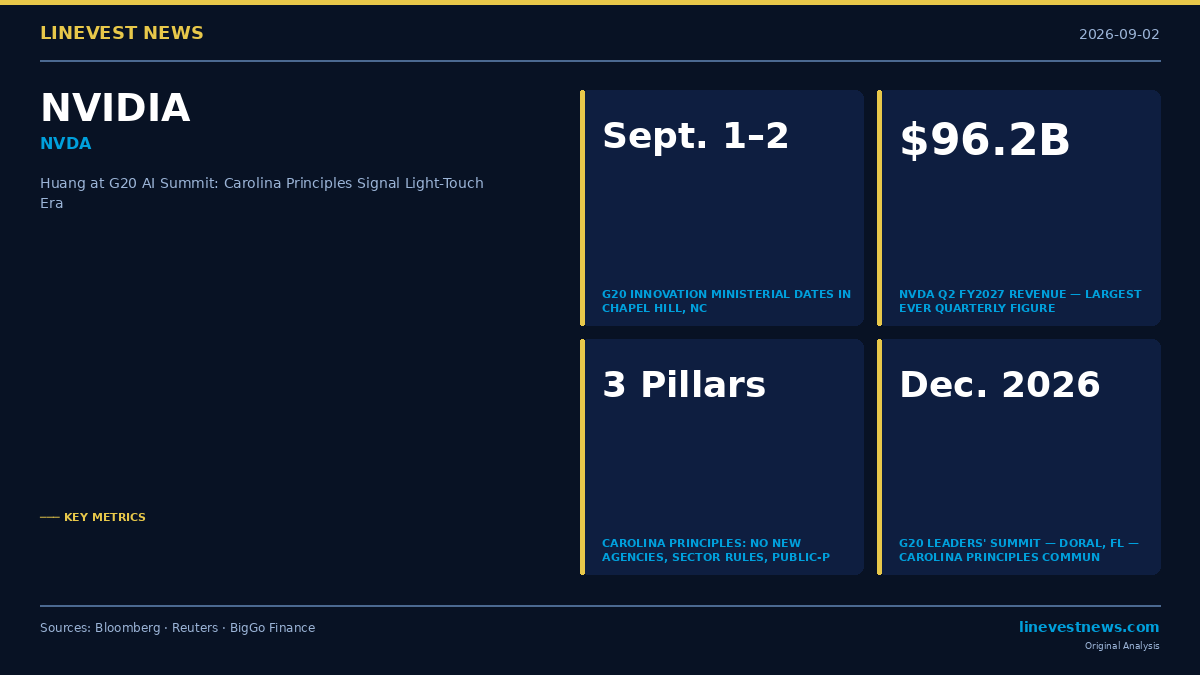
On August 26, Amazon Web Services and NVIDIA jointly announced that AWS will deploy 2 million additional NVIDIA GPUs across global data centers in 2027 and 2028. The new commitment covers Blackwell Ultra, Rubin, and Rubin Ultra — two full generational steps beyond the current Blackwell H100 fleet.
This followed a prior deal, signed approximately five months ago, for more than 1 million GPUs. NVIDIA confirmed customer demand "has exceeded those expectations" — so rather than managing queues, AWS pulled forward its next-generation build-out.
| Tranche | Volume | Timeline | Chip Generations |
|---|---|---|---|
| Original (March 2026) | 1M+ GPUs | 2026 | Hopper / Blackwell |
| Expansion (August 2026) | +2M GPUs | 2027–2028 | Blackwell Ultra, Rubin, Rubin Ultra |
| Total pipeline | ~3M GPUs | 2026–2028 | Multiple generations |
The deal extends well beyond chip volume. AWS and NVIDIA are integrating across the full technology stack: - NVIDIA Vera CPUs coming to AWS infrastructure - NVIDIA Nemotron open models available on Amazon Bedrock and SageMaker - GPU-accelerated data processing via cuDF and cuVS vector indexing libraries - Robotics via NVIDIA Isaac, Jetson, and Omniverse platforms (directly relevant to Amazon's fulfillment automation) - U.S. government AI factories: 100,000 GPUs on secure, IL6-classified AWS infrastructure for federal and national-security workloads
"AI is generating profitable tokens… If we had more compute, we could generate more profitable tokens, which results in more profit for all of the services." — Jensen Huang, NVIDIA CEO
"Customers want freedom to choose the best tools for their AI workloads, and they want confidence that everything works seamlessly together." — Matt Garman, AWS CEO
Financial terms were not disclosed.
Part B — What AMZN Investors Need to Know
The Agentic AI Retail Flywheel Is Now Empirically Verified
Traditional e-commerce is search-driven: you must know what you want before you can buy it. Alexa's agentic layer inverts that constraint. When 57% of users buy something they didn't previously know existed, Amazon's platform transitions from a marketplace (passive) to a demand generator (active).
That distinction has compounding implications. Amazon operates at roughly $600 billion in annualized gross merchandise value. A structural 1–2% lift in discovery-driven conversion — across 200 million+ Prime households — translates to $6–$12 billion in additional gross profit per year. At Amazon's current retail operating margins (~6%), the EPS impact is measurable.
The 36% of users who increased their total shopping volume reinforces the additive-not-substitutive thesis. Unlike search-optimized clicks, AI-surfaced products likely carry higher gross margins: they are not price-shopped, they suffer lower cart abandonment, and they command premium pricing because the customer has no reference anchor.
AWS Infrastructure: Betting $105B to Win the Compute Race
Amazon guided for $105 billion in full-year capex for 2026, the largest infrastructure investment in U.S. corporate history. The 2-million-GPU expansion is one visible data point inside that larger envelope.
The rationale for tripling the NVIDIA order: the first tranche ran out early. That is a supply-constrained demand signal, not a speculative build-out. It means paying cloud customers — developers, enterprises, AI labs, government agencies — are consuming GPU capacity faster than AWS can provision it. Accelerating the next build-out is a revenue-defensive move, not a capex-aggressive one.
Three factors differentiate AWS's compute position heading into 2027:
Multi-generation lock-in. By reserving Rubin and Rubin Ultra (generations 2 and 3 beyond the current Blackwell) now, AWS secures capacity before competitors can negotiate equivalent allocation. NVIDIA is supply-constrained across the board; early movers hold a structural advantage.
Federal exclusivity. The 100,000-GPU IL6-classified deployment is not a commodity contract. Achieving Impact Level 6 certification requires dedicated physical infrastructure, supply chain vetting, and government compliance overhead that took years to build. Microsoft Azure and Google Cloud are competing for the same contracts, but the certification timeline advantages incumbents.
Robotics-to-cloud loop. The NVIDIA Isaac and Omniverse integration is underappreciated. Amazon's fulfillment network operates 750,000+ robots today. As those robots require real-time inference (computer vision, path planning, anomaly detection), they generate persistent cloud revenue without competing with hyperscaler peers — it is internal workload that flows directly to AWS margins.
Valuation and Upside Scenarios
| Scenario | Implied Target | Key Driver |
|---|---|---|
| Wall Street consensus | $334 (+25%) | Base case AWS + retail growth |
| Evercore ISI (Mahaney) | $355 (+33%) | Agentic AI retail lift + AWS GPU moat |
| Bull case | $400+ | Full agentic AI monetization + AWS federal ramp |
Amazon closed Friday near $266, having crossed $3 trillion market cap in early August post-earnings. The brief retracement from post-earnings highs creates an entry point for investors who missed the initial surge.
Consensus: 39 Buy / 1 Hold, zero Sells. The Hold thesis is essentially a valuation discipline argument — "too expensive now" — not a fundamental concern about business trajectory.
Key Risks
Tariff tailwind normalization. Amazon's Q2 gross margin benefited from pull-forward inventory activity ahead of tariff cycles. That tailwind may fade in H2 2026 as trade policy settles, compressing retail margins sequentially.
Capex scale vs. utilization. $105 billion in annual capex requires sustained and accelerating demand. If enterprise AI adoption slows — corporate budget cycles are reverting to pre-AI-mania caution in some industries — AWS revenue growth could decelerate while fixed infrastructure costs are already committed.
NVIDIA dependency and pricing power. Tripling the GPU order deepens Amazon's concentration in a single silicon vendor at a time when NVIDIA commands 70%+ GPU market share. Any NVIDIA supply disruption, price renegotiation, or export-control event (U.S.–China dynamics remain fluid) could delay AWS capacity expansion.
Alexa adoption ceiling. U.S. shopper penetration of 92% is near-saturation. Further agentic AI conversion gains require deepening engagement among existing users — a different and slower growth curve than adding net-new customers.
Disclaimer: This article is for informational purposes only and does not constitute investment advice. LineVest is an independent financial news publication not affiliated with any brokerage.
Sources: - NVIDIA Newsroom: AWS and NVIDIA to Deliver 2 Million Additional GPUs - TechCrunch: Amazon just tripled its order of Nvidia chips over 'surging demand' - TipRanks: Amazon Stock Jumps as Evercore Lifts Target to $355 on Strong Retail Signals - Yahoo Finance: Amazon Stock Jumps After Evercore Raises Price Target to $355 - TechTimes: AWS Adds 2 Million More NVIDIA GPUs - StockTwits: AMZN Stock Rallies 4% After Evercore Says Agentic AI Could Supercharge Retail Growth