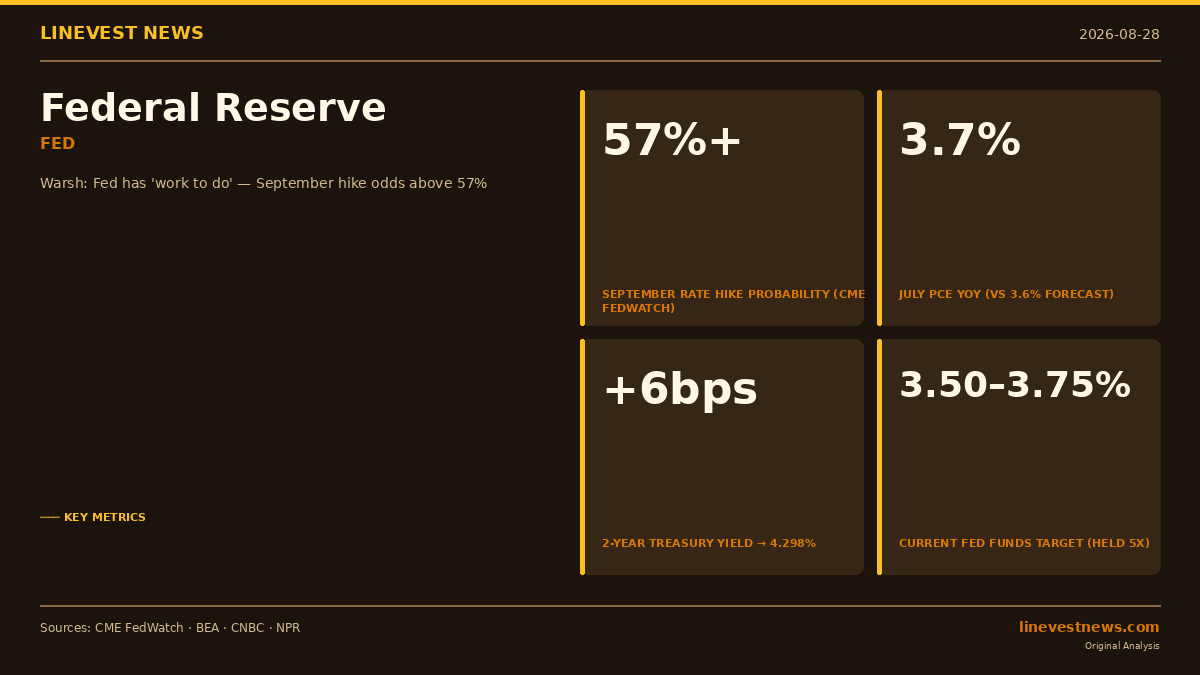
TL;DR - Fed Chair Kevin Warsh's inaugural Jackson Hole keynote (August 28) sent September FOMC rate hike odds from approximately 35.5% to above 57%, per CME FedWatch — crossing the "more likely than not" threshold for the first time since the Fed entered its current hold cycle. - July 2026 PCE, released by the BEA on August 26, held at 3.7% YoY (slightly above the 3.6% consensus); core PCE at 3.3% — both remain well above the Fed's 2% target. - The 2-year Treasury yield jumped 6 basis points to 4.298%; the 10-year edged modestly lower, flattening the yield curve. - The speech tracked closest to the hawkish scenario from our August 24 preview, though Warsh's continued refusal to give forward guidance keeps September still an open question, not a foregone conclusion.
Part A: What Happened
The PCE Data (August 26)
The Bureau of Economic Analysis released the July 2026 Personal Consumption Expenditures inflation report ahead of the speech, consistent with the BEA's typical late-August schedule for monthly PCE data:
| Metric | July 2026 | June 2026 | Consensus | Fed Target |
|---|---|---|---|---|
| Headline PCE (YoY) | 3.7% | 3.7% | 3.6% | 2.0% |
| Core PCE (YoY) | 3.3% | 3.3% | 3.2% | 2.0% |
| Core PCE (MoM) | +0.2% | +0.2% | +0.2% | — |
Source: Bureau of Economic Analysis (late August 2026); CBS News; Yahoo Finance.
For context, July CPI (BLS, 12-month) came in at 3.4% — a different index with its own basket weights; in July 2026, PCE ran higher than CPI, reflecting differences in housing cost methodology and spending weights.
Headline PCE came in a tenth above consensus at 3.7%. Core PCE printed 3.3%, a tenth above the 3.2% consensus. Both were flat with June — no acceleration. Importantly, the monthly core PCE pace of +0.2% MoM annualizes to roughly 2.4%, which is below the 3.3% YoY reading and consistent with slow underlying disinflation. However, the YoY level showed zero improvement from June — and Warsh focused on exactly that: recent readings "do not tell me that underlying trends have meaningfully improved." Flat YoY at 3.3% is not progress toward 2.0%. The data removed any expectation of a dovish pivot heading into Jackson Hole.
The Speech (August 28, ~10 AM ET)
Federal Reserve Chair Kevin Warsh delivered his inaugural keynote at the Kansas City Fed's annual Economic Policy Symposium in Jackson Hole, Wyoming on Friday, August 28. The address landed meaningfully more hawkish than the "opaque" modal scenario that LineVest's August 24 preview assigned 50% probability — a scenario where Warsh would speak vaguely without committing to a directional signal.
Warsh's central line: "Inflation is running above our 2% target. So the Fed's predominant focus right now should be on prices."
He elaborated with the formulation that became the defining quote of the speech: "We must be confident that underlying inflation is moving to our objective, clearly and at sufficient speed. Otherwise, we have work to do."
Key points from the speech:
- Warsh said recent PCE and CPI readings "do not tell me that underlying trends have meaningfully improved" — explicitly dismissing the argument that flat inflation constitutes progress.
- He cited breadth data showing that a majority of categories in the PCE basket are still running above 3% annually — characterizing this as structural inflation inconsistent with a sustainable return to target.
- Rising commodity prices were flagged as requiring "close monitoring."
- On wage growth as an inflation signal: Warsh said wage growth has not reliably predicted future inflation "for a very long time" — shutting down one of the main arguments used to justify a hold.
- On AI's economic effects: Warsh acknowledged AI's long-run productivity potential but noted that near-term data center investment carries inflationary implications through energy demand and construction costs.
- Warsh again declined to provide any "forward guidance" on rate moves, arguing that specific guidance constrains policy flexibility — a deliberate contrast to the Powell-era communications approach and the most controversial aspect of his tenure so far.
Market Reaction
The combination of the flat-but-hot PCE data (released mid-week) and Warsh's hawkish-without-specifics address triggered a clear repricing:
- September rate hike probability (CME FedWatch): Rose from roughly 35.5% before the speech to above 57% afterward — moving above 50% for the first time since the Fed entered its current hold period.
- 2-year Treasury yield: Jumped approximately +6 basis points to near 4.30%, reflecting front-end sensitivity to near-term Fed policy.
- 10-year Treasury yield: Edged modestly lower, causing the 2s10s spread to narrow further — consistent with markets pricing near-term tightening without revising long-run growth expectations.
- Equity markets: Major indices reversed morning gains. The S&P 500, Dow, and Nasdaq traded flat to modestly lower by midday, as investors recalibrated for a higher-for-longer scenario.
Part B: What This Means for Investors
Why September Is Still Not Certain
Warsh moved the odds above 50% without committing to a specific move. This matters: a 57% probability of a rate hike is meaningfully different from the 80–90% certainty markets typically price before a confirmed FOMC decision. Several factors could prevent a September hike:
Inflation data before the meeting. The most important data point is the August CPI (expected around September 10 — approximately five to six days before the FOMC decision). A reading showing core CPI clearly below the prior month's level could pull rate hike odds back toward 40%. A print coming in above the prior month would push odds above 70%. August PPI (typically released around September 11) and Fed officials' public statements will provide additional signals, but CPI will carry the most weight for market rate expectations.
The July vote was 9-3 to hold. With 12 voting FOMC members, a majority requires 7 votes. Currently, 9 members voted to hold and 3 voted to hike. For the vote to flip toward hiking at September, four of the current nine "hold" voters would need to switch — a meaningful coalition shift, not just marginal movement.
Warsh's "quieter Fed" posture creates optionality. By refusing to give forward guidance, Warsh can hold in September without contradicting Friday's tone — the speech said the Fed "has work to do," not that September is the moment to do it.
Political context adds complexity. Warsh's hawkish stance puts him in direct public tension with the Trump administration's stated preference for lower interest rates. The Fed's independence is institutionally grounded in statute and long-standing convention, but the political environment adds a layer of uncertainty around the timing and communications around any rate move.
Sector-Level Implications
Elevated rate hike expectations affect sectors differently:
Negatively exposed: - Utilities and REITs: The most rate-sensitive equity sectors, where rising short-term yields erode the relative attractiveness of their dividends and increase refinancing costs. - Growth and long-duration tech: Higher discount rates compress present-value calculations for companies whose earnings projections extend far into the future. Names with elevated forward multiples face multiple compression risk.
Mixed — depends on balance sheet structure: - Banks and financials: The effect is directionally positive for floating-rate loan books (commercial lending, credit cards), where rising short rates lift asset yields. However, the curve-flattening environment — 2-year rates jumping while the 10-year edges lower — compresses traditional net interest margin (NIM) for deposit-funded lenders. Net impact varies materially by institution.
Relatively insulated or positive: - Consumer staples and energy: Modest valuation multiples and near-term earnings visibility reduce discount-rate sensitivity. Energy names additionally benefit if commodity prices firm — which Warsh specifically flagged as an inflationary watch point. - Money market funds: Already the beneficiary of high short-term rates, money market AUM would continue growing if the Fed hikes — pulling cash from equities and longer-duration bonds.
The Dollar and Cross-Asset Dynamics
A September hike would likely reinforce U.S. dollar strength as the Fed diverges from central banks in economies where inflation is more clearly moderating. A stronger dollar creates mixed effects: - Negative for large-cap U.S. multinationals with significant non-U.S. revenue (earnings translated back to dollars compress). - Positive for U.S. import-oriented companies and purchasing power for American consumers of foreign goods. - Negative for emerging-market sovereign and corporate borrowers with dollar-denominated debt.
Preview Scorecard
LineVest's August 24 preview identified three scenarios for the Warsh speech: Hawkish (Scenario A, 20% probability), Opaque (B, 50%), Dovish (C, 30%). The actual outcome was closest to Scenario A on substance — Warsh's explicit acknowledgment that inflation is too high and the Fed "has work to do" was more pointed than the market expected. However, his continued refusal to give forward guidance means the speech retained elements of the opaque framing. The market reaction (odds crossing 50% but not reaching near-certainty) reflects this hybrid outcome.
What to Watch Before September 15–16 FOMC
- August CPI (approximately September 10): The most watched inflation data point before September 15–16. A print above the prior month's level would push hike odds above 70%; a clear deceleration would pull them back toward 40%.
- Fed officials' public statements: With Warsh declining to guide, any on-record comments from other FOMC members will be closely parsed for signals about which way the nine current "hold" voters are leaning.
- Labor market data: The August Nonfarm Payrolls report (to be released early September) will inform whether strong employment gives the Fed confidence to move or requires caution.
- Commodity prices: Warsh specifically flagged this. A run-up in energy or food prices between now and September 15 would further validate his hawkish stance.
The Bottom Line
Warsh's Jackson Hole debut was hawkish enough to cross the 50% threshold for September rate hike expectations without being definitive. The July PCE data, arriving flat but sticky at 3.7% headline and 3.3% core, gave him rhetorical cover. The Fed funds target has been at 3.50–3.75% through five consecutive holds; the next move is now more clearly up than down.
For U.S. equity investors: the rate trajectory signal has shifted. Growth-oriented names with high forward multiples face increased discount-rate risk. Banks with floating-rate loan books benefit from rising short rates, though the flattening curve mutes the gain for traditional NIM-dependent lenders. The most important single data point before September 15–16 is the August CPI print, expected around September 10 — five to six days before the FOMC decision.
This article is for informational purposes only and does not constitute investment advice. Rate probabilities from CME FedWatch are market-implied and change rapidly. Investors should conduct their own due diligence before making any investment decisions.
Sources: - The Motley Fool — Warsh "We Have Work to Do" Jackson Hole Speech (August 28, 2026) - CNBC — Kevin Warsh Jackson Hole Fed Inflation (August 28, 2026) - NPR — Fed Warns Inflation Too High (August 28, 2026) - CBS News — July PCE Inflation Index 3.7% - CNBC — July Core PCE 3.3% Annually (August 26, 2026) - Yahoo Finance — July 2026 PCE Inflation Data