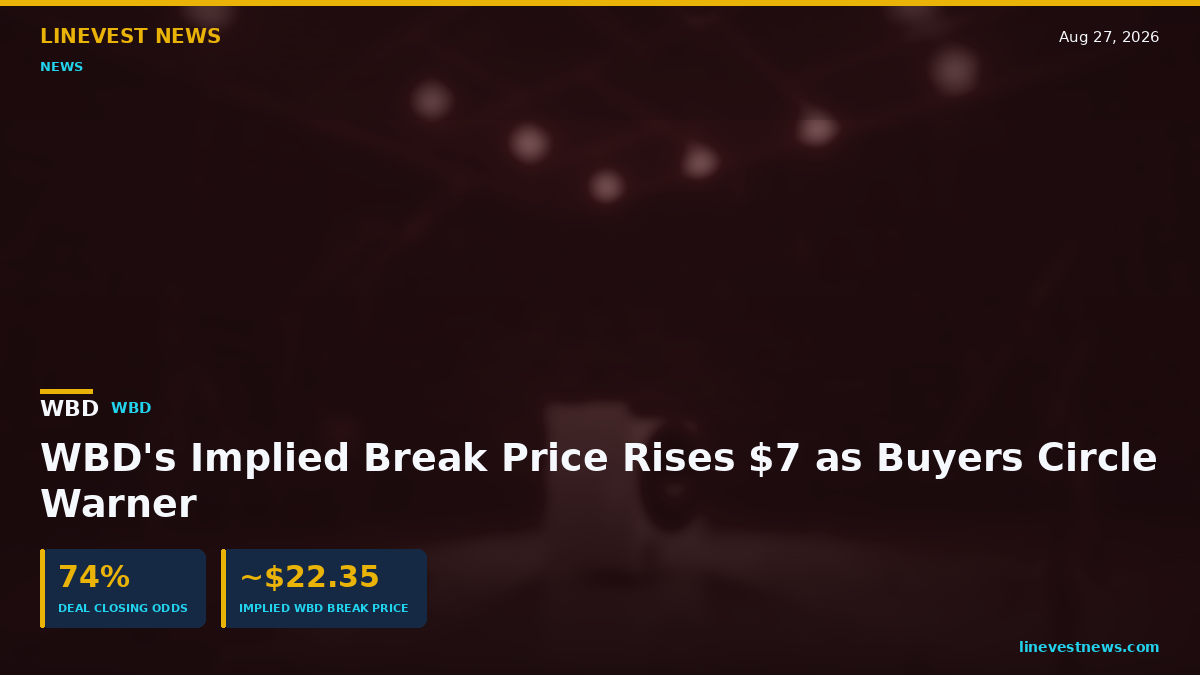
Wall Street has stopped treating a collapsed Paramount–Warner deal as a catastrophe. Rerun the arithmetic LineVest published nine days ago and the price traders implicitly assign to Warner Bros. Discovery (NASDAQ: WBD) if the merger dies has climbed roughly $7 a share. No court ruling has gone Warner's way in the meantime. What changed is who is standing behind Warner's assets.
Warner Bros. Discovery, the parent of HBO, CNN and the Warner Bros. film studio, closed Wednesday at $28.75, per stockanalysis.com. Paramount Skydance (NASDAQ: PSKY), the media group David Ellison controls, is offering $31.00 a share in cash. The gap is the merger spread — what a buyer of the stock earns if the deal closes, and gives up if it does not.
Why It Matters
The gap between a stock's price and a deal's payout is usually read as a wager on lawyers. Here it has become something else. It is a running tally of how many people want the pieces.
That distinction separates two very different questions. One is whether Paramount Skydance can complete this particular merger. The other is what Warner's networks, studio and library are worth to anyone at all. The first question depends on a courtroom. The second does not.
For shareholders, the second question carries consequences either way. If the merger closes, they are paid and the argument ends. If it collapses, they are left holding the company itself. What they hold is then worth whatever a buyer will pay for the parts. The market has spent recent sessions revising that second figure upward while the first barely moved.
The same split explains why this case is being watched well beyond one transaction. A state-led challenge can now stall a deal that federal regulators already waved through. That is a new fact about American media dealmaking, and it says the effective veto point has moved.
The number nobody quotes
A merger spread is one equation with three terms: today's price, the payout on closing, and the price if the deal breaks. Fix any two and the third is forced. Wire coverage almost always quotes the first two. The third is the one that tells a shareholder what they are actually holding on the morning the deal dies.
Prediction markets Kalshi and Polymarket — exchanges where traders buy contracts tied to real-world events — both sat near 73% on the deal closing, Bloomberg reported on August 14. CNBC put Kalshi at 74% three days later. Hold the odds there and the equation solves itself.
Price today (Aug 26 close)     $28.75
Payout if the deal closes      $31.00
Odds of closing                   74%
-------------------------------------
Implied price if it breaks     ~$22.35
The solve is LineVest's, and it mixes two dates: the odds quotes are from mid-August, the price is Wednesday's close. No more recent probability reading was available at publication.
LineVest ran that same equation on August 17, when WBD traded at $27.79, and arrived near $15.59. The implied floor has moved about $7 a share since.
Two things moved it, not one. WBD's own price rose about a dollar over those nine days, and the odds embedded in the earlier calculation were higher — the August 17 price against the same $31 payout implies roughly 79% odds of closing, versus 74% now. A lower probability of closing mechanically lifts the implied break price. So part of the $7 is arithmetic, not a fresh vote of confidence in the assets. The rest is the part worth explaining.
On the current numbers, spread across WBD's roughly 2.51 billion shares outstanding, that gap is about $17 billion of standalone value the market has added back — again, LineVest's calculation. It did so without a single favorable court ruling.
What California is actually demanding
California Attorney General Rob Bonta leads the twelve-state coalition that sued in July to block the merger. He has been explicit about the price of peace. "We do prefer to resolve cases in the boardroom instead of the courtroom," Bonta said, per Fox Business — but any settlement would require "robust structural remedies."
That phrase is the whole story, and it is worth translating. A behavioral remedy is a promise: we will not discriminate against rivals, we will keep licensing terms fair. A structural remedy is a sale. Bonta is saying he will not accept promises. Someone has to hand over assets.
The states' complaint puts numbers behind the concern. The combined company would hold about 27% of the wide-release theatrical film market and more than 30% of anticipated top-grossing films, per Fox Business's account of the filing. It would also control roughly 27% of the basic cable licensing market.
Why the buyers matter twice
Bloomberg reported Wednesday that buyers are circling Warner's assets while the legal fight runs. Paramount, the same report noted, has acknowledged weighing a wide range of options to settle the suits challenging its $110 billion acquisition. Put those two facts next to Bonta's demand and they stop being separate stories.
A structural remedy requires a buyer. Without one, the remedy is theoretical and the case goes to trial. So the interested parties Bloomberg describes are not bystanders waiting for a fire sale. They are the mechanism by which a settlement becomes possible at all.
They also do a second job, and this is the part the spread appears to be reacting to. If credible bidders will pay for HBO, CNN or the studio inside a settlement, they will pay for those same assets in a breakup. Buyer interest puts a floor under Warner whether the merger lives or dies. That is how the implied break price can rise while the litigation gets no better.
There is a real distinction hiding in the word circling. A bidder for all of Warner Bros. Discovery must finance an enormous transaction and clear the same antitrust gauntlet Paramount is stuck in. A bidder for one network or one studio faces neither problem. Piecemeal buyers are easier to find than whole-company buyers. They are also exactly what a divestiture order calls for.
The clock has a meter on it
Delay is not free for Paramount. Beyond September 30 the deal accrues what the parties call ticking consideration — an extra payment to WBD holders of $0.00277778 per share per day, per the deal terms LineVest reported on August 6. On the current share count that runs close to $7 million a day, matching the daily figure Bloomberg cited.
Run that meter to the March 2, 2027 trial date and it totals roughly $1.1 billion before opening arguments. Carried to the June 2027 outside date it approaches $1.7 billion, squaring with the $1.6 billion-plus Bloomberg reported. Every week of delay makes concessions cheaper by comparison.
Merger arbitrage funds have done this math too. "We think a settlement is the most likely outcome," Roy Behren, co-chief investment officer at Westchester Capital Management, a fund specializing in merger arbitrage, told Bloomberg. "There are so many financial incentives for Paramount to come to the table that will cost them less than what the break fee and ticking fee are."
What Warner looks like on its own
The standalone business is not comfortable. WBD's second-quarter earnings release shows revenue of $8.717 billion, down 12% after stripping out currency swings. Net income available to WBD fell to $149 million from $1.580 billion a year earlier.
Free cash flow — the cash left after running and reinvesting in the business — came in at $572 million, down from $702 million. Gross debt stood at $33.1 billion. All figures come from the company's own Form 8-K, the filing a U.S. public company uses to disclose material news to regulators, released this month.
Set that against the implied break price and a tension appears. The operating business is shrinking on every line above. Yet the market's estimate of what a broken deal leaves behind went up. Both can be true only if the value sits in the assets rather than the earnings — which is what a queue of buyers would imply.
That divergence is less strange than it sounds. Streaming and cable earnings can fall for years while the underlying libraries, franchises and brands keep their appeal to a strategic acquirer. A buyer of HBO is not paying for last quarter's operating profit. It is paying for programming rights and subscriber relationships that outlast any single reporting period.
Two precedents, two outcomes
Media antitrust fights have resolved both ways, and both templates are live here. The Justice Department sued to block AT&T's purchase of Time Warner on November 20, 2017, the Associated Press reported at the time, and it lost outright. Judge Richard Leon ruled against the government on June 12, 2018. The merger closed just two days after that ruling, according to the Associated Press. An appeals court upheld Leon the following year, CNBC reported.
The other template is the one Bonta is pointing at. The Justice Department allowed Disney to buy 21st Century Fox on the condition that the Fox regional sports networks be sold. Sinclair Broadcast Group, a U.S. local-television station owner, closed on 21 of them in August 2019 in a transaction the buyer announced at a $10.6 billion enterprise value. That deal survived because a buyer existed.
The instructive part of that episode is the sequencing, not the remedy itself. Regulators approved the merger before knowing who would end up owning the divested networks. The sale process ran afterward. A settlement here could follow the same order. That means Paramount does not need signed bids today, only credible ones.
LineVest's August 6 report called the March 2027 trial the deal's primary barrier. Three weeks later the more likely venue looks like a negotiating table — Bonta's own stated preference.
The wider chill
The case is also setting the temperature for everything behind it. CNBC reported on August 24 that the antitrust challenge may hold up more media deals than this one. Federal regulators had already stepped aside: the Justice Department let the merger's waiting period lapse without suing in June, and the European Commission cleared it in July, as LineVest reported at the time. If state attorneys general can stall a transaction of this size after that, the effective veto point for media dealmaking has moved.
What would make this reading wrong
The argument here fails in one specific way. If the buyer interest Bloomberg describes turns out to be opportunistic tire-kicking rather than funded bids, the floor under Warner is imaginary and the spread has narrowed on sentiment alone. A settlement also has to satisfy twelve attorneys general, not one. Until bids are funded and all twelve sign, the implied floor near $22 is an inference drawn from three numbers — not a price anyone has agreed to pay.