TL;DR
- Cisco added Supermicro rack-scale systems to its Secure AI Factory with NVIDIA portfolio, available October 2026, supporting NVIDIA Vera Rubin NVL72 and HGX Rubin NVL8.
- Taiwan prosecutors charged nine individuals over restricted-region server shipments without charging SMCI as a company — the company faces no corporate charges or business penalties.
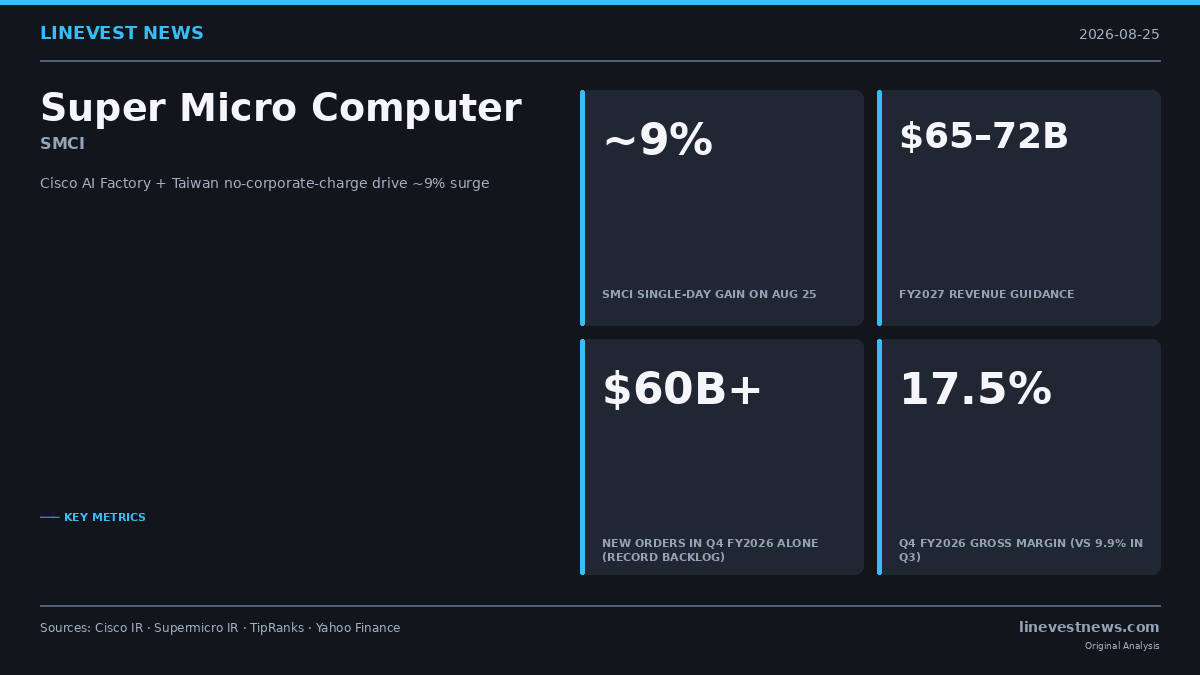
- SMCI rose approximately 9% on August 25 (news reports ranged 8–9.4% intraday); CSCO gained ~1%, NVDA ~2%.
- Q4 FY2026 gross margin rebounded to 17.5% (from 9.9% in Q3), and the company guided FY2027 revenue of $65–$72B on $60B+ in Q4 new orders.
Part A: Two Catalysts, One Day
The Cisco Deal: Entering the Rack-Scale Era
On August 25, 2026, Cisco Systems announced it would add Supermicro's liquid- and air-cooled server systems to its Secure AI Factory with NVIDIA portfolio — an end-to-end infrastructure stack that now spans networking, compute, and cooling in a single validated reference architecture. The expanded offering becomes available to customers in October 2026, targeting trillion-parameter AI training and high-throughput inference workloads.
The technical centerpiece is support for NVIDIA's latest GPU platforms: the Vera Rubin NVL72, a 72-GPU rack-scale system built for frontier model training, and the HGX Rubin NVL8, an eight-GPU board designed for dense inference deployments. Cisco becomes the first NVIDIA Cloud Partner (NCP)–compliant provider to deliver a reference architecture using its own Silicon One switches (front-end connectivity) alongside NVIDIA Spectrum-X Ethernet switches (back-end GPU fabric), unified under the Cisco Nexus switching architecture.
The partnership targets three customer segments: enterprise data centers, neocloud providers (AI-native cloud operators), and sovereign cloud deployments. For Supermicro, which has historically sold predominantly through direct relationships with hyperscalers and neoclouds, Cisco's established enterprise salesforce represents a meaningful new distribution vector reaching Fortune 500 accounts not accustomed to direct procurement from AI server builders like Supermicro.
Cisco and NVIDIA each rose roughly 1–2% on the announcement, but the market's biggest reaction was reserved for Supermicro, which has been working to rebuild investor confidence after a turbulent 18 months.
Taiwan Update: Nine Individuals Charged, Company Not Implicated
The second catalyst arrived from Taipei. Taiwanese prosecutors charged nine individuals — two Supermicro employees, one NVIDIA employee, and six others — with breach of trust and document forgery for allegedly diverting high-end AI servers to restricted regions without authorization. Critically, the indictment targeted individuals, not Supermicro as a corporate entity. The company faces no corporate charges, no business penalties, and no enforcement action.
The outcome is consistent with findings from Supermicro's special-committee independent investigation: no evidence that current senior management was aware of any diversion scheme; no evidence that Supermicro directly sold export-controlled products to known restricted parties; and — perhaps most important to institutional investors — no evidence that the company's previously issued financial statements are unreliable.
Part B: What It Means for Investors
Financial Backdrop: Margins Normalized, Order Volume Historic
The dual catalysts landed against a backdrop of sharply improving fundamentals. Supermicro's Q4 FY2026 results (fiscal year ending June 30, 2026) showed the company returning to normalized profitability:
| Metric | Q4 FY2025 | Q3 FY2026 | Q4 FY2026 | YoY Change |
|---|---|---|---|---|
| Revenue | $5.8B | $10.2B | $11.1B | +91% |
| Gross Margin | 9.5% | 9.9% | 17.5% | +800bp |
| Diluted EPS | — | $0.72 | $1.62 | — |
Full-year FY2026 revenue reached $39.1 billion (up from $22.0B in FY2025, +78% YoY), with net income of $2.2 billion ($3.26 diluted EPS; $3.63 adjusted diluted EPS). The gross margin inflection in Q4 — from approximately 10% to 17.5% — suggests pricing pressure from commodity AI server competition may be easing as Supermicro moves toward higher-value liquid-cooled rack-scale configurations: exactly the product category now entering the Cisco channel.
The demand signal is unambiguous: Supermicro received more than $60 billion in new orders during Q4 FY2026 alone — roughly 1.5 times the company's entire FY2026 annual revenue of $39.1B — pushing backlog to record levels at fiscal year-end.
FY2027 Guidance: $65B–$72B
Management guided FY2027 revenue of $65–$72 billion, implying 66–84% growth over FY2026's $39.1B. For Q1 FY2027 (July–September 2026), guidance is $14.5–15.5B in net sales with non-GAAP EPS of $1.01–$1.10. Gross margin guidance for Q1 FY2027 is 10.4–10.8% — well below Q4's 17.5% — indicating the Q4 rebound included favorable mix effects, and that FY2027 average margins will likely settle between these two data points.
Strategic Value of the Cisco Channel
Cisco's enterprise salesforce is one of the broadest in the technology industry, with deep incumbent relationships across accounts that Supermicro's direct-sales model has historically underserved. Three strategic angles stand out:
- Validated architecture trust: Enterprise IT buyers require third-party validation for critical infrastructure purchases. A Cisco-certified, NVIDIA Cloud Partner–compliant solution materially lowers adoption friction.
- Sovereign cloud access: Government-directed AI compute programs — from Europe's sovereign cloud mandates to Middle East national AI strategies — typically route through incumbent networking vendors as system integrators. Cisco is often the networking layer of choice in these environments.
- Rubin cycle timing: NVIDIA's Rubin GPU generation is beginning commercial ramp now. Supermicro's placement in the Cisco channel at launch gives it enterprise exposure to Rubin adoption from day one.
Risks That Remain
Three risk categories persist even after Tuesday's positive news flow:
- DOJ investigation: The U.S. Department of Justice inquiry into Supermicro's export-control compliance is entirely separate from the Taiwan prosecutor action. The Taiwan case resolved at the individual-conduct level; DOJ scope and timeline remain undisclosed.
- Gross margin sustainability: Q4's 17.5% rebound contrasts sharply with Q1 FY2027 guidance of 10.4–10.8%. Whether FY2027 can average above ~14% — or whether Q4 was an anomaly — is unresolved.
- Customer concentration: Supermicro's revenue base depends heavily on a small number of hyperscaler and neocloud customers. Any sustained slowdown in AI infrastructure CapEx could have outsized impact.
Analyst Landscape
Following Q4 FY2026 earnings, analyst consensus shifted modestly positive, settling at a Hold rating from approximately 19 analysts, with an average price target of approximately $42.38 per S&P Global data (this average reflects a broader pool of analysts, including those with targets above the examples below). Multiple analysts raised their targets after the Q4 earnings print: BofA to $33, Goldman Sachs to $34, Wedbush to $40, and Barclays to $45 (from $29). Following the Cisco partnership news, Loop Capital raised its target to $70 (from $50), implying approximately 82% upside relative to the August 25 post-deal closing price.
The Investor Calculus
August 25's approximately 9% move reflects the convergence of two signals institutional investors had been waiting on: (1) Cisco enterprise channel entry at the start of NVIDIA's Rubin GPU ramp, and (2) confirmation from Taiwan's indictment that SMCI's export-control exposure is an individual-conduct issue rather than a corporate-level systemic failure. Together, the day's developments ease two distinct investor concerns — the corporate criminal-liability overhang and the enterprise distribution gap — while leaving the DOJ inquiry and gross-margin sustainability as open questions.
For investors, the key inflection point will be Q1 FY2027 earnings (expected October–November 2026): will the record order backlog (fueled by $60B+ in Q4 new orders) translate into sustained revenue execution, and will the Cisco channel contribute meaningful enterprise bookings in its first quarter of availability?
This article is for informational purposes only and does not constitute investment advice. All figures are sourced from company press releases, SEC filings, and publicly reported analyst estimates. Investors should conduct their own due diligence.
Sources - Cisco IR — Cisco Expands Secure AI Factory with NVIDIA for the Rack-Scale Era (Aug 25, 2026) - Supermicro IR — Q4 & Full Year FY2026 Financial Results - Supermicro IR — Q4 FY2026 Preliminary Business Update - TipRanks — SMCI Jumps 9% as Cisco AI Deal and Taiwan Clearance Lift Overhang - Benzinga — Cisco Expands Rack-Scale AI Computing With Nvidia, Supermicro - SiliconAngle — Cisco expands rack-scale secure AI factory for neocloud and sovereign clouds - Yahoo Finance — Super Micro Surges 8% as Taiwan Indicts Employees but Not the Company - 247 Wall St — Super Micro Q4 2026: Margins Doubled, Guidance Hits $72 Billion