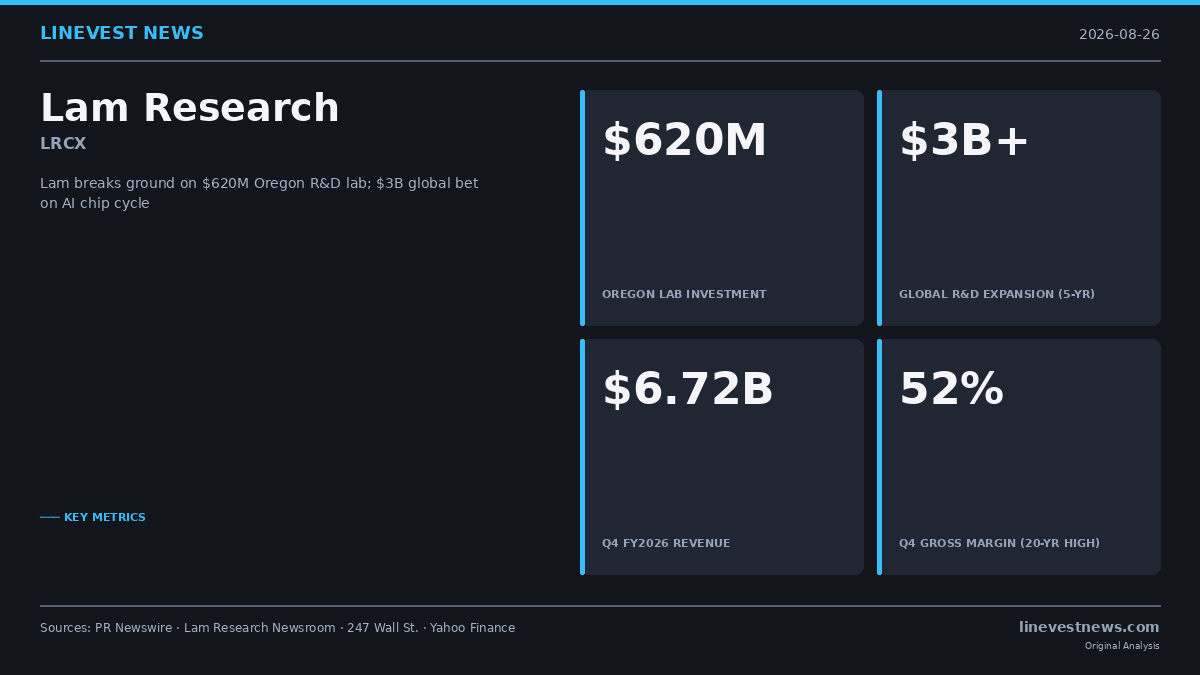
TL;DR - Lam Research broke ground on August 26 on a 120,000-sq-ft R&D lab in Tualatin, Oregon — the anchor of a $1.5 billion, 15-year commitment to the state and part of a $3 billion+ global R&D network expansion over five years - The investment comes weeks after Lam reported record Q4 FY2026 revenue of $6.72 billion (+30% YoY) and a 52% gross margin, its highest in two decades, with Q1 FY2027 guidance of $8.10 billion implying ~20% sequential acceleration - Management raised its 2026 wafer fabrication equipment (WFE) market outlook to approximately $140 billion, the broadest addressable pool in semiconductor equipment history - LRCX shares traded near $314 on August 21, roughly 27% below their June 30 all-time high of $433.33, while fundamentals logged multi-decade records — a divergence that merits attention from investors weighing semiconductor equipment cycle risk against structural AI demand
Part A: The Groundbreaking
A $620 Million Anchor in Oregon's Silicon Forest
On August 26, 2026, Lam Research officially broke ground on a new, 120,000-square-foot research and development laboratory at its existing Tualatin, Oregon campus — part of the cluster of semiconductor companies that have long called the Willamette Valley the "Silicon Forest."
The new building, expected to be completed by 2028, will expand Lam's cleanroom lab space at the Tualatin R&D center by more than 50%, enabling what the company describes as "expanded experimentation and accelerated solution development" for AI-era chip manufacturing processes.
The facility is the centerpiece of a broader $1.5 billion, 15-year commitment Lam has made to invest in Washington County laboratories. That regional commitment sits within an even larger strategic bet: a $3 billion+ global R&D lab network expansion planned over the next five years, expected to increase Lam's overall R&D capacity by more than 50% across multiple sites worldwide.
Jobs and Economic Footprint
The new Oregon lab is projected to add approximately 400 permanent R&D positions to Lam's Tualatin workforce, which already numbers around 3,000 people at the campus. Construction is expected to generate roughly 900 temporary jobs and $500 million in economic output during the build phase. Lam estimates it currently supports more than 11,000 jobs statewide and contributes more than $1.8 billion annually to Oregon's economy.
Washington County and the City of Tualatin formally approved an incentive agreement with Lam in early August 2026 that could unlock up to $1.7 billion in combined investment, a signal of how aggressively local governments are competing to anchor semiconductor supply chain infrastructure.
Government and Academic Partnerships
The groundbreaking drew Oregon Governor Tina Kotek and U.S. Senator Jeff Merkley, reflecting the political weight now attached to domestic semiconductor investment. Lam has deepened ties to Oregon's academic institutions: it funds Oregon State University semiconductor materials research at more than $500,000 per year under a five-year partnership, supports a Microscopy Technician Training Program at Portland Community College, and partners with Clackamas Community College on advanced manufacturing training.
Key customer relationships at the Oregon facility include Intel and Micron Technology, both of which operate major semiconductor manufacturing and R&D sites within the region — Intel's large-scale fabrication complex in Hillsboro is effectively a neighbor of the Tualatin campus.
Part B: What This Means for Investors
Record Fundamentals, Lower Stock
Lam's financial results for fiscal Q4 2026 (the quarter ending June 2026) were exceptional by almost any measure:
| Metric | Q4 FY2026 | Context |
|---|---|---|
| Revenue | $6.72 billion | +30% year-over-year |
| Gross Margin | 52% | Highest in 20 years |
| Non-GAAP EPS | $1.82 | Beat $1.68 consensus by $0.14 |
| Q1 FY2027 Revenue Guidance | $8.10 billion ± $400M | ~20% sequential growth |
| Full FY2026 Revenue | $23.2 billion | Company record |
| Full FY2026 Non-GAAP EPS | $5.82 | vs. $4.13 in FY2025 |
The Q4 52% gross margin was the highest in two decades. The Q1 FY2027 guidance of $8.10 billion, if achieved, would represent another significant step-up and imply a roughly $32 billion annualized revenue run rate.
Yet LRCX shares closed near $314 on August 21, 2026 — roughly 27% below their June 30 all-time high of $433.33. The divergence between record results and a meaningfully lower share price is the defining investor question heading into Lam's fiscal first quarter.
Why the Stock Fell: Export Controls and China Exposure
The market's primary concern centers on export control risk. Lam, like the other U.S. semiconductor equipment leaders — Applied Materials (AMAT) and KLA Corporation (KLAC) — derives meaningful revenue from Chinese customers investing in domestic chip capacity. Tightening U.S. export restrictions on advanced semiconductor manufacturing equipment have periodically constrained this revenue stream, and the policy environment in 2026 remains unsettled.
Analysts tracking the WFE market estimate China has represented 30–40% of global equipment spend during the recent expansion cycle. Any material shift in that share — whether from U.S. export license restrictions or China redirecting purchases toward domestic tool suppliers — would affect Lam's near-term revenue trajectory.
The Q1 FY2027 guidance of $8.10 billion, while substantially above Q4's $6.72 billion, may have landed below some sell-side models that anticipated an even steeper ramp given the pace of AI infrastructure capital deployment globally.
The $140 Billion WFE Market: Lam's Strategic Position
Lam management's decision to raise its 2026 WFE market outlook to approximately $140 billion signals conviction about the durability of the semiconductor equipment cycle beyond near-term export control volatility. To provide context: the WFE market was approximately $92 billion in 2024. A $140 billion market in 2026 would represent one of the most rapid expansions in the semiconductor equipment industry's history.
Lam occupies the number one market share position in etch — the largest single segment within WFE — and holds a clear number two share in deposition. These are among the most technically demanding process steps in chip manufacturing, and they become increasingly critical as advanced logic and memory nodes shrink.
The AI semiconductor investment thesis runs directly through memory. High-bandwidth memory (HBM), NAND flash storage for AI inference infrastructure, and DRAM for GPU-memory interfaces are all segments that require the etch and deposition processes where Lam holds dominant positions. HBM — the stacked memory architecture that enables the memory bandwidth required by leading AI accelerators — involves dozens of precise etch and deposition cycles per stack layer.
What a $620M Lab Signals About Cycle Duration
Companies do not invest $620 million in R&D infrastructure for demand they believe is temporary. Construction timelines for semiconductor labs typically span two to three years; the return horizon on such investments extends a decade or more. The fact that Lam is formally breaking ground in August 2026 — with the facility targeted for completion in 2028 — indicates management's internal assessment of AI-driven semiconductor equipment demand extends well into the next equipment cycle.
The $3 billion global R&D expansion amplifies that signal. Multi-site, multi-year network expansion implies a coordinated long-term view that AI-era chip complexity — driven by 3D NAND stacking, advanced DRAM architectures, and increasingly intricate etch requirements for leading-edge logic — will sustain above-trend equipment intensity for at least five years.
The counterargument, which the stock's 27% decline partially prices in, is that semiconductor equipment cycles have historically been boom-bust: periods of intense capital deployment followed by sharp inventory corrections as fab customers work through overbuilding. The question investors face is whether AI represents a structurally new demand driver that moderates those cycles or merely extends the current upswing before a similar correction arrives.
Key Risks for LRCX Investors
Export controls: U.S. restrictions on advanced semiconductor manufacturing equipment destined for China remain the primary near-term swing variable for Lam's revenue trajectory.
Customer concentration: Intel and Micron are both major customers and Oregon lab partners. Intel's ongoing financial restructuring and capex discipline remain a potential headwind for equipment orders.
WFE cycle timing: Even if the long-term AI thesis holds, quarterly WFE demand is lumpy and customer-capex-driven. The stock's decline from $433 to $314 partly reflects concern that the most aggressive phase of the current order cycle may be near or past its peak rate of change.
$3B buildout execution: Simultaneously expanding multiple global R&D sites carries integration and cost overrun risk that could compress margins from their current record 52% level.
Sources
- Lam Research Oregon Lab Groundbreaking — PR Newswire (Aug 26, 2026)
- Lam Research Expands in Oregon's Silicon Forest to Power the AI Era — Lam Newsroom
- Washington County Proposed $1.7B Agreement with Lam Research
- Lam Research Q4 FY2026 Earnings — 247 Wall St.
- Lam Research LRCX Leads Etch Market as AI-Driven Memory Supercycle Fuels WFE Outlook — Yahoo Finance
This article is for informational purposes only and does not constitute investment advice. LineVest News is an independent publication.