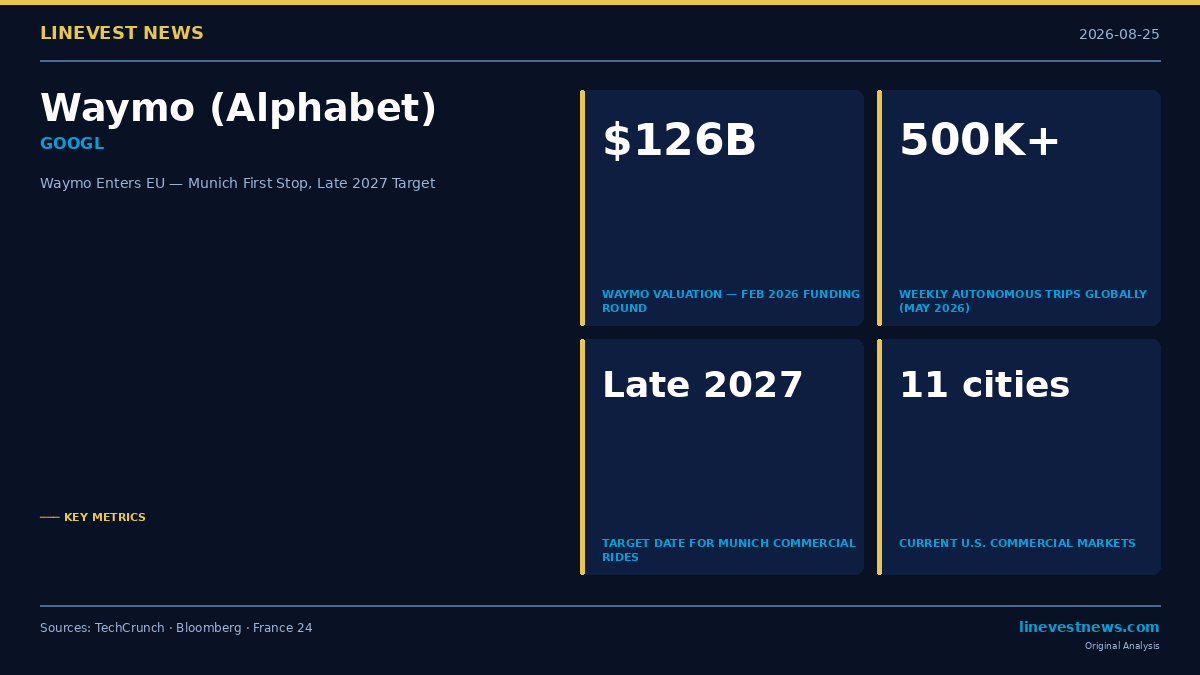
Waymo, the autonomous vehicle unit of Alphabet Inc. (NASDAQ: GOOGL), confirmed on Tuesday it will begin mapping Munich roads in the coming weeks and is targeting fully autonomous commercial rides in Germany by the end of 2027. Munich becomes Waymo's first city in the European Union and its third international market after London and Tokyo.
TL;DR - Waymo picks Munich, Germany as its first EU robotaxi city (commercial launch: late 2027) - Preparatory road mapping begins in the coming weeks using a Jaguar I-PACE validation fleet; no fares until regulatory approval - Waymo Germany GmbH incorporated at Google's Munich campus, registration approved June 2026 - Waymo valued at USD 126 billion after a USD 16 billion February 2026 funding round - Parent GOOGL trades at approximately USD 349, market cap approximately USD 4.21 trillion, +10.4% YTD
Part A — The Announcement
Waymo said its preparation in Munich will follow the same phased playbook used in its 11 U.S. markets: street mapping, autonomous testing with trained validation drivers, limited service rollout, and finally commercial availability to the public.
The first vehicles on Munich roads will be all-electric Jaguar I-PACE SUVs, a platform Waymo has operated at scale across its U.S. fleet. No specific fleet size was disclosed. The company established Waymo Germany GmbH in May 2026, with its corporate registration formally approved on June 15, using Google's Munich office as its registered address.
Waymo has also registered legal entities in France, Spain, the Netherlands, and Switzerland, pointing to a broader European expansion strategy beyond the German entry point.
Regulatory Gate
Germany enacted an Autonomous Driving Act in 2021 that permits Level 4 vehicles — those capable of driving autonomously in defined areas, with a remote technical supervisor required — on public roads. That framework positions Germany as one of the few markets globally where Waymo's driverless technology is legally permissible without a special experimental exemption.
Waymo must still seek permits from the Federal Motor Transport Authority (Kraftfahrt-Bundesamt, or KBA), Bavarian state authorities, and Munich city officials before any commercial operation. The company holds no German testing permits as of this announcement. The regulatory process is the primary variable in the 2027 timeline.
| Milestone | Status | Target |
|---|---|---|
| Waymo Germany GmbH incorporation | Complete (Jun 2026) | — |
| Road mapping phase | Starting "in coming weeks" | 2026 |
| Validation driver testing | Follows mapping | 2026–2027 |
| Regulatory permits (KBA + Bavaria + Munich) | Not yet applied | 2026–2027 |
| Commercial fully autonomous rides | — | Late 2027 |
Waymo spokesperson Chris Pappas said Munich was chosen in part because it is "one of the world's leading mobility hubs with its own distinct transport network" — positioning the robotaxi service as complementary to, rather than competitive with, Munich's existing transit infrastructure.
Part B — What This Means for Investors
Scale Entering the EU
Waymo is among the world's largest autonomous ride-hailing operators. Its current U.S. footprint spans 3,500-plus vehicles across 11 cities. Weekly paid trip volume reached 500,000 globally in May 2026, up from 250,000 in April 2025 — a doubling in roughly 13 months. Management has said publicly it is targeting more than one million weekly rides by the end of 2026. International testing operations are active in London and Tokyo, with commercial services not yet launched in either city.
| Metric | Value | Period |
|---|---|---|
| U.S. fleet size | 3,500+ vehicles | 2026 |
| Weekly paid autonomous trips (global) | 500,000+ | May 2026 |
| Active commercial markets | 11 U.S. cities | 2026 |
| International testing markets | London, Tokyo | 2026 |
| Valuation (last funding round) | USD 126 billion | Feb 2026 |
The USD 16 billion round that closed in February 2026 was the largest single capital raise in autonomous vehicle history. External investors now hold a meaningful minority stake alongside Alphabet's controlling interest, creating independent pressure toward commercialization and, eventually, a public listing.
The Alphabet Calculus
Waymo is a majority-owned subsidiary of Alphabet and does not file separate public financials. Waymo's carrying value is not separately disclosed in Alphabet's filings, but its USD 126 billion external valuation would represent roughly 3% of Alphabet's approximately USD 4.21 trillion market capitalization.
For Alphabet shareholders, the Munich move is not a direct near-term earnings catalyst. No fare revenue will flow from Germany before permits are issued, and even after a 2027 launch, European operations will be small relative to Waymo's U.S. base. The signal value is different: it shows that the USD 16 billion raised in February is being deployed on schedule, and that management is executing on the "international" pillar of its growth plan.
Alphabet's Class A shares (GOOGL) closed Tuesday at approximately USD 348.83, giving the company a market capitalization of about USD 4.21 trillion. The stock has gained roughly 10.4% year-to-date.
Competitive Map in Germany
Waymo will not be alone in Munich. Uber Technologies (NYSE: UBER) announced a strategic alliance with Israeli AI developer Autobrains to run a localized robotaxi pilot inside Munich. Baidu (NASDAQ: BIDU) and Momenta — a Chinese autonomous driving technology company — are also testing autonomous vehicles in Germany.
The competitive dynamic differs from the U.S., where Waymo has a multi-year lead on safety miles, regulatory relationships, and commercial scale. In Germany, every participant — including Waymo — is starting near the same point: no commercial permits, no fare revenue, and roughly the same regulatory gate to clear.
In London, where Waymo is targeting commercial operations in 2026, the competitive picture already includes Wayve (backed by SoftBank, with an Uber distribution deal), Baidu, Lyft, and Freenow. Munich appears to be a somewhat less crowded first-mover window, though the Uber/Autobrains partnership changes that calculus if the pilot expands.
What Would Alter the Timeline
The 2027 commercial launch depends entirely on KBA and state regulatory approval. German vehicle safety authorities, while operating under a permissive legal framework, have no track record of approving a fully driverless commercial service at scale.
A second variable is the vehicle platform. Waymo has signaled it will eventually transition from the Jaguar I-PACE to a next-generation vehicle developed with a new manufacturing partner. If that transition is underway while Munich permits are being sought, the platform question could introduce additional regulatory complexity.
A third variable is political. Germany's federal government has generally supported autonomous vehicles as part of its automotive competitiveness agenda, but Munich city politics — particularly around shared road space and taxi industry lobbying — could affect the pace of local approvals.
The Number That Anchors Everything
USD 126 billion. That is Waymo's valuation as of February 2026, set by investors who paid USD 16 billion for a minority stake in a company with no public revenue disclosure. The Munich announcement does not change that number today. What it does is give investors a clearer picture of how management intends to justify it: a global network, not a U.S.-only service.
If Waymo scales from 11 U.S. markets to 11 U.S. markets plus London plus Munich — and eventually Paris, Amsterdam, and Madrid, given the entity registrations already filed — the addressable market calculation shifts materially. The question is whether the regulatory, competitive, and operational timelines in each new city allow that calculation to close before the next capital raise is needed.
Sources: TechCrunch · ZAG Daily · France 24 · Yahoo Finance · Bloomberg · Quartz
Disclaimer: LineVest is an independent financial news publication and is not a registered investment adviser. This article is journalism, not investment advice, and makes no recommendation to buy or sell any security. All figures are sourced from the publications named above and were accurate as reported on August 25, 2026.